Rindis.com

All my hobbies, all the time
  • Home
  • My Blog
  • Games
  • History

Categories

  • Books (503)
  • Comics (10)
  • Gaming (917)
    • Boardgaming (673)
      • ASL (154)
      • CC:Ancients (83)
      • F&E (78)
        • BvR – The Wind (26)
        • Four Vassal War (9)
        • Konya wa Hurricane (17)
        • Second Wind (5)
      • SFB (78)
    • Computer games (162)
      • MMO (77)
    • Design and Effect (6)
    • RPGs (66)
      • D&D (25)
        • O2 Blade of Vengeance (3)
      • GURPS (32)
  • History (10)
  • Life (82)
    • Conventions (9)
  • News (29)
  • Technology (6)
  • Video (49)
    • Anime (47)
  • Writing (1)

Patreon

Support Rindis.com on Patreon!
Become a patron at Patreon!

Other blogs:

RSS Inside GMT

  • Foxes and Lions (Part 3): Military Matters, Captains, and Condottieri June 12, 2026

RSS Playing at the World

  • Playing at the World 2E V2 Arrives May 5, 2025

RSS Dyson’s Dodecahedron

  • Barrow of the Great Mothers June 16, 2026

RSS Quest for Fun!

  • The Expense Post May 24, 2026

RSS Bruce Heard and New Stories

  • Pain, Exhaustion, and Morale in D&D BECMI June 7, 2026

RSS Chicago Wargamer

  • The 2 Half-Squads - Episode 310: Cruising Through Crucible of Steel January 27, 2023

RSS CRRPG Addict

  • Yendorian Tales: Here There Be Dragons June 15, 2026
SF&F blogs:

RSS Fantasy Cafe

  • The Leaning Pile of Books May 24, 2026

RSS Lynn’s Book Blog

  • Booking Ahead/Weekly Wrap Up June 14, 2026
ASL blogs:

RSS Sitrep

  • Cardinal ASL Sins March 18, 2026

RSS Hong Kong Wargamer

  • FT114 Yellow Extract After Action Report (AAR) Advanced Squad Leader scenario April 16, 2025

RSS Hex and Violence

  • This still exists? March 25, 2025

RSS Grumble Jones

  • YouTube AAR for Critical Hit's Gettysburg Turning Point 1863 - ID4 At Will Fire June 16, 2026

RSS Desperation Morale

  • How to Learn ASL March 16, 2025

RSS Banzai!!

  • October North Texas Gameday October 21, 2019

RSS A Room Without a LOS

  • [Crossing the Moro CG] T=0902 -- Rough start July 18, 2015
GURPS blogs:

RSS Dungeon Fantastic

  • Rules & Rulings from Session 224 June 16, 2026

RSS Gaming Ballistic

  • B-Scale: Damage That Scales from Tardigrades to Kaiju June 5, 2026

RSS Ravens N’ Pennies

RSS Let’s GURPS

  • Review: GURPS Realm Management March 29, 2021

RSS No School Grognard

  • It came from the GURPS forums: Low-Tech armor and fire damage January 29, 2018

RSS The Collaborative Gamer

  • Thoughts on a Town Adventures System January 18, 2022

RSS Don’t Forget Your Boots

  • GURPS Supers Newport Academy #6: “Old Friends, New Again” June 7, 2026

RSS Orbs and Balrogs

  • Bretwalda - Daggers of Oxenaforda pt.4 - Fallen King May 27, 2017

The Age of Religious Wars

by Rindis on October 24, 2013 at 8:37 pm
Posted In: Books, History

Part of the Norton History of Modern Europe series, this is a good introductory history of a fairly turbulent period written in 1970. I’ll note that the series was apparently reorganized later, as there is a 1979 version of the book that runs to 1715 instead of 1689.

The book starts with the end of international conflict, and runs through the internal crises that beset most of Europe in the later sixteenth century. In so doing, it lays some groundwork that would have helped me with parts of Braudel’s Mediterranean in the Age of Philip II. It spends a fair amount of time showing the evolution of political structure, with the rise of absolutism in France, the failure of absolutism in Spain, the rise of constitutional government in England, to the dissolution of central power in much of Central Europe and Russia.

Despite the title, there’s not a lot of warfare here. Everything from the Hugenots to the Glorious Revolution is discussed, and gives a fairly solid understanding of why things happened for such a small volume. There is a good chapter on the limitations of pre-modern production, and how it limited the economy, and the end of the book gives a whirlwind tour of the trends in art and evolution of the sciences.

In all, if this is a period where you don’t have a lot of background knowledge (and it was never a popular period in my classes), this is an excellent and clear place to start.

└ Tags: books, history, review
 Comment 

Empires of the Sea

by Rindis on October 5, 2013 at 1:15 pm
Posted In: Books

Roger Crowley tackles the sixteenth-century clash between East and West in the Mediterranean as a grand epic story in this book. Over fifty years of history is his canvas for a tale of peoples and cultures, which he does a wonderful job with. From start to finish, it is history, and a tale to be told, and Crowley tells it very well.

He starts with the siege of Rhodes (1521), as a prelude to the action in the rest of the book, as several key players later on were there. The centerpiece of the book is the siege of Malta (1565), which gets far more attention than any other subject in the book. Of course, it is the most dramatic, and lasted several months. The end of the book details the Battle of Lepanto (1571). In between, he covers the important personalities, raids, and politics.

The only way I can’t recommend this book is if you are already well familiar with the 16th century, and even then it can still be a fun read. Otherwise, I recommend this book as an excellently written overview of warfare  in the Mediterranean. My only real concern is that it is less sympathetic to the Turks than the West, though that is also part of the nature of the tale. Personally, I am now eager to pick up Crowley’s 1453, and City of Fortune.

└ Tags: books, history, review
 Comment 

The Mediterranean World in the Age of Philip II (part two)

by Rindis on August 22, 2013 at 10:41 pm
Posted In: Books

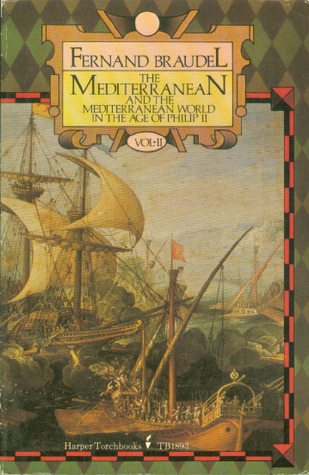
Braudel’s massive scholarly treatment of the Mediterranean from 1550 to 1600 is in three parts split between two volumes. However, even with part two being split between volumes, there is a change in direction at the volume break.

Part two deals with long term trends, and stuck to fairly abstruse subjects such as the economy in volume one. The first chapter in volume two is ‘Empires’. This is an examination of the two poles of the Mediterranean: Spain and the Ottomans. From there he looks at society, civilization and warfare before moving on to a more regular history of the period in part three. Being of the annales school of history, he is almost apologetic for including it, but argues that it has its place too.

In many ways, the centerpiece of part 3 is the battle of Lepanto. While the description of the battle itself only takes a couple of pages, an entire chapter is devoted to event around the battle. History has often recorded the battle as a great spectacle—which lead nowhere. Braudel argues that while it did not lead to further successes, it did bring the erosion of the Christian world to a halt, and break a defeatist sentiment that had taken root.

Like the first half, it is a truly massive undertaking, and well deserving of its status of one of the landmarks of 20th century historiography. It is by far the more readable and interesting half for the non-academic historian, but at the same time revealed less of the sixteenth century from its archives.

└ Tags: books, history, review
1 Comment

The Mediterranean World in the Age of Philip II (part one)

by Rindis on July 15, 2013 at 10:35 pm
Posted In: Books, History

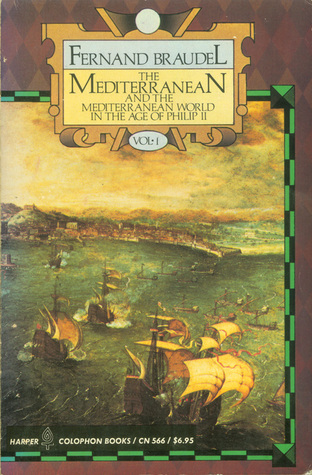
Quite some time ago, there was a photo on BGG of a bookshelf with the poster’s references for a game on the Battle of Lepanto (I have no idea how the game is coming along), and Braudel’s two volume work on the period was on it. A little while later, I spotted them in my local used book store, and I picked them up.

They’re an interesting set. Really, the book is a series of two to four page essays. These are grouped into larger subjects (subchapters), and those into chapters, and those into three parts split across two volumes. It is big, weighty, history and it is not something to read to get interested in the subject, it is for when you already are interested, and want as much information as you can get on the Mediterranean (and surrounds) in the period 1550-1600. It will certainly stay on my shelf as reference.

Braudel organized his material to proceed from the things that change the least, to the things that change the most. So the first part deals with the geography of the Mediterranean and the surrounding lands. Ironically, the ‘large picture’ of geology is where our understanding has changed the most, and the early parts are noticeably out of date. Past that, he starts talking of agriculture, and peoples, and movements, and starts the slow process of building up a detailed picture of the world he is writing about.

Part two (which is split between the two volumes) deals with long-term trends, which in the first volume mostly means the economy. From the flow of metals into Europe from the New World, to patterns of trade, there is, again, a lot here. Unfortunately, he does assume you already know about certain things, like bankruptcies of the Spanish crown, so there is not always an explanation when I could use one.

As for the rest, well, I’ll check in again in about six weeks….

└ Tags: books, history, review
1 Comment

The Pacific Ocean

by Rindis on May 26, 2013 at 12:50 pm
Posted In: Books

I picked up The Pacific Ocean a while ago at a library sale. It’s a history of the exploration of the Pacific Ocean written in 1940. It was the first of the “Oceans of the World” series, all written by different authors, and searching around shows that the other ‘forthcoming’ books were indeed released. This one was written by Felix Riesenberg, who, according to Wikipedia, wrote quite a number of books on nautical subjects (including one which served as a standard textbook); he also took part in two failed expeditions to the North Pole via airship, and had a Liberty Ship named after him.

It’s really meant as a young-adult level book, which makes sense given that it was published by a division of the McGraw-Hill company. It’s more in the lines of ‘true sea stories’ dealing with Magellan, Drake, Cook and the like, and not a thorough study of the subject.

Being seventy-three years old, it does come from another time. This is most obvious in the first chapter, which discusses the possible origins of the Pacific, and you are reminded of the fact that Continental Drift theory was known, but not yet accepted. “It is an interesting theory, over which geographers still dispute. Wegener lost his life in Greenland trying to substantiate it, and the observations taken there over a long period of time seem to indicate that Greenland is still moving west, as he predicted it must be.”

An even more telling part, is the second-to-last chapter, which deals with the opening of Japan by Commodore Perry, as this was written in 1940, when tensions were extremely high, but war had not actually started. The chapter is nicely sympathetic to the Japanese point of view, and recognizes past grievances. “The same difficulties that Perry met with in 1853 and 1854 exist today, and anyone who studies his attempts to cultivate the Japanese will find an astonishing Parallel between his negotiations and those that have made relations difficult in recent years between the United States and Japan. The Nipponese mentality and psychology have not changed, and neither have those of the United States.”

In the end, it’s a decent enough book, and might be worth picking up if you happen across it. But it isn’t worth seeking out.

└ Tags: books, history, reading, review
 Comment 
  • Page 90 of 93
  • « First
  • «
  • 88
  • 89
  • 90
  • 91
  • 92
  • »
  • Last »

©2005-2026 Rindis.com | Powered by WordPress with ComicPress | Hosted on Rindis Hobby Den | Subscribe: RSS | Back to Top ↑