Rindis.com

All my hobbies, all the time
  • Home
  • My Blog
  • Games
  • History

Categories

  • Books (503)
  • Comics (10)
  • Gaming (917)
    • Boardgaming (673)
      • ASL (154)
      • CC:Ancients (83)
      • F&E (78)
        • BvR – The Wind (26)
        • Four Vassal War (9)
        • Konya wa Hurricane (17)
        • Second Wind (5)
      • SFB (78)
    • Computer games (162)
      • MMO (77)
    • Design and Effect (6)
    • RPGs (66)
      • D&D (25)
        • O2 Blade of Vengeance (3)
      • GURPS (32)
  • History (10)
  • Life (82)
    • Conventions (9)
  • News (29)
  • Technology (6)
  • Video (49)
    • Anime (47)
  • Writing (1)

Patreon

Support Rindis.com on Patreon!
Become a patron at Patreon!

Other blogs:

RSS Inside GMT

  • Foxes and Lions (Part 3): Military Matters, Captains, and Condottieri June 12, 2026

RSS Playing at the World

  • Playing at the World 2E V2 Arrives May 5, 2025

RSS Dyson’s Dodecahedron

  • Barrow of the Great Mothers June 16, 2026

RSS Quest for Fun!

  • The Expense Post May 24, 2026

RSS Bruce Heard and New Stories

  • Pain, Exhaustion, and Morale in D&D BECMI June 7, 2026

RSS Chicago Wargamer

  • The 2 Half-Squads - Episode 310: Cruising Through Crucible of Steel January 27, 2023

RSS CRRPG Addict

  • Yendorian Tales: Here There Be Dragons June 15, 2026
SF&F blogs:

RSS Fantasy Cafe

  • The Leaning Pile of Books May 24, 2026

RSS Lynn’s Book Blog

  • Booking Ahead/Weekly Wrap Up June 14, 2026
ASL blogs:

RSS Sitrep

  • Cardinal ASL Sins March 18, 2026

RSS Hong Kong Wargamer

  • FT114 Yellow Extract After Action Report (AAR) Advanced Squad Leader scenario April 16, 2025

RSS Hex and Violence

  • This still exists? March 25, 2025

RSS Grumble Jones

  • YouTube AAR for Critical Hit's Gettysburg Turning Point 1863 - ID4 At Will Fire June 16, 2026

RSS Desperation Morale

  • How to Learn ASL March 16, 2025

RSS Banzai!!

  • October North Texas Gameday October 21, 2019

RSS A Room Without a LOS

  • [Crossing the Moro CG] T=0902 -- Rough start July 18, 2015
GURPS blogs:

RSS Dungeon Fantastic

  • Rules & Rulings from Session 224 June 16, 2026

RSS Gaming Ballistic

  • B-Scale: Damage That Scales from Tardigrades to Kaiju June 5, 2026

RSS Ravens N’ Pennies

RSS Let’s GURPS

  • Review: GURPS Realm Management March 29, 2021

RSS No School Grognard

  • It came from the GURPS forums: Low-Tech armor and fire damage January 29, 2018

RSS The Collaborative Gamer

  • Thoughts on a Town Adventures System January 18, 2022

RSS Don’t Forget Your Boots

  • GURPS Supers Newport Academy #6: “Old Friends, New Again” June 7, 2026

RSS Orbs and Balrogs

  • Bretwalda - Daggers of Oxenaforda pt.4 - Fallen King May 27, 2017

From Raiders to Kings

by Rindis on June 29, 2014 at 10:50 pm
Posted In: Books

Lars Brownworth’s first book catapulted to success on the back of a related podcast, and he used the same formula this time. The Norman Centuries has been another good history podcast from him (though very slow, fourteen episodes in four years, and a note saying the next episode is under production is still the most recent note a year later), and his latest book is more directly tied to it than the first time. With Byzantium he covered (in passing) most the entire history in the book, and picked the highlights for the podcast; with the Normans, it feels more like like each chapter is one of the podcast episodes.

The Normans only held sway in Europe for a couple of centuries, and Brownworth’s writing is stronger for having a more limited subject than the thousand-year life of the Eastern Roman Empire to talk about. As always, he does a great job with bringing history to life, and is at his best describing larger-than-life characters. The Normans provide plenty of larger-than-life people to write about.

My biggest complaint is that the book skips around more than I’d like in time. It starts with Normandy and the conquest of England, before stepping back to the early Norman conquests in southern Italy. The book then goes on to a brief history of the founding of the Crusader state of Antioch, and then spends the bulk of its time talking about the Kingdom of Sicily. The other complaint is that it’s all about the big-name leaders, and nothing outside of that. But, as a light popular history, that is what the book is about, and as I already said Brownworth handles them very well, and very enjoyably.

└ Tags: books, history, review
 Comment 

After Tamerlane

by Rindis on June 21, 2014 at 9:53 am
Posted In: Books

John Darwin’s After Tamerlane is a look at empire making from 1400 to pretty much the current day. His beginning idea is that the Timurid state represents the last time that the age-old pattern of a vast Eurasian empire based out of the Iranian plateau played out, and he then goes on to examine the patterns of force that happened in place of this usual pattern of empire.

He effectively splits the Eurasian land-mass into four parts: Europe, Middle East, India, China, and examines what was going on in each of these places as the centuries roll on. As he stays pretty much in a chronological frame work, this makes the book handy just as a cross-reference to which periods are contemporaneous. However, those four general regions don’t quite add up to all of Eurasia, and he actually says surprisingly little about the region of Iran/Persia (and precious little about southeast Asia and inland central Asia, but that is less surprising).

Any book covering from 1400 on is pretty much going to be about the rise of European states to dominant roles in the world, but the emphasis here is on re-balancing the traditional triumphalist narratives that see this as an inevitable result of superior European culture. He very carefully points out just how constrained early European ventures were, and how limited the actual effects of most colonial ventures were. I think he is a little too strident on this at times, pointing out just how limited the initial Portuguese trade around Africa to India was, without really acknowledging that no one else was really able to skip an entire large zone of trade to get at the next one beyond it.

If there is a major failing to the book, it is that after Darwin successfully shows the non-empire-building motivations of several earlier eras, in the 20th century he tends to assume most empire-building that was going on had more consistent motives and agendas than they did.

In all, this is good big-picture history that tries to remove a lot of Eurocentric bias, and will certainly give the reader plenty to think about.

└ Tags: books, history, review
 Comment 

Medieval Russian Fortresses

by Rindis on June 18, 2014 at 10:48 pm
Posted In: Books

Osprey’s Fortress series is quite interesting, as it tackles all sorts of subjects I had not thought about (nor seen anything else on), as well as more familiar ground. For example, I’m used to seeing quite a bit about western European castles (which probably are siege engineering at its most interesting), and I know how much of that was borrowed from what was in already developed in the Near East, but, there’s almost nothing outside of that.

This volume is a very good, and dense, introduction to the fortifications of the Medieval ‘Rus, and shows off a number of features not seen in the more familiar west. Most fortifications were simply earthen ramparts with wooden walls on top (stone fortifications generally came much later than elsewhwere). The Kievan state built ‘snake ramparts’ that ran for over 500 miles to protect the southern borders. The common forms of all of these and these are explained in some detail, with common features and styles gone into.

In all, the book suffers most from having to be crammed into the standard Osprey page count, but still manages to give a pretty good look at most everything, and as usual, illustrations and photographs go a long way towards making everything clear.

└ Tags: books, fortress, history, Osprey, review
 Comment 

Samurai Armies

by Rindis on June 1, 2014 at 12:00 pm
Posted In: Books

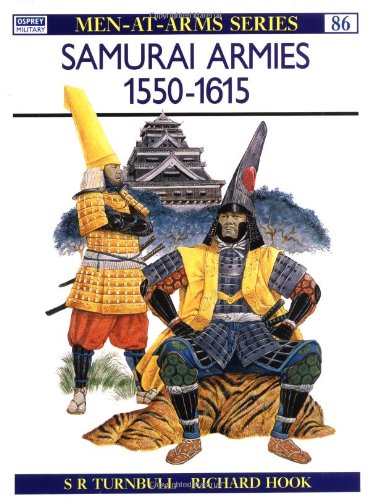
Osprey’s Men-At-Arms book Samurai Armies is a pretty good introduction to the warring states period of Japan. The series is more focused on men and equipment, and that is what you get here, though the three-page summary of the period is not bad.

It is a bit primitive in a couple ways, so it must be remembered that this is a 1979 book. Steven Turnbull turned into a fairly popular author on Japan in the ’80s, and is still writing today, but this was his first book. Also, Osprey was still just moving away from the stiff figure illustrations that had dominated military uniform books in the ’70s and earlier, and while the people in the color plates are shown in a variety of activities, backgrounds that might give more context of the world of these people are almost entirely absent still.

As is often the case with Osprey, the book suffers a bit from being too short; it has a good introduction to the use complicated formations in Japanese warfare, but no practical examples of how it worked out in practice, it gives a whirlwind tour of the evolution of armor styles, but you have to read very carefully to catch everything being said. On the other hand, there’s a nice three-page reproduction of a Japanese print showing how to put on armor, and another page with a print showing various ways of lacing the helmet (the reproduction isn’t so good on this one).

In all, it still stands up as a good beginning book on the subject, which is remarkable given how much more has been written on the subject since.

└ Tags: books, history, MAA, Osprey, review
 Comment 

Song of Wrath

by Rindis on May 25, 2014 at 12:00 pm
Posted In: Books

J. E. Lendon’s history of the Peloponnesian War differs from the usual treatments in two ways: First, instead of tackling the entire 27-year period, he (after pointing out that the “Peloponnesian War” is really four different wars traditionally grouped together) only covers the first ten years, from the outbreak of hostilities to the treaty between Athens and Sparta in 421 BC (he calls this the Ten Years War, whereas others call it the Archidamian War). And second, he challenges the traditional view of what the war was fought over (first put forward by Thucydides) in favor of one based on a study of Ancient Greek culture.

He starts with an overview of honor/glory/worth, or timē, which is how ancient Greeks ranked and competed among themselves, and by extension how the intensely competitive city-states measured themselves against each other. To have timē was to be of importance, to have importance, to have other cities look to you; to be the hegemon. Status for cities was a mix of current strength and past glories, and Sparta stood tall in both in the fifth century BC, allowing it to lead an alliance (to be the hegemon) of many of the Greek states against the Persians.

Athens’ past was not considered nearly so glorious, but in the aftermath of the Persian Wars she became the head (hegemon) of the Delian League; a collection of overseas territories in the Aegean that banded together for protection against Persia. Athens slowly converted this mutual defense league into more of an empire, taking money tribute instead of the loan of naval forces, and establishing a firmer say in the internal affairs of its members. Thucydides (and most everyone follows his lead) claims that the Pelopennesian War started because of Sparta’s fear of Athens’ growing power.

Lendon points out that this was a controversial argument at the time, which is why Thucydides spends so much time elaborating and defending it. He believes that the war actually stemmed from an argument more readily understood by the Ancient Greeks, but more obscure to us. Athens now considered itself to be Sparta’s equal in timē, and wanted Sparta to admit it (without which, convincing anyone else would be difficult).

The bulk of the rest of the book is Lendon playing connect-the-dots with what we know of the events of the Ten Years War, and interpreting them in terms of timē. He constantly refers back to this theme, as if afraid it might go somewhere without him. But since it is, at best, a very nebulous concept, this is essential, though it might have been better handled.

The major weakness of the thesis and book is that since timē is all in the minds of the people involved, it is very hard to prove that it really had the bearing on events he says it does. Even worse is the fact that it is more of a ‘groupthink’; a collection of what the entire Greek world thought of the relative standings of Sparta and Athens. But, towards the end, he finally brings forth his answer to that problem. If Athens (who is the city with something to prove) can get Sparta to act like Athens is proving its point, then the rest of the Greek world will tend to follow the line of the two principles.

Despite the fact that the book is inevitably nebulous in some particulars, it really is a convincing reconstruction of events based on what we know of the culture, and I highly recommend it.

└ Tags: books, history, review
1 Comment
  • Page 88 of 93
  • « First
  • «
  • 86
  • 87
  • 88
  • 89
  • 90
  • »
  • Last »

©2005-2026 Rindis.com | Powered by WordPress with ComicPress | Hosted on Rindis Hobby Den | Subscribe: RSS | Back to Top ↑