Rindis.com

All my hobbies, all the time
  • Home
  • My Blog
  • Games
  • History

Categories

  • Books (503)
  • Comics (10)
  • Gaming (917)
    • Boardgaming (673)
      • ASL (154)
      • CC:Ancients (83)
      • F&E (78)
        • BvR – The Wind (26)
        • Four Vassal War (9)
        • Konya wa Hurricane (17)
        • Second Wind (5)
      • SFB (78)
    • Computer games (162)
      • MMO (77)
    • Design and Effect (6)
    • RPGs (66)
      • D&D (25)
        • O2 Blade of Vengeance (3)
      • GURPS (32)
  • History (10)
  • Life (82)
    • Conventions (9)
  • News (29)
  • Technology (6)
  • Video (49)
    • Anime (47)
  • Writing (1)

Patreon

Support Rindis.com on Patreon!
Become a patron at Patreon!

Other blogs:

RSS Inside GMT

  • Foxes and Lions (Part 3): Military Matters, Captains, and Condottieri June 12, 2026

RSS Playing at the World

  • Playing at the World 2E V2 Arrives May 5, 2025

RSS Dyson’s Dodecahedron

  • Hollowshore Cairn June 17, 2026

RSS Quest for Fun!

  • The Expense Post May 24, 2026

RSS Bruce Heard and New Stories

  • Pain, Exhaustion, and Morale in D&D BECMI June 7, 2026

RSS Chicago Wargamer

  • The 2 Half-Squads - Episode 310: Cruising Through Crucible of Steel January 27, 2023

RSS CRRPG Addict

  • Yendorian Tales: Here There Be Dragons June 15, 2026
SF&F blogs:

RSS Fantasy Cafe

  • The Leaning Pile of Books May 24, 2026

RSS Lynn’s Book Blog

  • Summer of Horror: Can’t Wait Wednesday: Sleepers in the Snow by Joanne Harris June 17, 2026
ASL blogs:

RSS Sitrep

  • Cardinal ASL Sins March 18, 2026

RSS Hong Kong Wargamer

  • FT114 Yellow Extract After Action Report (AAR) Advanced Squad Leader scenario April 16, 2025

RSS Hex and Violence

  • This still exists? March 25, 2025

RSS Grumble Jones

  • YouTube AAR for Critical Hit's Gettysburg Turning Point 1863 - ID4 At Will Fire June 16, 2026

RSS Desperation Morale

  • How to Learn ASL March 16, 2025

RSS Banzai!!

  • October North Texas Gameday October 21, 2019

RSS A Room Without a LOS

  • [Crossing the Moro CG] T=0902 -- Rough start July 18, 2015
GURPS blogs:

RSS Dungeon Fantastic

  • Rules & Rulings from Session 224 June 16, 2026

RSS Gaming Ballistic

  • B-Scale: Damage That Scales from Tardigrades to Kaiju June 5, 2026

RSS Ravens N’ Pennies

RSS Let’s GURPS

  • Review: GURPS Realm Management March 29, 2021

RSS No School Grognard

  • It came from the GURPS forums: Low-Tech armor and fire damage January 29, 2018

RSS The Collaborative Gamer

  • Thoughts on a Town Adventures System January 18, 2022

RSS Don’t Forget Your Boots

  • GURPS Supers Newport Academy #6: “Old Friends, New Again” June 7, 2026

RSS Orbs and Balrogs

  • Bretwalda - Daggers of Oxenaforda pt.4 - Fallen King May 27, 2017

Enchantress From the Stars

by Rindis on June 16, 2017 at 12:00 pm
Posted In: Books

Enchantress From the Stars has a bit of an ambitious high concept, and pulls it off very well. The main ‘problem’ with the book is a galaxy full of inhabited planets where all the naturally-occurring intelligent life is human, or very nearly so; but paying attention to alien biology would be to miss the point of the book (and in 1970, it was still a somewhat acceptable idea).

The book is a clash between three civilizations, with a viewpoint character from each one. The ‘main’ story is given by the most advanced civilization, which has a non-interference policy that makes the Prime Directive look fairly tame. They keep keep themselves hidden from ‘younglings’: civilizations at a less-developed stage than themselves, including several star-faring ones, letting them find their own way, and assert that trying to help only leads to problems and stunted development.

But they do interfere on occasion. Such as here, where a less-developed Empire (I don’t think any other name is given) is colonizing a planet with natives that are still at a medieval level of development. The Service sends a small team to scare the Empire off the planet, and leave both cultures to evolve on their own. There are plenty of problems of course, and it makes a good YA adventure, with a certain amount of philosophy and growing up.

The main part that works is each of the three viewpoint character’s sections are written differently. They’re not announced or otherwise kept rigid enough to ordinarily keep it from being confusing, but the style changes between the three is so marked as to eliminate that problem. The native’s point-of-view is by far the most striking, being written with the feel of a lot of medieval tales, and is very successful. The Empire’s point-of-view conversely is the weakest, being in a conventional third-person, and being the least frequent, and least involved in the actual plot.

It’s a little too obvious with the points that it is making, but the novel does avoid feeling ‘preachy’, by virtue of the main character always being challenged to thing thinks out herself, so the philosophy is always a dialog. So it maintains a good flow and remains a fun read throughout, with the plot and characters always keeping center stage.

└ Tags: books, reading, review, science fiction
 Comment 

White Mare’s Daughter

by Rindis on June 8, 2017 at 12:00 pm
Posted In: Books

White Mare’s Daughter is technically a historical novel, but I find it hard to classify it as such. This takes place way back in prehistory, around 4500 BCE or so, featuring a pair of cultures that it is impossible to know much about. Moreover, Tarr uses a contentious interpretation, and then takes a fair amount of artistic license to build her societies. Moreover, the world is drawn in broad enough strokes that it is hard to get a grasp on, and I never got more than the vaguest notions of the landscape and geography.

So, it took me a while to get into the book. It started slow, and trades between three viewpoint characters, which helped keep the action slow as they all got established. Ironically, Danu was the one who really started to get the book moving for me, and his viewpoint nearly disappears late in the book. Once going, however, it drew me in and kept me going with a very well structured plot.

The central piece of the novel is the Goddess-worshiping culture of the settled cities, with it’s entirely female-dominated society. Much of the book revolves around the culture shock of them meeting the entirely patriarchal steppe nomads, and demonstrating the differences between them (and giving us an anchor into this society). Much of it is fine, and the archaeological record does show that they seemed to have no knowledge of war, it is presented as too much of a utopia to fully hang together. Violence is nearly unknown (though not completely), though there are still some personal conflicts; the presentation would not be off as how a society views itself (…which it effectively is at first).

As appropriate for an early period, there is a lot of spiritualism inherent in the characters, which reminds me strongly of how Mary Renault depicted Theseus’ inner workings in The King Must Die. It’s very well done, and in conjunction with the overriding ‘end of an era’ theme of the book, really lends a mythic feel to what is otherwise a fairly straightforward plot.

This also is a source of my resistance to classifying it just as a historical novel, though I have no real reason not to. I also classify it as a very good one, though again, it does take a while to get started.

└ Tags: books, historical, reading, review
 Comment 

Medieval Siege Weapons: Western Europe

by Rindis on June 4, 2017 at 12:00 pm
Posted In: Books

Osprey’s book on siege weapons does it’s intended job of introducing the subject, but that’s about it. Sam Thompson’s gouache illustrations show a nice variety of specific examples of machines, but the rest of the book tends to be unspecific and feels lost in the weeds.

Now the main culprit for this is just the lack of real evidence. The book spends a lot of time looking at various terms used in manuscripts, and is good for showing region variations, but since most times its just the term with no description, it’s nearly impossible to know how technically precise any of these authors are, and therefore more than the most vague generalities. Since this was a New Vanguard book, I was wanting a fairly detailed physical analysis and description of the parts, but it just doesn’t exist here. The main chapter on throwing machines is nicely divided up into sections on the basic types, and gives some indication of when certain types were known to be in use in various parts of Europe, though a timeline for the major pieces of evidence would have helped there too.

That said,the 585-1385 time period fits with the dates of the first and last solid examples that are given, though there’s nothing else to really give a reason to those 400 years. I think I’d much prefer a book more like the Elite-series one on Roman siege engineering, which went a lot more into how sieges were conducted.

└ Tags: books, history, New Vanguard, Osprey, reading, review
 Comment 

Catherine the Great

by Rindis on May 27, 2017 at 12:00 pm
Posted In: Books

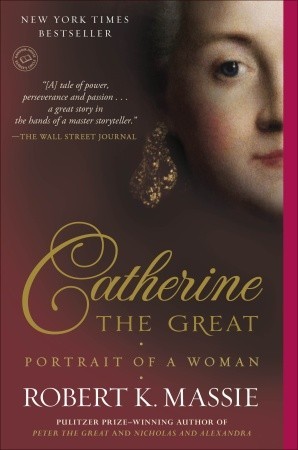
Massie’s book on Catherine the Great is first and foremost a biography, and never loses sight of this fact. As an empress, there is a temptation to equate her with the state, and end up with more of a history of Russia during her reign. I wouldn’t have minded that, but instead the focus is mostly kept on Catherine herself.

However this is one of the best biographies I’ve read (I don’t read a lot of them) for getting a true sense of the person that is the subject of the book. It is a decidedly sympathetic view (aided by the extensive use of her autobiography for the first part of her life), but this helps with gaining a sense of the ideals she aspired to. Further, the focus is not so narrow that Catherine is the only person you get to know in these pages. Naturally, both Peter III and Empress Elizabeth get a lot of time and attention, and while there there are a lot of other people in these pages, they are the only other ones that get a lot of attention.

As ever, Massie is a great writer, and really brings the 18th century to life. Chapters are generally organized around a subject, so while this is generally a chronological telling, there is also a certain amount of back-and-forth, which gets annoyingly prominent right at the end. Since Catherine did not directly lead in her few wars, there is less of that side of things compared to Massie’s Peter the Great, and instead there is a lot of attention paid to her relationship with Enlightenment values.

└ Tags: biography, books, history, reading, review, Russia
 Comment 

Zita the Spacegirl

by Rindis on May 19, 2017 at 12:00 pm
Posted In: Books

Zita is young girl (I’d guess around 10) who gets whisked away to wild adventures in space where she survives with courage, daring, and a number of friends she makes along the way. In this, it reminds me strongly of Mark Crilley’s Akiko, especially as they both are well-written adventures that kids will enjoy just as much as adults, but where Akiko tends to be quiet and thoughtful, Zita is headstrong and rambunctious (“Grabbing my notebook out of my hand isn’t ‘finder’s keepers'”).

A very good touch is that Zita doesn’t immediately throw herself into adventure. When she presses a red button on a strange device, and a portal opens and something reaches out and grabs her friend Joseph… she runs away. She has a very human reaction, and only later goes back and reopens the portal to throw herself in and rescue him. From there, there’s the usual ‘stranger in a strange land’ bit, as Zita lands in an alien city, has problems, runs into both nasty and nice people (and lots of indifferent ones), while getting one glimpse of Joseph.

The initial adventure wraps up in the first book, but Zita actually getting home takes the next two as well. As with anything, it’s hard to follow up a strong beginning, but the second and third books are just shy of the first one, and do a great job developing Zita and allowing her to get herself into trouble. The ending of the trilogy leaves things open for more stories, though at the moment Hatke has sadly moved on to other projects (which I will have to try out soon).

A highlight of the series is Hatke’s ability to design all sorts of odd creatures and whimsical places (which also reminds me of Akiko), and he also understands when to pull back and have a quiet moment contemplating the scenery. This is my favorite new discovery I’ve had in a while, and highly recommend it.

└ Tags: books, graphic novel, reading, review, science fiction
 Comment 
  • Page 76 of 96
  • « First
  • «
  • 74
  • 75
  • 76
  • 77
  • 78
  • »
  • Last »

©2005-2026 Rindis.com | Powered by WordPress with ComicPress | Hosted on Rindis Hobby Den | Subscribe: RSS | Back to Top ↑