Rindis.com

All my hobbies, all the time
  • Home
  • My Blog
  • Games
  • History

Categories

  • Books (503)
  • Comics (10)
  • Gaming (917)
    • Boardgaming (673)
      • ASL (154)
      • CC:Ancients (83)
      • F&E (78)
        • BvR – The Wind (26)
        • Four Vassal War (9)
        • Konya wa Hurricane (17)
        • Second Wind (5)
      • SFB (78)
    • Computer games (162)
      • MMO (77)
    • Design and Effect (6)
    • RPGs (66)
      • D&D (25)
        • O2 Blade of Vengeance (3)
      • GURPS (32)
  • History (10)
  • Life (82)
    • Conventions (9)
  • News (29)
  • Technology (6)
  • Video (49)
    • Anime (47)
  • Writing (1)

Patreon

Support Rindis.com on Patreon!
Become a patron at Patreon!

Other blogs:

RSS Inside GMT

  • Foxes and Lions (Part 3): Military Matters, Captains, and Condottieri June 12, 2026

RSS Playing at the World

  • Playing at the World 2E V2 Arrives May 5, 2025

RSS Dyson’s Dodecahedron

  • Hollowshore Cairn June 17, 2026

RSS Quest for Fun!

  • The Expense Post May 24, 2026

RSS Bruce Heard and New Stories

  • Pain, Exhaustion, and Morale in D&D BECMI June 7, 2026

RSS Chicago Wargamer

  • The 2 Half-Squads - Episode 310: Cruising Through Crucible of Steel January 27, 2023

RSS CRRPG Addict

  • Yendorian Tales: Here There Be Dragons June 15, 2026
SF&F blogs:

RSS Fantasy Cafe

  • The Leaning Pile of Books May 24, 2026

RSS Lynn’s Book Blog

  • Summer of Horror: Can’t Wait Wednesday: Sleepers in the Snow by Joanne Harris June 17, 2026
ASL blogs:

RSS Sitrep

  • Cardinal ASL Sins March 18, 2026

RSS Hong Kong Wargamer

  • FT114 Yellow Extract After Action Report (AAR) Advanced Squad Leader scenario April 16, 2025

RSS Hex and Violence

  • This still exists? March 25, 2025

RSS Grumble Jones

  • YouTube AAR for Critical Hit's Gettysburg Turning Point 1863 - ID4 At Will Fire June 16, 2026

RSS Desperation Morale

  • How to Learn ASL March 16, 2025

RSS Banzai!!

  • October North Texas Gameday October 21, 2019

RSS A Room Without a LOS

  • [Crossing the Moro CG] T=0902 -- Rough start July 18, 2015
GURPS blogs:

RSS Dungeon Fantastic

  • GMing Shortcuts in Felltower June 17, 2026

RSS Gaming Ballistic

  • B-Scale: Damage That Scales from Tardigrades to Kaiju June 5, 2026

RSS Ravens N’ Pennies

RSS Let’s GURPS

  • Review: GURPS Realm Management March 29, 2021

RSS No School Grognard

  • It came from the GURPS forums: Low-Tech armor and fire damage January 29, 2018

RSS The Collaborative Gamer

  • Thoughts on a Town Adventures System January 18, 2022

RSS Don’t Forget Your Boots

  • GURPS Supers Newport Academy #6: “Old Friends, New Again” June 7, 2026

RSS Orbs and Balrogs

  • Bretwalda - Daggers of Oxenaforda pt.4 - Fallen King May 27, 2017

His Majesty’s Dragon

by Rindis on June 2, 2019 at 12:00 pm
Posted In: Books

Napoleonic naval adventure plus dragons. That does pretty well sum it up.

Of course, there’s more to it than that. I’ve gotten lots of recommendations for this book, but have put off trying out for a long time as while the high concept is one that could be a lot of fun, it’s also one that could go disastrously wrong, especially if you know something of the history of the era.

Thankfully, it does work, and there is some nice worldbuilding around making it all work. Once into the main part of the book, the sharp-eyed will soon see that it is 1805 (I recall no year being given in the novel), and the campaign that ends in the Battle of Trafalgar is in motion.

But this is about dragons, and not ships, so that’s not the focus nor climax of the novel, even though it provides a very good framework for some of the action. Instead, we have an introduction to the world of dragons (which is conveniently gauche enough that our ship captain main character needs as much introduction to the Aerial Corps as we do), with training, integrating with a unit and social norms, etc. This is a lot of the backbone of the center of the book, and is well done with a fairly appropriate feel for the society of the era without going overboard in it (not that I’m an expert, but it sure felt true to what I know).

The dragons are intelligent, and therefore characters in their own right, as well varied in form and function, having been bred for different roles about as much as dogs have been. You can’t stare at them too long, as there’s no way for a smaller dragon to really work without a fair amount of magic (and so far there seems to be none past the dragons and some having breath weapons of fire and acid and the like), and most of the dragons here are huge. A true ‘combat dragon’ carries a load of marines (for boarding actions) and gunners to fire at the enemy, along with gear and tackle for all them, and the space to put it all… goodness. There’s a number of nods the problems inherent in all this, but just enjoy it and don’t think too hard about it. But the tone is small ship actions, not fighters (though there’s some of that too, since the dragons attack each other directly as well).

That was a lot of what gave me pause going into this, but it works out. The characters are well worth reading about, the action is well done, and overall the plot works out very well. Certainly recommended.

└ Tags: books, historical fantasy, reading, review
 Comment 

Fifth Quarter

by Rindis on May 25, 2019 at 12:00 pm
Posted In: Books

This isn’t quite a sequel to Sing the Four Quarters, since the locale and characters change. However, the world is the same, and the magic is the same, though it ends up elaborated a bit more here.

It does take place a bit after the first book, and over the border in the Empire. This means that bardic magic doesn’t appear until about halfway through, and is never a prominent force. However, this is the one place where someone who hasn’t read the first book might be a little lost. Explanations of exactly what the kigh are, and bardic commands are possibly a bit lacking. The ‘fifth quarter’ is more than just a four+one title though. The four quarters are the elemental spirits that bards can command, and the fact that bards can also directly affect humans implies that they have a kigh as well. This is something that should probably have been seen in-universe before now, though Shkoder does seem to be a small country that is the only place trains bardic talent.

Which brings us to the story, which features body swapping and necromancy from singing the fifth quarter. It juggles four different plot lines as part of this, and pulls that off well by being very focused on one, which the others flow towards. The main content… gets a lot of comment, and understandably so. After the first book, one wonders if this series is all a vehicle for various types non-explicit sexytimes, with the first book having a fairly sexually liberated society, and this one having a bit of incest along with other complications.

I think this book is overall a bit better than the first one; it’s paced better, it doesn’t have a need for a truly over-the-top ending. But in both cases, what makes it work is the same: the characters are complex. They bend against their central core concepts in personal ways that don’t feel forced. Hmm. Except perhaps Karlene (the only major character bard), who remains a bit flat as a character despite some extensive screen time in the second half of the book, perhaps because her role is a bit functional as well as character driven.

└ Tags: books, fantasy, reading, review
 Comment 

The Chronicles of Chrestomanci II

by Rindis on May 17, 2019 at 12:00 pm
Posted In: Books

The third and fourth books featured in this collection are better than the first two. Interestingly, they also don’t focus on Chrestomanci, and seem to happen around the same time as the first book (as opposed to decades before as in the second book).

Book three, The Magicians of Caprona, takes place in an alternate Italy that is still a collection of regional city-states (DWJ states that Chrestomanci’s world is a bit more ‘old fashioned’ than ours, so things are roughly like they were in the first half of the Nineteenth Century). So, you have a city-state, Caprona, with founding myth of being protected by an angel, and two feuding families that specialize in crafting magic. Things have apparently been going downhill in Caprona for a while, but the viewpoint young characters aren’t overly aware of that. Overall, the story is a lot of fun, though it gets more serious for much of the climax. Chrestomanci is basically the ‘special guest star’, as he shows up for parts of the second half as the plot gets moving. I saw some of the twists coming, but they weren’t really the important parts. Definitely my favorite of the series so far.

Book four, Witch Week, is even odder. Chrestomanci doesn’t show up until very late, and is fairly mystified as to what’s going for much of his time there. Though he has a fair amount of fun with the situation in usual DWJ style. This time, we have a boarding school farce. A dreary, depressing, institutional English boarding school, absolutely ordinary from our contemporary point of view. Oh, but witches are a thing in this world, and witchcraft is against the law, and punishable by burning at the stake. Which is an instant signal that this isn’t the normal world of magic we’ve been seeing in the series. A world that sounds a lot like ours, but burnings at the stake happen might seem like something of a stretch, but that turns out to be the point of all the action. Like most of her books, this one has a lot of flailing around until the ending just suddenly collapses into place, but it doesn’t feature characters just popping out of the woodwork like some of her’s do.

Overall, the Chrestomanci series is a lot of fun, and while these books feel more… peripheral thanks to Chrestomanci not being a major part, they’re also very much their own thing. I felt the first book suffered to much from characters just showing up for the ending, and the second mirrored the first too strongly, so I definitely like the change of pace here, even if seeing more directly with Chrestomanci and/or Cat would be good.

└ Tags: books, fantasy, reading, review
 Comment 

The Lions of Al-Rassan

by Rindis on May 9, 2019 at 12:00 pm
Posted In: Books

Guy Gavriel Kay is an author who I really, really need to read more of. My first experience with him (Tigana) was very good, and I’ve been meaning to read more for a couple decades now. Thankfully, I was reminded of him a while back, and picked this up just recently.

His general formula is to do a rich story in an invented, fantasy world that borrows heavily from a particular period of history. Here, the invention is fairly limited, as the geography is quite recognizable, if juggled around a little. Of course, geography had, in many ways, so much to do with the Reconquista, that that’s probably necessary. And… past that its fantasy side is stunted. One secondary character has a foreseeing ability. And that’s it. There’s no other magic here.

But, the religions are also shifted around, with the three-way tension of the Abrahamic faiths being instead different peoples who worship the sun, the moons (two), or the stars. Which allows Kay a few devices that add to the poetry of the book, but… grates on my sensibilities a bit. How did any of these get started? Why, when there’s already worship of one, does another get started? I mean, factionalism inside any of these would be easier to understand than just what exact problems these three religions have with each other. What would the fantasy-Romans or Greeks have worshiped? The can of worms can only stay closed when you refuse to look outside the confines of the story.

But the story itself is well done, and powerfully presented. This is Kay’s real strength. He brings ~14th Century Spain to life, and makes some interesting choices on how to do it. The Caliphate is gone, and the major characters are a little too aware of where history is going, and that not only will it not return, but the brilliant culture it produced is doomed to fade away. The major characters are all too well aware of where history is going (really, anyone this prescient would make a killing on Wall Street), which is more a vehicle to simply explain to the reader and add to the tone of loss. He also goes for a lot of poetic imagery, deliberately concealing information in one scene until it can be revealed later, and other literary slight of hands to raise tension and bring more of a ‘mythic’ feel to a story that is solidly grounded in real characters. They’re a bit larger-than-life, with some action-adventure tropes, but those impulses are restrained.

Kay juggles action and world-watching throughout the book. The types of action vary a bit, which is nice, though one portion felt more like it was lifted from a Clancy novel. On the other hand, part of the magic is being able to incorporate so many different things. It’s not perfect, but it is well-balanced and enjoyable throughout.

└ Tags: books, fantasy, reading, review
 Comment 

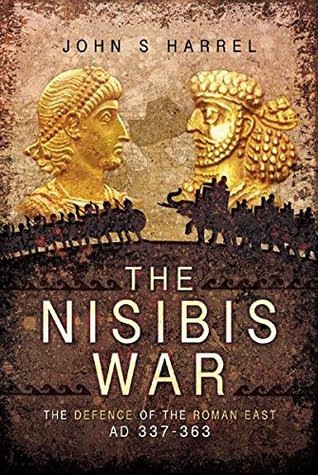
The Nisibis War

by Rindis on May 1, 2019 at 12:00 pm
Posted In: Books

You’ve probably never heard of this war. There’s a good reason: John Harrel is the only one calling it that. This book covers what is usually considered two wars, neither of which seems to have any sort ‘official’ name. “Nisibis” was the name of a city that Rome had gotten in the previous peace deal with Persia (known as the Peace of Nisibis), and was the focus of much of the campaigning in this period, though not where the most decisive actions happened.

Considering that there is basically nine quiet years on the frontier between the two wars, I’m not sure considering them one war is justified. However, they are of a piece, with Shapur II campaigning to drive the Roman Empire out of Mesopotamia, so no matter how you look at it, studying them together is well justified.

This is a fairly in-depth study of the campaigning and the armies of the period, and definitely recommended for anyone interested in 4th Century military history. Given the state of knowledge of the period, I think he’s a bit too certain on some of his statements, but he does a good job of laying out his thinking for the state of the Roman army, it’s composition, and sources of replenishment. There’s a good number of maps, I found the symbology a little crude, but effective.

My main problem is the use of terminology, which kind of goes all over the place. For most Roman offices, he sticks with the Roman names, in italics as foreign words, which is fine. However, he then insists on translating comes and dux as ‘count’ and ‘duke’. That is where the English words come from, but those forms come with a lot feudal baggage that has nothing to do with the Roman offices, and they shouldn’t be translated like that. Also, oddly, he insists on giving place and unit names italics as foreign words, even though as proper nouns, that not the general practice. It makes for some highly distracted reading in places.

There is also some good discussion of Shapur II’s activities (including during the ‘lull’), and discussion of his strategic skill. Sadly, while he gives a good look at Emperor Julian (and a very good account of the entire retreat from Ctesiphon), he touches on Julian’s experience (and gives an account of his campaigns in Gaul), but doesn’t consider anything analogous to  Goldworthy’s assertion from In the Name of Rome that Julian’s being unused to the scale of operations (in men and distance) was the major Roman failing in 363, though he does touch on a similar idea.

└ Tags: books, history, reading, review, Rome
 Comment 
  • Page 59 of 96
  • « First
  • «
  • 57
  • 58
  • 59
  • 60
  • 61
  • »
  • Last »

©2005-2026 Rindis.com | Powered by WordPress with ComicPress | Hosted on Rindis Hobby Den | Subscribe: RSS | Back to Top ↑