Rindis.com

All my hobbies, all the time
  • Home
  • My Blog
  • Games
  • History

Categories

  • Books (503)
  • Comics (10)
  • Gaming (917)
    • Boardgaming (673)
      • ASL (154)
      • CC:Ancients (83)
      • F&E (78)
        • BvR – The Wind (26)
        • Four Vassal War (9)
        • Konya wa Hurricane (17)
        • Second Wind (5)
      • SFB (78)
    • Computer games (162)
      • MMO (77)
    • Design and Effect (6)
    • RPGs (66)
      • D&D (25)
        • O2 Blade of Vengeance (3)
      • GURPS (32)
  • History (10)
  • Life (82)
    • Conventions (9)
  • News (29)
  • Technology (6)
  • Video (49)
    • Anime (47)
  • Writing (1)

Patreon

Support Rindis.com on Patreon!
Become a patron at Patreon!

Other blogs:

RSS Inside GMT

  • Meet The Northern Wei: A Civilization of GMT’s Ancient Civilizations of East Asia  June 19, 2026

RSS Playing at the World

  • Playing at the World 2E V2 Arrives May 5, 2025

RSS Dyson’s Dodecahedron

  • Blog Updates June 20, 2026

RSS Quest for Fun!

  • The Expense Post May 24, 2026

RSS Bruce Heard and New Stories

  • Pain, Exhaustion, and Morale in D&D BECMI June 7, 2026

RSS Chicago Wargamer

  • The 2 Half-Squads - Episode 310: Cruising Through Crucible of Steel January 27, 2023

RSS CRRPG Addict

  • The Search for Freedom: Our Repeated Petitions June 20, 2026
SF&F blogs:

RSS Fantasy Cafe

  • The Leaning Pile of Books May 24, 2026

RSS Lynn’s Book Blog

  • Summer of Horror: Can’t Wait Wednesday: Sleepers in the Snow by Joanne Harris June 17, 2026
ASL blogs:

RSS Sitrep

  • Cardinal ASL Sins March 18, 2026

RSS Hong Kong Wargamer

  • FT114 Yellow Extract After Action Report (AAR) Advanced Squad Leader scenario April 16, 2025

RSS Hex and Violence

  • This still exists? March 25, 2025

RSS Grumble Jones

  • YouTube AAR for Critical Hit's Gettysburg Turning Point 1863 - ID4 At Will Fire June 16, 2026

RSS Desperation Morale

  • How to Learn ASL March 16, 2025

RSS Banzai!!

  • October North Texas Gameday October 21, 2019

RSS A Room Without a LOS

  • [Crossing the Moro CG] T=0902 -- Rough start July 18, 2015
GURPS blogs:

RSS Dungeon Fantastic

  • GMing Shortcuts in Felltower June 17, 2026

RSS Gaming Ballistic

  • B-Scale: Damage That Scales from Tardigrades to Kaiju June 5, 2026

RSS Ravens N’ Pennies

RSS Let’s GURPS

  • Review: GURPS Realm Management March 29, 2021

RSS No School Grognard

  • It came from the GURPS forums: Low-Tech armor and fire damage January 29, 2018

RSS The Collaborative Gamer

  • Thoughts on a Town Adventures System January 18, 2022

RSS Don’t Forget Your Boots

  • GURPS Supers Newport Academy #6: “Old Friends, New Again” June 7, 2026

RSS Orbs and Balrogs

  • Bretwalda - Daggers of Oxenaforda pt.4 - Fallen King May 27, 2017

Doomsday World

by Rindis on September 28, 2022 at 12:00 pm
Posted In: Books

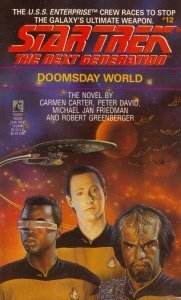
Writing is generally seen as a solo affair, though some team ups can be really useful. (Larry Niven was almost always far better with a co-author.) That said, seeing four authors on a book really makes one wonder just what was going on. Thankfully, there’s a good introduction talking about how this particular collaboration came to pass, which boils down to some group luncheons with the NY-area Star Trek novel writers..

The list of authors isn’t bad either: Carmen Carter wrote Dreams of the Raven, one of my all-time top recommendations for TOS Star Trek novels. Michael Jan Friedman has written several TNG novels, of which I’ve only read Crossover, which wasn’t stellar, but was a lot of fun. Peter David is a very prolific and consistently good Star Trek author, in several media, including the novel Q-in-Law, one of the few TNG novels I highly recommend. Robert Greenberger is the only author that I haven’t read something else by, but it turns out he’s the one to get this project properly organized.

Having just read Gulliver’s Fugitives (TNG #11), it was quite nice to find that this novel had more characterization in the first ten pages than the previous had throughout its length. In fact, it’s obvious the team deliberately set up little character moments for the entire regular cast throughout the first couple of chapters. The emphasis on on this continues throughout the novel, though extraneous characters are dropped as the plot tightens up and starts moving. The real problem here is more over-characterization. Most notably, Data has far too many moments where he trips over an idom and Geordi has to explain. This is something that he has trouble with, but obviously, once he’s had one explained, he wouldn’t need it explained again, so he wouldn’t need them all explained, and the frequency here feels well off from the series.

The plot itself is a mixed bag. We get a new small insterstellar government, the K’Vin, a planet they hold jointly with the Federation, and a large archaeological dig uncovering secrets of an earlier, vanished race. The setup is nicely done, we get to meet a mentor figure for Geordi, the Federation and K’Vin ambassadors, and then we get an attack on a settlement in another system to get the plot moving.

The initial effect of this is to force the Enterprise elsewhere while leaving Data, Geordi and Worf are on-planet as tensions start ratcheting up with a string of terrorist attacks. The plot does keep the promise that this will all tie up in the end. In fact, structure-wise, there’s no real problems. However, we do get problems with the main characters not being quite as competent as they should be, and missing things that the reader picks up on.

Some of that is the reader getting to know more than the characters, and some of it is some really ham-fisted stage direction early on. As we go on, we do get to see more and more what’s going on with the ‘primary villains’, which if that had been done a bit earlier and better would help shore things up a bit. But even then, the ending kind of dissolves into a mess where what should be important elements sideline themselves, and it feels more like an early decision ‘and this is what the final scene should look like’ without it being allowed to flow naturally out of the rest.

All that said, this still makes for a better early TNG novel than what I’ve seen so far (I’ve read about seven of #1-11). It falls short in places, but is a good effort, and certainly not to be avoided.
└ Tags: books, reading, review, Star Trek, TNG
 Comment 

Trafalgar: Countdown to Battle

by Rindis on September 20, 2022 at 12:00 pm
Posted In: Books

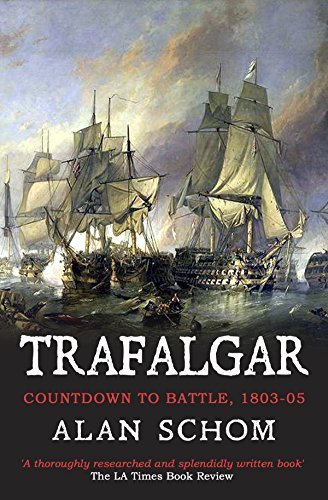
Alan Schom’s book is supposedly as much on the campaigns leading up to the famous battle as on the battle itself (thus the subtitle). And it generally succeeds at that. Better, it presents a lot of the French side of what was happening, and takes a real look at Napoleon’s plans to invade England.

Since that never got attempted, there have been doubts about how serious Napoleon was about the attempt, starting with some of his own propaganda. However, Schom lays out his reasons for treating it as very much a real and pressing project of his, and traces it through way too many changes and contradictory orders. More interesting to me, is his descriptions of the naval flotilla built to support the invasion.

This is Schom’s main reason for discounting any claims that the invasion was in the end a feint. Way too much effort, materials, and manpower were spent on all the little craft that were to protect and support the transports for a mere distraction. And they were, in a word, useless. Even the largest of the three classes was not really rated for service in the rough seas of the Atlantic, the cannons they mounted were too small to be any use against regular military ships, and those same cannons dangerously overloaded the vessels.

The British efforts to blockade the French fleet in ports gets more attention elsewhere, but the presentation here is good, and concentrates a bit more on William Cornwallis’ (brother of the more famous Charles Cornwallis of Yorktown fame) command of the Channel Fleet. I do think this side could have been presented a bit better, with more of a look at the administration of the naval effort, and how the various demands for ships in different posts were met over time. A true detailed look would be too much for a more popular book such as this, but keeping an eye on policy development would have been a good addition.

Overall, the book does it’s job quite well, and my main actual complaint is that it’s nearly impossible to keep track of all the changes in French plans over time despite Schom paying attention to that aspect. Of course, those changes were numerous and frequent enough that I doubt anyone at the time could really keep track of it all.

└ Tags: books, history, reading, review
 Comment 

A Wizard of Mars

by Rindis on September 12, 2022 at 12:00 pm
Posted In: Books

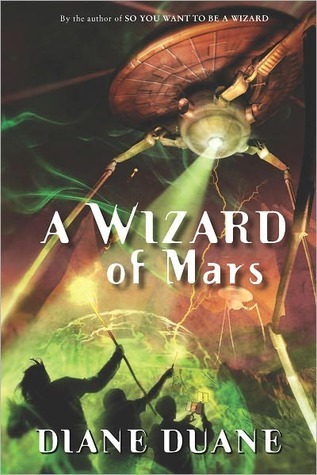
When you look at a book in a contemporary fantasy series, and it name drops “Mars”, and has a tripod on the cover, you have to wonder if someone’s gone insane.

And the title, “of Mars” implies, well, people, on Mars, which with this being a very scientifically grounded series, seems… off.

But worry not, Diane Duane has it all covered here, successfully delivering on promises you’d think can’t be kept.

Like some of the best setting-based stories, Mars itself is almost a character here, and certainly Duane and her characters have done far more homework than I have, and it the geography of Mars plays a part in the novel (and provides chapter titles).

An interesting conceit in the novel is that any time a nearby planet weighs as heavily in popular consciousness as Mars does in ours, it’s a sign that something more is going on. And of course, much more goes on during the novel. Along the way, Duane pays tribute to the continuing popularity of Mars in popular culture (referencing two versions of War of the Worlds, B-movies, and of course Edgar Rice Burroughs). I’d point out the psychological reasons of being the second brightest ‘star’ in the night sky, and more easily visible than Venus, which never strays too far from the sun from our point of view, but it still makes for a sensible “there’s a secret here, if we can find it” hook.

Meanwhile, personal threads with Kit and Nita continue. It’s been long enough since reading the previous books that I don’t remember some of it, but they’re generally introduced well enough to pick up without much trouble. I certainly would recommend going back to the start of the series than picking up here (or anywhere else), but I do recommend the series as a whole, and this book in particular.

└ Tags: books, contemporary fantasy, fantasy, reading, review
 Comment 

Medieval Scandinavian Armies (2) 1300-1500

by Rindis on September 4, 2022 at 12:00 pm
Posted In: Books

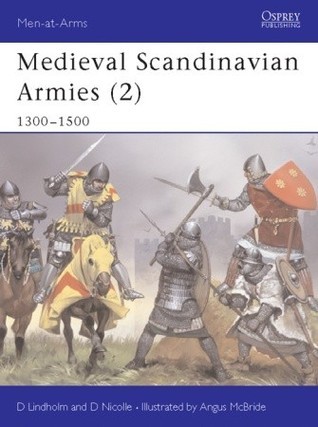
Much like the first book, this is a solid but unspectacular Men-At-Arms volume.

The Angus McBride art is better this time, with one two-page spread battle scene (shown in part on the cover). There’s a couple where the backgrounds aren’t detailed, but Plate A depicts (in not a lot of detail) a group on one of the smaller ships of the 1300s in the North Sea, which is a plus.

Again, most of the photos are of period illustrations and carvings rather than actual artifacts. But there are some, and they tend to be varied and useful, including a light canon taken from a Danish shipwreck. There’s also several photographs of period fortifications, since more of them were made in stone in this period, and have thus survived.

The chronology section is very extensive and runs over four pages (all with illos…). Certainly, this is an excellent first stop for finding out what was happening in Scandinavia in the period, and covers the outlines of the failing settlements in Greenland.

The opening section deals with the politics of the region, notably the Union of Kalmar, and Scandinavia breaking into western Denmark/Norway, and eastern Sweden/Finland in the Fifteenth Century. The rest of the text naturally deals with the usual Osprey focus on military equipment and organization. It’s well done, but there’s not necessarily any surprises here; by this point Scandinavia was more integrated with the rest of Europe, so technology and fashions are no longer lagging so far behind. On the other hand, interior roads were still few and underdeveloped, so the control of blocking positions was still important. At the same time militia was becoming more important, and later rebellions razed many wooden fortifications, prompting their replacement with stone castles in areas with a stronger economy.

└ Tags: books, history, MAA, Men-at-Arms, Osprey, reading, review
 Comment 

The Worm Oroboros

by Rindis on August 19, 2022 at 12:00 pm
Posted In: Books

First off, I recommend against buying the Evinity Kindle edition. While it does have the original illustrations, it also has a number of errors, and breaks up the text with tags for the original pages—breaking up paragraphs and sentences willy-nilly. This is, I believe, straight from old Project Gutenberg files, though those do not have the pagination notes any more.

As for the book itself, it’s a 1922 proto-fantasy, using some tropes of the sword and planet genre. Though that last is really just an intro or broken frame to introduce the action. Supposedly, this all happens on Mercury (which here just means “not on Earth at any time”), and the initial viewpoint character is transported there as a vision and introduced to some of the major characters (for the benefit of the reader). After the second chapter, this device is dropped, and never mentioned again, so it’s not even a framing device. These days, there’s no problems with the idea of a landscape with people and places that have no reference to Earth, but I imagine an introduction was considered necessary when written.

Complicating matters is that it is written in Elizabethan English, making it a bit rougher for most readers to get through. It’s been praised for how consistently he keeps up what is effectively a foreign dialect, and doesn’t miss the mark, spoiling the illusion. That is beyond my ability to judge. The really rough parts are when a letter or other writing appears in the novel, as none of the characters are great scribes, and the text is an appropriately phonetic approximation of words that quickly becomes very tedious to parse through.

On top of the rest of this, the story is basically a chivalric romance, set in prose. (In fact, I could see Pendragon, with its passion system, being an excellent RPG for this world.) So, we follow the struggle between the island power of Demonland and the continental Witchland (tell me there’s not a parallel going on here…), as the hubris of Gorlice of Witchland has him demand fealty from the Demons, and war results. (And I will note that various fantasy staple terms are used here, demons, imps, pixies, etc., but they are more ethnicities than meaning to evoke actual fantastical powers.)

In the end, it’s certainly an important book, and generally entertaining in the high heroic mode of great men doing great deeds and leading great armies. Personally, the pacing was all over the place, with all the elements you’d expect: sieges, battles, heroes in single combat, beautiful ladies, politics, beautiful ladies politicing…. And a too-long sequence of climbing a glacier. If you are willing to buckle down with the language, it will reward you, but you have to be mindful of that going in.

└ Tags: books, fantasy, reading, review
 Comment 
  • Page 31 of 93
  • « First
  • «
  • 29
  • 30
  • 31
  • 32
  • 33
  • »
  • Last »

©2005-2026 Rindis.com | Powered by WordPress with ComicPress | Hosted on Rindis Hobby Den | Subscribe: RSS | Back to Top ↑