Rindis.com

All my hobbies, all the time
  • Home
  • My Blog
  • Games
  • History

Categories

  • Books (503)
  • Comics (10)
  • Gaming (917)
    • Boardgaming (673)
      • ASL (154)
      • CC:Ancients (83)
      • F&E (78)
        • BvR – The Wind (26)
        • Four Vassal War (9)
        • Konya wa Hurricane (17)
        • Second Wind (5)
      • SFB (78)
    • Computer games (162)
      • MMO (77)
    • Design and Effect (6)
    • RPGs (66)
      • D&D (25)
        • O2 Blade of Vengeance (3)
      • GURPS (32)
  • History (10)
  • Life (82)
    • Conventions (9)
  • News (29)
  • Technology (6)
  • Video (49)
    • Anime (47)
  • Writing (1)

Patreon

Support Rindis.com on Patreon!
Become a patron at Patreon!

Other blogs:

RSS Inside GMT

  • Meet The Northern Wei: A Civilization of GMT’s Ancient Civilizations of East Asia  June 19, 2026

RSS Playing at the World

  • Playing at the World 2E V2 Arrives May 5, 2025

RSS Dyson’s Dodecahedron

  • Blog Updates June 20, 2026

RSS Quest for Fun!

  • The Expense Post May 24, 2026

RSS Bruce Heard and New Stories

  • Pain, Exhaustion, and Morale in D&D BECMI June 7, 2026

RSS Chicago Wargamer

  • The 2 Half-Squads - Episode 310: Cruising Through Crucible of Steel January 27, 2023

RSS CRRPG Addict

  • The Search for Freedom: Our Repeated Petitions June 20, 2026
SF&F blogs:

RSS Fantasy Cafe

  • The Leaning Pile of Books May 24, 2026

RSS Lynn’s Book Blog

  • Summer of Horror: Can’t Wait Wednesday: Sleepers in the Snow by Joanne Harris June 17, 2026
ASL blogs:

RSS Sitrep

  • Cardinal ASL Sins March 18, 2026

RSS Hong Kong Wargamer

  • FT114 Yellow Extract After Action Report (AAR) Advanced Squad Leader scenario April 16, 2025

RSS Hex and Violence

  • This still exists? March 25, 2025

RSS Grumble Jones

  • YouTube AAR for Critical Hit's Gettysburg Turning Point 1863 - ID4 At Will Fire June 16, 2026

RSS Desperation Morale

  • How to Learn ASL March 16, 2025

RSS Banzai!!

  • October North Texas Gameday October 21, 2019

RSS A Room Without a LOS

  • [Crossing the Moro CG] T=0902 -- Rough start July 18, 2015
GURPS blogs:

RSS Dungeon Fantastic

  • GMing Shortcuts in Felltower June 17, 2026

RSS Gaming Ballistic

  • B-Scale: Damage That Scales from Tardigrades to Kaiju June 5, 2026

RSS Ravens N’ Pennies

RSS Let’s GURPS

  • Review: GURPS Realm Management March 29, 2021

RSS No School Grognard

  • It came from the GURPS forums: Low-Tech armor and fire damage January 29, 2018

RSS The Collaborative Gamer

  • Thoughts on a Town Adventures System January 18, 2022

RSS Don’t Forget Your Boots

  • GURPS Supers Newport Academy #6: “Old Friends, New Again” June 7, 2026

RSS Orbs and Balrogs

  • Bretwalda - Daggers of Oxenaforda pt.4 - Fallen King May 27, 2017

A Country of Vast Designs

by Rindis on October 25, 2024 at 12:00 pm
Posted In: Books

The subtitle “James K. Polk, the Mexican War and the Conquest of the American Continent” is on point. This primarily about Polk, and takes the view from the White House for the bulk of the book. After that in importance is the Mexican-American War, and then the dispute over Oregon.

I had initially expected more of a history of the Mexican-American War, but it’s really a political history of Polk. Which is an eminently sensible subject. I can remember him being pointed out in a high-school history textbook in what is usually a fairly ignored stretch. Polk came to office after an unexpected nomination, and had a very clear-cut list of major goals for the US, which he then proceeded to determinedly accomplish.

Merry starts out with background, giving a thumbnail of Polk’s early biography, and then more detail on his political background as a protege of Andrew Jackson. As a true dark horse candidate, the Democratic convention of 1844 is gone into with some detail along with the election, and then the selection of the cabinet.

Once in office, Polk is juggling several things at once, but Merry starts with concentrating on domestic issues, and then on the Oregon Territory dispute, leaving the Mexican-American War to be concentrated on in the later part of the book. All of this is largely told from the political point of view, so while what was going off in such far-off places as California and Veracruz is shown, it is done in sense of detail.

But, the point is to see how Polk went after his goals, and got them. His strategy with Britain and Oregon was one of close-mouthed brinkmanship. It worked, getting a good compromise solution, after scaring the rest of the cabinet with what seemed a likely war first. His reticence makes it much harder to figure out what his plans for Mexico were. It certainly looks to be the same modus operandi, just with an explicit threat of force by sending Zachary Taylor into disputed territory.

This turns into skirmishes, then a battle, and war. Generally, it was a war with popular support in the US, but the political fallout steadily erodes Polk’s influence in congress. This had started strong enough to help him pass his tariff act and other measures, but by the end of the war, ratifying a peace treaty was a very chancy thing. Merry’s evaluation of Mexico’s actions leading to war come rather later in the book, and generally this is one of the friendlier opinions of the US’s actions I’ve seen, but he is correct that Mexico did itself no favors. Of course, things were so unstable that I’m not sure I’d say there was a government you could negotiate with, but what there was refused to even talk. To one extent, it’s tempting to say that the proper course of action is to wait for a stable government, but there were no hints as to how long, if ever, that would take.

Also, the same process of American colonization-via-immigrants that happened in Texas was in the early stages of happening in California and Oregon, and if let drift would have ended about the same way. Polk certainly seemed to be willing to cut to the chase with a large cash payment that could also stabilize any government that accepted it (since it would let them pay troops and functionaries long enough to possibly get some momentum), but he was asking for more than anyone would accept. Worse than just not accepting this as a possible, much less good, idea, the Mexican government responded belligerently to all this. And so war came.

Through all of this is Secretary of State James Buchanan. I knew he was later a terrible president, but to plumb the depths, you need to look at his earlier career. Buchanan is a constant source of conflict with everyone else, and incapable of dropping an argument. After promising that he wasn’t seeking to be president himself, he starts maneuvering for a later nomination, and causes all sorts of extra problems and scandals. Polk’s main failing is that he has no desire for in-person confrontations, and never really brings the boom down on Buchanan, even after incidents where it was richly deserved.

Parts of this book were reasonably well known to me, but there was plenty here that was new. I certainly recommend this as an addition to any study of the Mexican-American War, as there’s a lot here. The writing is good, though the distant perspective sucks the life out of a lot of colorful figures.

└ Tags: books, history, reading, review
1 Comment

The Queen’s Secret

by Rindis on October 17, 2024 at 12:00 pm
Posted In: Books

So, book 2 of a YA fantasy horse series.

Warning: there is a cliffhanger ahead.

The fact that this leads directly into book 3 explains a few things, because on its own the plot is a mess. Even as the middle of a story there are problems here.

Ironically, this was published in 2019 and deals with a deadly plague. In general, the situation is well handled, especially at a YA level. Since this world is somewhere around late 19th to early 20th century in general technology, the general sense of what is going on is known, and it’s down to trying to find a cure, or, as it turns out, a good inoculation.

Of course, this isn’t something the main characters are directly involved in, though they get the chance to be involved in finding a crucial bit of knowledge. That’s dropped a bit suddenly, and comes in from outside the active plot. But, the answer is suggestive of what deeper things are going on, because there is a deeper plot going on underneath all the happenings of the book.

…And that’s really the source of the trouble. Things start unraveling near the end, and while there’s a lot of questions left, the end is also where we start getting the questions in the first place. There were dropped threads near the beginning, and then there’s a lot of motion that goes nowhere until we head into the end. Put together directly with the next book, this may work out well, but inside of this book, the pacing is too uneven, and important things are set aside too long. That said, the writing and characters are enjoyable, and everything is set up well for what should be a very good concluding book.

└ Tags: books, fantasy, reading, review
 Comment 

Imperial Twilight

by Rindis on October 5, 2024 at 12:00 pm
Posted In: Books

Platt’s book is really about the relationship between Britain and China before the Opium War, and shows why a conflict was unexpected, almost right up to when it did happen.

The two had a stable trading relationship for about two centuries. While the very limited contact (all through Canton) seems repressive, in practice it did mean that everyone involved knew what to expect from each other, and how to keep the goods, and cash, flowing.

Instability arrived on the British side in the guise of opium. Notably, while official British trade stayed away from the substance, the East India Company was doing its best to control the sale of opium in India, and make a big profit from it. However, there was competition from areas not yet under control of the EIC, which led to them competing on price, driving the cost of opium in China down so that it was no longer just available to the rich.

On the Chinese side,  there were serious rebellions that sapped much of the available political will, as insane numbers of men and money were spent to put down the White Lotus rebellion, and right after dealing with the ever-growing problem of piracy. The ultimate cause of both is really that the population of China had doubled during the 1700s, while the tax structure meant no more money came in to oversee the greater needs of the greater population; this left the import tariffs claiming a more and more prominent place in the budget.

These combine to create ever-growing corruption in the Chinese government just as they have to deal with a new popular problem: An ever-growing number of people hooked on opium. (This also starts draining silver coinage out of China—historically extremely rare.) The Chinese go through a number of ideas on their war on drugs, including contemplating legalizing opium, before taking a very hard-line stance with a new administrator, who actually starts getting things done. Whether he was really doing enough to start stemming the tide, or just breaking up a couple waves is taken for granted here, but I have my doubts.

Either way, Lin Zexu ended up on a collision course with the latest British superintendent, Charles Elliot, as the EIC monopoly had just been ended (to the immediate benefit of opium smugglers). Elliot was months away from further instructions, did not have as much authority as he generally needed, and increasingly erratic under the strain. Collision was inevitable, and when it happened war followed.

Though the war itself was still not inevitable. Britain fought, on the surface at least, the abstract notions of honor and respect. That other motives lurked under the surface were obvious, and the effort to push the war through nearly caused top members of the government to be censured by Parliament, and may have led to a collapse of the Melborne government.

Overall, the book mostly sticks with the British side of things, partially, I believe, because the two British efforts to send embassies to China that form the beginning parts of the book are much better documented from that side (and still nearly gets stuck in the weeds of conflicting and incomplete accounts). Much of the middle is better on showing the internal challenges of China, but the figures involved never really come to life. The war itself is merely summarized, though Plat points out that the Chinese, operating with a much weaker miliary, didn’t play to its strengths either.

└ Tags: books, history, reading, review
 Comment 

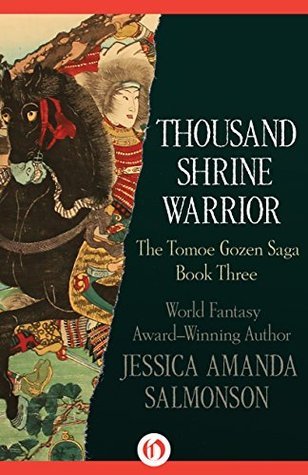
Thousand Shrine Warrior

by Rindis on September 27, 2024 at 12:00 pm
Posted In: Books

The final Tomoe Gozen novel is much more cohesive as a novel than the first two. But it is broken into three parts, and they are somewhat independent.

A sad repeat from the second book is that there’s an ad from the publisher of the Kindle version of the book right at the end of part three. And right before a final short story epilogue. This is a really bad habit by Open Road, and needs to stop. If it was before a preview of another book, that’d be one thing, but but this is splitting apart something that’s supposed to be a cohesive whole.

At least they’re not advertising soup.

At any rate, we have more grand adventure in a world of Japanese myth. Tomoe is now a mendicant monk, making her way while trying to atone for actions she now regrets. She is older, and sadder, and no less deadly, even as arthritis starts afflicting her joints.

Of course, this she stumbles into a small province where an ex-samurai will find plenty of things to regret. Much Japanese storytelling is somber, and this book has the tone down perfect, just like the entire series has gotten so much right.

Overall, the pace is often slow, but the fact that this is much more one cohesive whole helps a lot, and I think this is the best part of the series. Overall, it’s well worth a read, and needs to be better known than it is.

└ Tags: books, fantasy, reading, review
 Comment 

Powersat

by Rindis on September 15, 2024 at 12:00 pm
Posted In: Books

This is the first book in Ben Bova’s “Grand Tour” series—chronologically at least. I get the idea it was one of the later ones written, but I haven’t looked deeply into that. Each one was written about a particular location in the solar system, and this one is… “orbit”.

Technothrillers generally have at least a whiff of science-fiction to them, since they often deal with the intersection of modern military and new technology, so every once in a while SF authors will come at it from the other direction. This is the second such I’ve read, and by far the more successful.

Bova avoids any mention of what year it’s supposed to be, but there’s some interesting hints of background as he writes from a 2005 perspective. There was a second 9/11 style event (three major bridges being blown up near-simultaneously), and the US occupied a decent amount of the Middle East, and is still there as a result. There’s no overall look at the privatization of space flight that was starting at the time, but there is certainly one company making a real go at it, and it is the center of the novel.

Thankfully, Dan Randolph has none of the authoritarian foot-in-mouth baggage that the real world has to deal with. But he is obsessive, and obsessive enough to have two separate obsessions, one of which powers the central plot, the other of which helps tie together pieces of the secondary plot (or maybe tertiary, the side stuff tends to be a bit fragmented to easily sort out).

The primary obsession is to deliver cheap power by setting up a large geosynchronous satellite that will gather solar power and beam it down to Earth. Whatever year this is, the various technical hurdles of this plan have been dealt with, and there’s even been a Japanese demonstration model already (which Randolph helped with).

Of course, this would completely upend current power structures (pun not quite intended). And that’s where the book goes from hard SF to technothriller as various groups try to stop or control this about-to-be new source of comparatively cheap power. It’s odd that all of this comes up as the project is nearing completion, instead of a decade or two of political fighting, but that would make for an extremely dull novel.

The novel starts with the crash in a test flight of the last piece of Randolph’s plan. A true reusable space plane that can get maintenance people up to geosynchronous orbit to perform any needed maintenance. Late in the novel you finally find out that there’s already an equivalent to the ’80s “space tug” proposal up there that is what is transferring everything from low orbit to geo. But there’s no discussion of when/how that was put there, what keeps it fueled, or any other infrastructure. Not even evidence of current space stations in orbit. The novel has a lot to talk about on the ground anyway, but it does make it feel like Astro Corporation is operating in a vacuum (har har).

Pacing is overall a bit slow, a little uneven, and ramps up to a technothriller action climax. Overall, it’s a good book, but a lot of the secondary parts feel underbaked. It’s a strong enough book for me to be continuing on to the asteroids.

└ Tags: books, reading, review, science fiction
 Comment 
  • Page 15 of 93
  • « First
  • «
  • 13
  • 14
  • 15
  • 16
  • 17
  • »
  • Last »

©2005-2026 Rindis.com | Powered by WordPress with ComicPress | Hosted on Rindis Hobby Den | Subscribe: RSS | Back to Top ↑