

Hubris of Rome
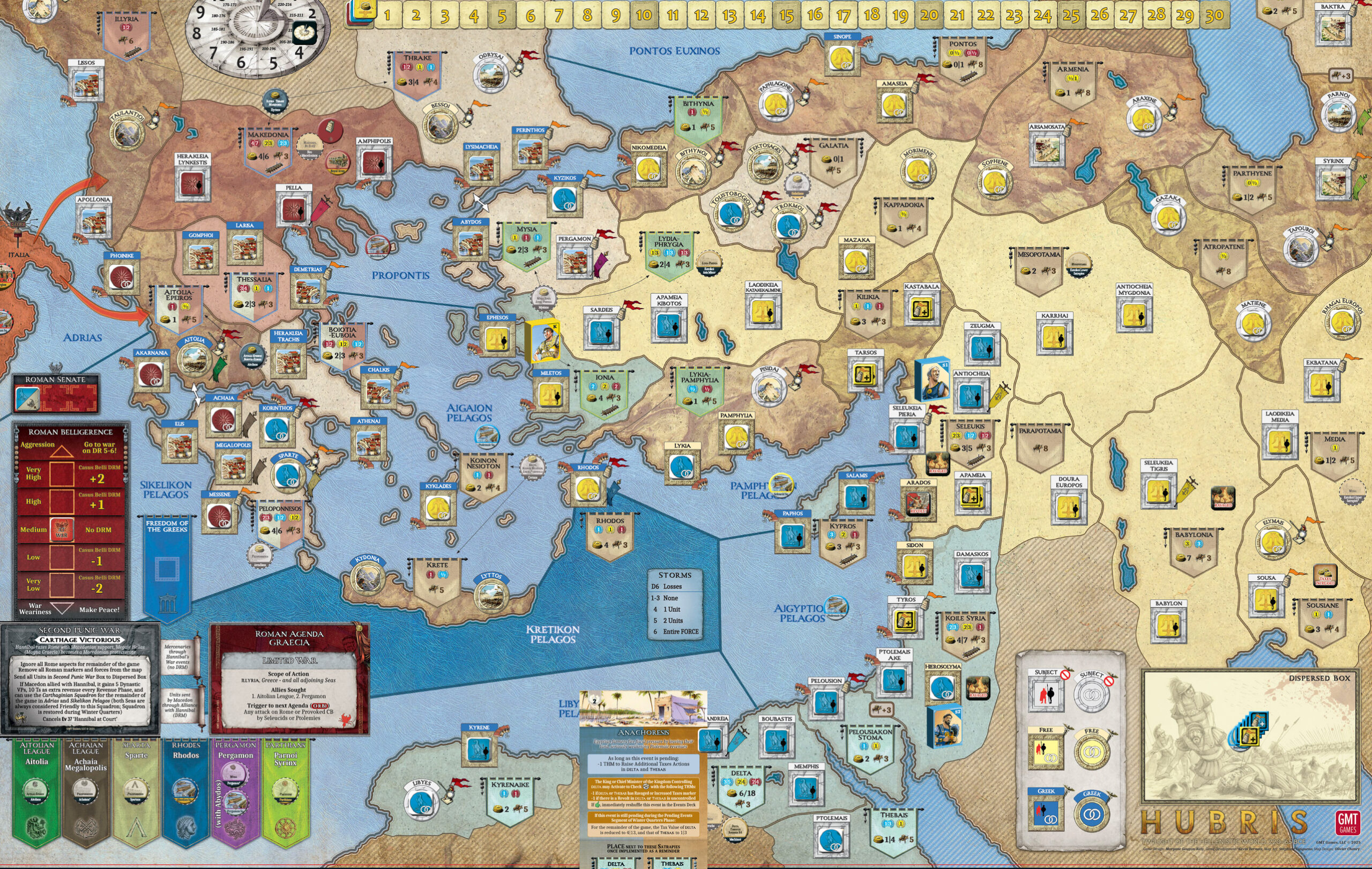
After defending Sicily, Mark and I moved to the eastern Mediterranean to try out Hubris which he got a bit ago. It’s a very interesting looking game about the later Hellenistic period, with Rome as a non-player power getting more and more involved in the region. Normally, it’s a three-player game, but for this trial run it was just the two of us, which leaves Macedon also as a non-player power, and Mark took the Seulucids while I was the Ptolemies for the short intro scenario (turns 1-3).
The first turn has 13 event cards in the deck to determine what happens (including Winter Quarters, which ends the turn), and everything we got was recurrent events. This had us mystified on how a few things worked (notably Rome), since they depend on the other events.
At any rate, any of the recurrents have three parts; an event, a game mechanic, and a set of player turns. Each event section has a die roll for variations, so despite going off on most turns, they’re different each time, and more than anything else seems to end up removing existing control markers. For our actual positive efforts, I conducted a campaign into Lydia, defeating a Seleucid reaction, and took two of the cities there. (We had not realized this area was in rebellion until much later, so this should have gone against Achaios, instead of Mark directly.) I then turned north to campaign in Mysia, taking Abydos. Mark sent envoys to Rhodes and got an alliance, and then more to Lykia for an alliance with Pamphylia. Rome campaigned successfully in Illyria, taking over the satrapy. He then did a counter-attack in Lydia and retook the cities I had taken (on two tries).
Revolt caused riots in Alexandria, and I had to do a campaign in Egypt to take it back. Macedon took Boiotia. I increased taxes in the Delta, but only barely passed the roll to get half money and ravage the province. Then Enemies at the Gates caused me to lose Ptolemais (/Thebais), which I got back with an envoy (…which was illegal, darn it).
The turn 2 deck was 17 cards and I got a new Friend (/general). Mark got alliances in Bithynia, I did another campaign into Lydia, winning another battle, but getting no result on sieges. Mark went into Armenia, subjecting the two tribes there. A second attempt in Lydia got me Sardeis (the -2 stronghold, and finishing off Achaios’ revolt) and Apameia. Then our first immediate event came up; Fall of Tylis ravaged Bithynia and Galatia. Then Hannibal’s War advanced Second Punic War to “Hannibal in Italy”. Envoys flipped the Kyclades to Seleucid alliance, while I did the same with Rhodos. We then tied a bid for Andromachos, who went to Mark, and then campaigned in Lydia and defeated Theodotos, but couldn’t take any cities. I established an alliance in Kyzikos (Mysia).
Aitolia Allied With Rome, which moved the Roman agenda to Graecia, while the Second Illyrian War partially reset things there, and started a war with Macedon. Mark had a Revolt in Babylon, but Intrigues erupted in my court, killing my chief minister, Sosibios (by far the most competent man there), who I replaced with Tlepolemos. I sent envoys to Galatia (giving me access to their mercenaries), and Mark retook Babylon. The Romans forced Macedon to surrender, converting much of Greece to being allied with them. Hannibal’s War continued, putting him at the gates of Rome. This has a low chance of actually taking Rome, and we had actually seen an event to improve it, Alliance With Hannibal, but it’s a Macedon only triggered event; we just hadn’t removed non-two player events ahead of time.
…but it happened. Hannibal took Rome. All Roman influence is removed, and they are ignored for the rest of the game. Somewhat appropriately, the turn ended at that point, triggering Anachoresis to lower the value of Egypt.
The turn 3 deck was down to 11 cards, and Mark got Antiochos the Younger. Mark opened with an offensive into Koile Syria, defeating Ptolemaios IV handily (2 hits to 0…), and took Sidon, Damaskos, and Tyros for simple control of the region. I sent an army into Kilikia, hoping to threaten Seleukis from behind, but couldn’t take anything. Arados (Seleukis) Revolted, and Mark shifted his army over to Lydia to invade Ionia, taking both cities there. Ferryman of Souls took Andromachos (on schedule), but no one else, despite some close rolls. Envoys flipped Rhodes back to Seleucis.
The next part seems to be legal, but I know it physically couldn’t happen. My army was in Kilikia, which has a land route to Seleukis, which I have a controlled space in, so I declared a campaign there (as origin and target), shifting my army from Kilikia. In actuality, that means somehow getting the army through the still defended Cilician Gates…. But with the main army spent for the turn, I had a free hand to press sieges, letting me take Antiocheia and Zeugma, and simple control of the region.
The treasury nearly empty, Mark raised taxes in Babylon and Sousiane, only getting half value from the former. I activated a new army to go into Koile Syria, and took Damaskos, barely giving me simple control back. Winter Quarters ended the turn, and Mark attempted to keep the war going, because I was going to fail the war exhaustion check, and at least have a revolt, and quite possibly lose a dynastic VP. While he had the admin to likely avoid that, he couldn’t make the diplomacy check to continue the war, especially after I offered a squadron for peace.
Afterword
Final VPs were 16 to 14 for a Ptolemaic win. This is about the same gap as given in the historical VP schedule, but we were both down about eight VPs. Most of this is from lower territorial totals, but we’re also down a dynastic VP each. Those seem to have come from assumed Evergetism actions, which neither of us had the spare 20T to even begin considering.
Ptolemy has a powerfully large budget to work with, the leaders aren’t quite as good (especially with the king only getting one action per turn), and has to manage a split empire, which limits transfer of forces. I should have looked more at the naval campaign options, but it didn’t seem like a good option against the largely inland Seleucids. Maybe if I’d had to fight Macedon. I would have loved to have time for occupying the power vacuum Rome left in Greece, but it just wasn’t as important as activities closer to home.
The overall system is good, though our event draws kept being lopsided towards the repeatable events. But, while it certainly does a great job getting the feel of events, and multi-year campaigns for areas, the rules have problems. A number of subjects are split up, so you can’t find what you want without looking in two places. Section 2 tries explaining all the various concepts of the game, which turns it into a dumping ground which takes up over 10 pages. The biggest problem to me though is the fact that the reactions chapter is completely divorced from the campaigning sections, and the sequence of what to do in the latter never mentions former. We had multiple instances of getting through everything and then going, “oh right, you should have reacted somewhere in there”.
This is all made worse by the fact that all graphics, and especially (I think) the fancy background graphic of the rules make this a very slow loading PDF. Going more than a couple pages away (which is constant) caused a long loading wait on both of our systems. (Meanwhile the Sword World sample PDF has background graphics and the like, is 75 pages, and has the same problem… but takes maybe a quarter of that time to load.) A version without the background would be a big plus.
I’ll also note the Vassal module is about three-quarters baked. It’s in good shape, but there’s a few things which would really help. First, move activating a leader off of just “Enter” bare key commands are never good, and this causes problems with chat. Second, when sending to the dispersed box (and a couple other places), separate out the destination by type and owner instead of one big pile in the center. And this would be a lot more work, but the spaces should just have single permanent markers with all the various ownership types as layers (see the Successors module for a slightly simpler implementation of this).
Finally, there was some confusion at first as the rules just refer to the color for the Macedonians as “purple”. I believe it’s meant to be a Tyrian purple, but the color selected is just a rust red to modern sensibilities (at least in the Vassal module, print might be a bit better).
I do hope to play a proper three-player game at some point, because it is a good game, but the slope to learning it is tougher than it needs to be.
Discussion ¬