

Final Test
After finishing up with Centurion, Mark and I decided to try out the Avalon Hill WWI dogfight game Knights of the Air. It’s sub-genre that’s always had a steady number of releases, and I generally like a bit more than the WWII version. This is on the very technical side of things, and I think some of the mechanics are a simplified version of Air Force/Dauntless (it’s been nearly forty years since I played that, so I can’t be sure).
Altitude is mechanically broken up into 1000′ bands, which are grouped into 3000′ sections; these last are color-coded, and each aircraft has engine and flight performance broken out by color bands. Each turn you set your control stick (number tracks with counters) to climb or dive, which modifies effective engine power (and therefore speed), and a more fine-grained altitude level which ranges from 1 to 53 within the band (about 19 feet each—annoyingly, the ‘1000’ foot level exactly is level 1 instead of 0, so the math ends up off).
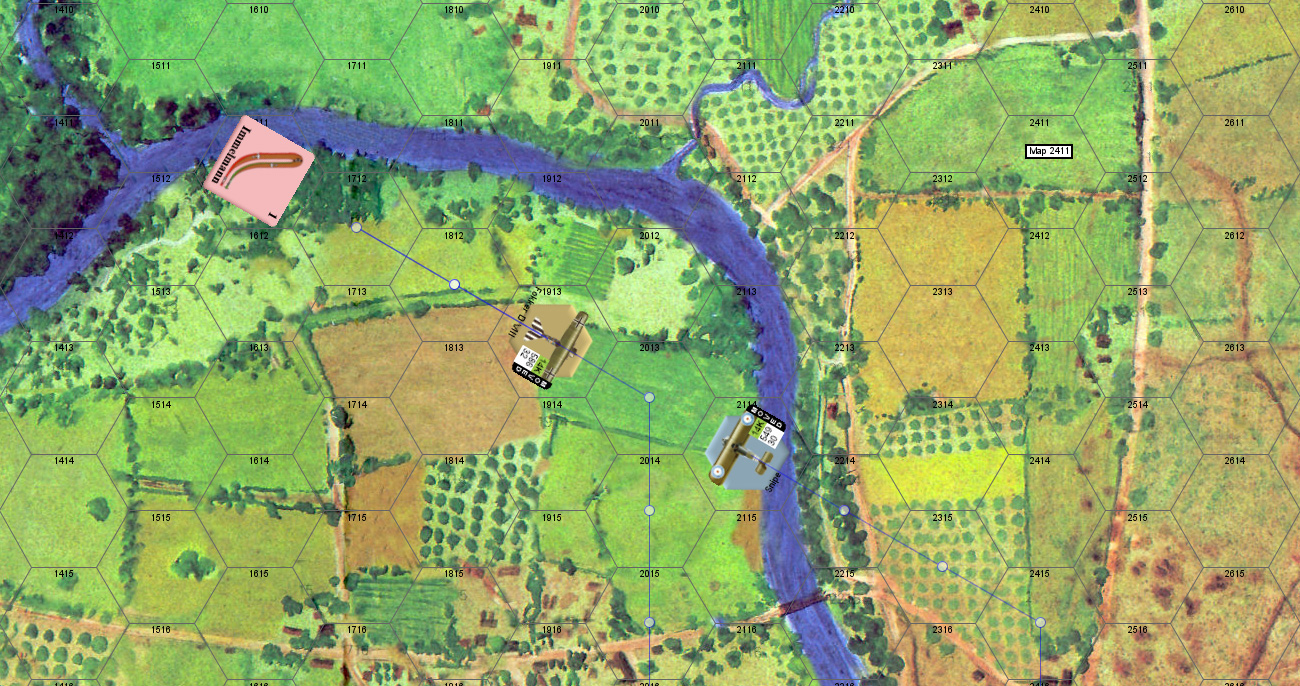
We ended up with the “Final Test” scenario, which is a somewhat generic scenario with a pair of late-war planes against each other. To my surprise, the Sopwith Snipe and Fokker DVIII are later rotary planes, so they’re part of the Ace of Aces Rotary set instead of Powerhouse. I had the Fokker, which has slightly better performance, with a one better power rating at most altitudes, less tendency to lose altitude in turns (which is an optional rule which we didn’t use), a slightly lower stall speed, and a slightly higher level flight speed (110 MPH) at our starting altitude of 15000′. The Snipe does have a better top speed, but it’s hard to take advantage of that, especially as the scenario forbids you from going below 14000′ (with no specified mechanism or instant loss penalty for violating it).
The rules are not well organized for figuring out beginning questions like, ‘what is your current speed at setup?’ Once over that hump, there is the little matter of spotting your opponent. Since we were pointed at each other, our spotting distances were 3d6 x 2 hexes, but since the starting distance is 39 hexes, it was impossible. Without spotting any targets your maneuvers are limited, but we just wanted to get closer anyway. I did S-turn out a bit, but Mark rolled very well on turn 2 to spot me, and used an S-turn to get closer to my track again. At range 7, we had no trouble spotting each other for turn 3.
Mark side-slipped in behind me (going away), so I did a Immelmann to get turned around, ending 8 hexes behind him. Technically, this was a firing opportunity, but it would be extremely low odds, and I was quite a bit higher than him. (Generally, the fixed-mount pilot machine guns can only fire at targets within one level of your craft, though there is an optional rule for that while climbing and diving.) About a turn later, Mark did a half loop that ended with us both looking over our shoulders to keep track of the other plane and losing sight of each other. (We were only three hexes away, but a thirty level difference was too much separation.)
That took a couple turns to recover from, and I finally managed the first shot of the game, but at range 6, you need pretty good dice, and I missed. Mark got a bead on me a couple turns later, and while I couldn’t prevent it, I saw it coming to start jinking and he missed. Mark’s lower speeds generally let him do 2T turns while I was forced to 3T or 4T, so I had a lot of trouble keeping with him, and had a few bad ideas at this point. Eventually, I did another Immelmann to get turned around, and Mark came in after me. The end of the turn had me in the middle of the turn around (where I can’t fire), and Mark missed at range 7.
Attack opportunity was declared 3 moves/6 half-seconds into the next turn, and range 2 shots both connected. Mark did two damage, and I managed 1, despite a penalty for still being in the Immelmann. Damage is then assessed by rolling on a series charts picked by relative positions and speeds. There’s a few modifiers to the chart you use, but we didn’t get that this first time, and thought it was to the die roll. At any rate, I took damage to my tail, and a fabric tear that reduces my max effective power before a crack up (we weren’t getting anywhere near that). Mark had his engine power reduced by three, potentially limiting options, and slowing him down about 10 MPH.
Page 20.
We circled for a couple turns, and then I got another shot at him, but my hit turned into a miss by the result on the damage chart. Mark tried a loop (I’m not sure of the thinking on this one) while I circled, and then jinked straight as he came out, and I did a half loop to turn around and give chase. In this case, Mark did an Immelmann, and I gained a little speed in a shallow dive to get back down to his level, and called an attack opportunity as he hit the turn point. This got one more hit, which caught his engine on fire, which forces him to do right sideslips each turn until he could get it put out.
I did right turns and managed to start catching up, getting a range 6 shot that missed, and then a range 3 shot that caused another engine fire. By a special stipulation in the damage type, a second simultaneous fire causes pilot death.
Afterword
There are decided things to like here. Aircraft maneuvers take time to do, and learning just how to get to the location you want to be in takes work. Climbing and diving are part of a good trade off system, and the optional rules largely look like they’ll add to it. The rules could use some reorganization. Notably, the Time Chart needs a proper thorough introduction instead of just how to use it in one (central) circumstance, and hanging other things off that.
And it is interesting in its own right, as its basically an inverse impulse chart. Instead of keeping track of proportional movement for everyone the entire time, you do complete turns until someone says it’s important, and you use the chart to see how far through the turn’s movement you are, and then calculate how far through their move another plane would be, and they do that fraction of their turn. Just as if you’d been doing impulses all along.
This could cause problems, but the rules only let a single pair use the evade/attack options so no one else gets to interfere within one turn. It restricts the scale of the fights a bit, but with this much per-plane tracking, you wouldn’t want more anyway.
The damage system is interesting, but a bit too bespoke. Notably, there’s a bunch of different unique damage conditions that can happen, and no way to mark them in the game other than taking notes. There’s no status counters associated with them, or other memory aids. (Ammo tracking has the same problem.) Also—I note that you can’t do engine damage from the rear of an aircraft, but it appears on damage tables that you are highly unlikely to see except by firing at the rear of an aircraft.
The Vassal module has definitely had some attention from a playing community, but it too could use some work. First, there’s a number of shift-commands that we tripped over while typing out records. There’s nice maneuver cards to put down to show what you’re currently doing, but they’re clumsy, there’s no way to associate one with a particular plane, and don’t cover things like jinking. And lastly, setting up the scenario was impossible with the stock module because the hex grid numbering is off, and the hex I started in didn’t exist in the grid.
I’m still uncertain of what I think of Knights of the Air overall, though I’m certainly impressed by much of it.
Discussion ¬