

The Long Land
Last year, Mark and I got The Little Land from Compass’ Company Scale System. It’s an offshoot of MMP’s Grand Tactical Series, and we’ve been wanting to see how it compares, though the initial Pacific island fighting titles don’t appeal to either of us. So, after our game of Rebel Fury, we got to trying it out. Each title had it’s own unique rulebook, but there is now a proper series rulebook, which we used as the primary rules reference. There’s only a handful of scenarios, and the first one looked a little too tiny, so we went for scenario 2, “The Little Land”. (This may have been a mistake.) I took the Soviets, who are conducting an amphibious invasion just south of Novorossiysk. This was intended as a diversionary attack, but when the main one stalled the beachhead here gained importance, and there’s two waves of reinforcements coming ashore over the next couple of days.
There’s one German infantry company at first (plus three Romanian cavalry companies), plus five immobile gun companies, two of which are good indirect fire batteries (there’s no eligible transport for them). And after the first day, Kampfgruppe Busche comes in with some much needed infantry and some more support (with transport). Additionally, neither side has any HQs or leaders to start with, so there can be no second actions, and the available support weapons are distributed at the start (never to be reassigned short of breakage).
The first action of the game (by special rule) is the just-landed 83rd Infantry battalion, which mostly works off the suppression markers from landing. Since those affect an entire hex, you can have one unit in a stack rally and then the rest maneuver. Also, the unit has a hero included, who doesn’t do anything. Except automatically remove every bad status marker in the hex as soon as he activates, so his stack doesn’t even need to rally. This let me get into the Fish Cannery, and up close to the various Romanian units.
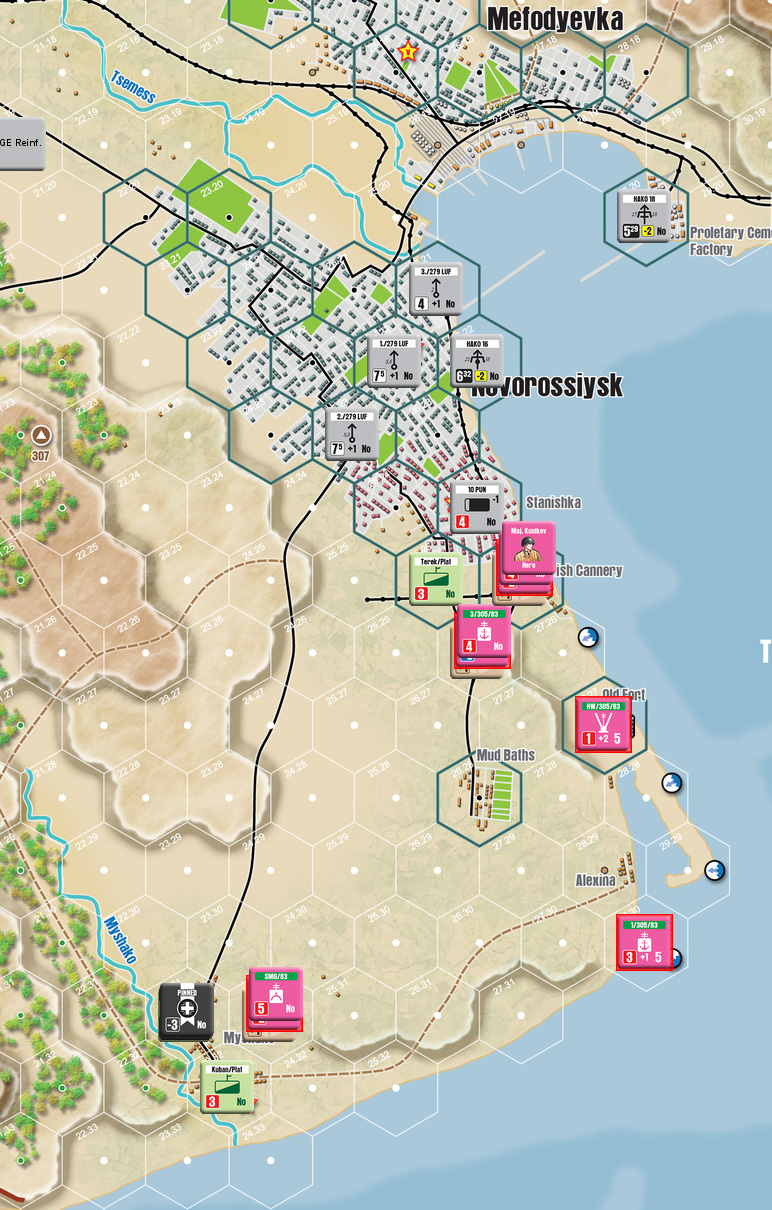
The second chit was the Soviet Marine Division, which allowed further maneuvering and fire, and the shore batteries across the way to put down some barrages. The German Direct Command came up next, and Mark pulled a Romanian unit deeper into the city, while rallying the garrison down at Myshako (both units down there got suppressed). The Soviet Direct Command let me follow the Romanians into Novorossiysk.
For some reason, the 255th Infantry Brigade chit also starts the scenario in the cup, even though there are no units from that formation on board. This was the last chit of the turn, and it waited for dawn (07:00). Originally, CSS did not use the idea of holding the last chit of a turn for the next turn like GTS, but the latest version of the rules puts it back in; it does look like CSS is slowly drifting back towards GTS in some of the non-essential wrinkles. I put the 83 IB back into the cup, and it was the first draw for the new turn, and suppressed a couple units again with 0s. Shortly after that the Soviet Direct Command chit let me go over the 4 disorganization limit and eliminate one of Romanian garrison units in Myshako.
After that, things started grinding to a halt. My main goal was to finish off the second unit down there so I could concentrate on Novorossiysk before reinforcements could arrive (the two places worth VPs in this scenario are Myshako and Stanishka, the south end of Novorossiysk, and where Mark’s line stabilized). The German Direct Command was the last chit to go off in 09:00, and that turn features three German infantry companies arriving to bolster the defense. Thanks to the roads, he was able to move to the front line in the city immediately (with the third unit kept in reserve a couple hexes back).
I finally eliminated the second Romanian defender of Myshako at the start of the 17:00 turn, right before an assault could go in (on the next turn, thanks to final chit draw) and take the victory hex. My next goal was to get some of the high ground before more German reinforcements could show up and threaten to go around my tiny force for the invasion beaches. Some of this had to wait for wind, as the SMG/83 was stuck under a heavy barrage (which has “no” movement).
During Night I, the second wave of the landing arrives, a second formation (255 IB) with another six infantry companies and a couple batteries. (Sadly, no SMG company with extra firepower.) 83 IB was the first chit of the turn, and the SMG company headed north to get some high ground. Then the German Direct Command allowed Busche to start arriving, with the four infantry companies lining up north of the current line in the city. The 255th went right afterwards, and started wrapping around the flank of the German defense. This left me outside the city, but I started digging in for some protection on my Direct Command. Mark inserted the 229 JgR chit at this point (this is the only German formation in the scenario, and belongs to Kampfgruppe Busche; as a minor division formation, it is only used as an interrupt) and started bringing in most of the support equipment.
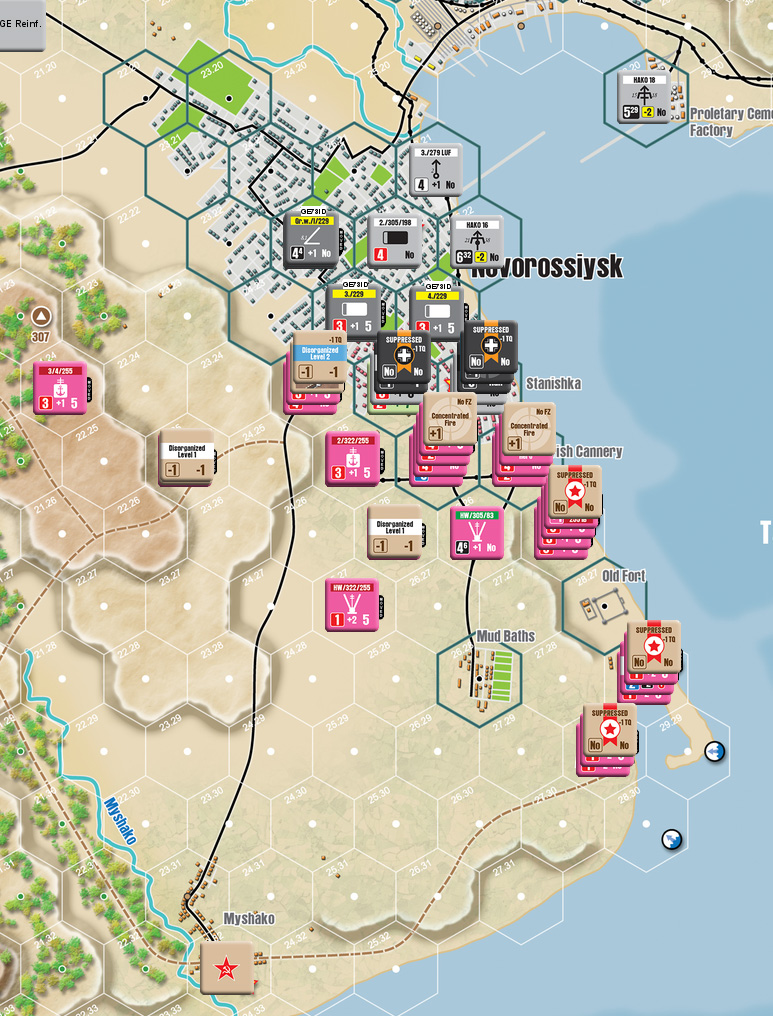
Then an event caused a German assault on the flank of my new line, and I got lucky: my defensive fire was a “0” to suppress and halt one hex, and a better die roll kept me to a one loss difference despite being in the open. However, both of us now had hexes in big trouble (I’d gotten lucky against Stanishka to suppress and get to disorganization 4. Mark had an easier time with my guys in foxholes, and then the assault got them up to 3) as we went to Night II. This brings in the rest of 255th IB, with its leader, HQ, another battery, and a company of Matilda IIs (the main German anti-tank capability are two batteries of 88s….).
Mark managed to get my vulnerable flank up to disorganize 4, and then got a good indirect fire result on the same hex to wipe out my stack, and then he pinned the next stack (still in foxholes in the open). I then started working on my line again. Since the Germans had funneled into defending the city, I didn’t worry as much about controlling the heights, though I did put a unit in the 21.23 observation post, tried to keep the end of my new shorter line alive, and sent units into a more northern sector of the Novorossiysk (24.23). I had also by this point managed to get the new 255th IB units into the positions I was holding, allowing the 83rd IB to concentrate on the south end of the city to boost firepower a little.
All the divisional chits were purchased for the first daylight turn of day 3 (Feb 5), as both sides tried to make gains in the early morning, and finish up the moves from the night. The 83rd was waiting in the cup, and finally scored a kill in Stanishka, but by the time they got another crack at it, disorganization was down to 1, and two new units had shown up (from Busche). This was a pattern we both saw over the next few turns. We could get some effective attacks, and drive disorganization up, but then there’d be a series of enemy chits, and it would drop back down before they could be finished off. I started trying for some assaults to press things home, but generally I’d be under a heavy barrage (no movement) and have to call it off. (The answer to this is to have the formation in reserve for an interrupt right after the wind chit, but I was having to be very sparing with my dispatch points—which the assault declaration also needs.)
Despite some close calls, I managed to keep my flank just barely intact, but I wasn’t really getting anywhere with Staniska. Over in the west of the city, I was taking a lot of punishment from Busche being present (+1 fire), an AT battery (support weapon; +2 fire and change to the better high explosive line), and the 88 battery there (different division, so only fires as a stack with Direct Command, but is a native 7 high explosive). So, I pulled back/north, getting merely adjacent to much less capable units. I put a full stack there, including the Matildas.
I had to cancel another assault from there (heavy barrage), but then declared a new one and one on Stanishka. Wind was the held over chit for that turn (15:00), and 229 JgR went right after to prepare for the coming storm, rallying and suppressing the NW assault stack. Direct Command let me remove that right before the assault went in. The artillery support suppressed the target, so there was no defensive fire, and managed a 17-14 win (after a German reroll)… forcing the stack to disorganize 4 without actually causing casualties.
Afterword
We called the game at that point (with the southern assault yet to go off). I generally seemed to have an advantage, but it was taking forever for it to pay off into actual motion. Thanks to taking the first victory hex, I was leading 11 VPs to 2, and taking Stanishka would be an auto-win, but for that to count you also need to take the adjacent hexes (only two for me to worry about), but clearing three city hexes just wasn’t happening.
Unfortunately, it’s been a little long since I’ve last played GTS, so I can’t do as much comparison as I’d like. Overall, the simplified fire types seems to work well. GTS desperately needs to borrow the “wind” chit into the main system. I don’t entirely know how I feel about the planned assaults, and the interrupt ability; the latter grates against me in a chit pull game (I think I’d want only let a few elite formations do it at all), the former is a trade-off with the quality check that GTS requires (also, the CSS assault procedure is much simpler, and I like it). I think I do like the more limited reaction fire (generally once until the unit activates again, and you can sacrifice that to get +1 firepower), but I’m not expert enough to know how it interacts with all the cup changes. I also approve of the addition of fatigue to the game; it’s a bit easier to send a division activation to the cup, but you’ll wear out the troops if you do it more than a couple times a day. On the other hand, when you have multiple divisions to keep track of, it might get onerous.
The rules need help. Comparing the original TLL rulebook with the series rulebook shows a major improvement, but we still had plenty of questions, and took a couple sessions just getting the basics sorted out. It feels like it was written, and then passed around for comment only with people who already knew how to play the game, so there’s hidden assumptions that are hard to answer. The longest running one was whether or not a “9” is an automatic failure on a rout check (or troop quality check in general, but unlike GTS, they almost never happen outside of rout checks), made important by the number of rout checks that just can’t be failed while in a city (with an extra -3 to the roll). The scenario book has major problems with reinforcements that just don’t make sense, until you realize that the night turns are given the correct calendar date (being that they run from ~11 PM to 7 AM, they are almost entirely in the next day), but the wrong game turn date as Night I and Night II are considered part of the previous day, with the new day starting with the 07:00 turn.
The fact that there’s only single divisions on each side helps keep the scenario simple, though the “attachment” mechanic for the Germans adds a little complication. It’s also a neat idea for having smaller units represented better in the system. However, it does do some odd things to pacing and dispatch points, as the Germans will generally get three per turn (80% chance), but they’ll only spend one per turn on a regular basis (for the KG Busche interrupt) as they can’t afford too many divisional chits (fatigue). Attempting more assaults would be wise (especially as they can always be canceled at “go” time), but the delay on those is likely to be great, and we usually didn’t feel confident enough to be doing those, though I was getting more into them at the end. But Russian points go from adequate to overextended as the scenario goes on and they have more formations to pay for.
The early star of the show was the Marine Division’s SMG/83 unit, which gets a 5 firepower instead of 4, and teamed up with the HMG support weapon (which is another idea potentially worth borrowing) pushed firepower to levels I’m not used to seeing. I don’t know the actual composition of a Soviet SMG company, but unless they were given more LMGs than normal, it seems overrated by CSS’s simplifications. I would assume in GTS, it’d have a small regular firepower, but get a good assault rating, which is a bit more nuanced.
While there’s a lot of play nuances we doubtlessly missed, this set does seem to be geared to static warfare, with a lot of potential wristage. The bigger scenario is geared around a Soviet assault on a fortified line. That’s not as tough as city fighting, but it’s not easy, and the Soviet divisions start at least somewhat worn out. But in city fighting, there’s going to be a lot of attacks that don’t do anything, and rout checks that can’t be failed. Worse, this scenario lends itself to strings of activations for one side so that you can’t react to the disorganization piling up, and then you can’t keep the other side from earning off all of their disorganization.
Discussion ¬