

Forgotten Reams—The Beginning
:strip_icc()/pic517631.jpg) Since playing Neverwinter, I’ve been thinking of the Realms again, and just got through re-reading the original box set I got back in ’87.
Since playing Neverwinter, I’ve been thinking of the Realms again, and just got through re-reading the original box set I got back in ’87.
This served as the introduction to a new setting for the 1st Edition Advanced Dungeons and Dragons game. The box held two 96-page perfect-bound books; one held general geographical and cultural information on the Realms, and the other was oriented to use by Dungeon Masters. Four poster-sized full color maps were included. The maps are completely gridless, instead being illustrative style maps, and a pair of clear plastic sheets were provided with hex grids on them, so that distances could be easily computed and travel figured. While clever, and reused with later sets, I don’t know that anyone used them much in preference to just measuring with a ruler or eyeballing it.
Forgotten Realms was far from the first RPG setting produced, and not even the first from TSR, but it set a new bar in presentation. The two-book, multiple-map box set would be re-used several times by TSR. This is marred by some poor editing with typoes and mistaken word choices abounding and some missing illustrations in the second book. One gets the sense that this was rushed through editing and proofing in a big hurry.
But the real value comes from the Cyclopedia of the Realms (the first book), which lists scores of places in the Realms and gives some description of them. Unlike the earlier Greyhawk set, which tended to be dryly biographical, the Cyclopedia helped instill a sense of the lore and history of the Realms with descriptions that often give a bit of history and some of the important people. While some of the book can go into a bit more detail than a player should probably know, it is still pretty safe for a player to read through, and will not spoil any big secrets that the DM may wish to keep.
The DM’s Sourcebook of the Realms (the second book) is a little more disappointing, with about half the book taken up by descriptions of various spellbooks known to be wandering around the Realms where adventurers might come across them (this is actually a good idea, and helps add some more flavor, especially with the histories provided, but a quarter of the available page count in the introductory product is a bit much). Important sections include two years of ‘rumors and events’ (tavern talk), which help give a sense of recent events and the Realms as a place where things are happening, and fuller descriptions of several NPCs already met in the first book. Rounding it out are some DM advice, and a couple small sample adventures (one merely okay, and one with some real possibilities).
The main pair of maps were given a scale of 90 miles/inch, covering an area perhaps twice as large as the continental United States (as shown in an illo in the DM’s Sourcebook), and was based off of Ed Greenwood’s original map, with a number of changes made to fit in other setting bits from other TSR products. Notably, the Moonshae Isles were greatly enlarged, and probably completely redrawn to fit the novel Darkwalker on Moonshae, which had started as an independent fantasy novel (as did The Crystal Shard, but I don’t think the map changed much to incorporate the Ten Towns), and part of the The Great Glacier was cleared away to place Damara and Vassa from the Bloodstone H-modules. The original map was somewhat bigger than what TSR showed, but it would be some time before TSR got to showing any of that elsewhere. In the meantime, a bit just off the southeast edge was also changed, to incorporate the Desert of Desolation adventure.
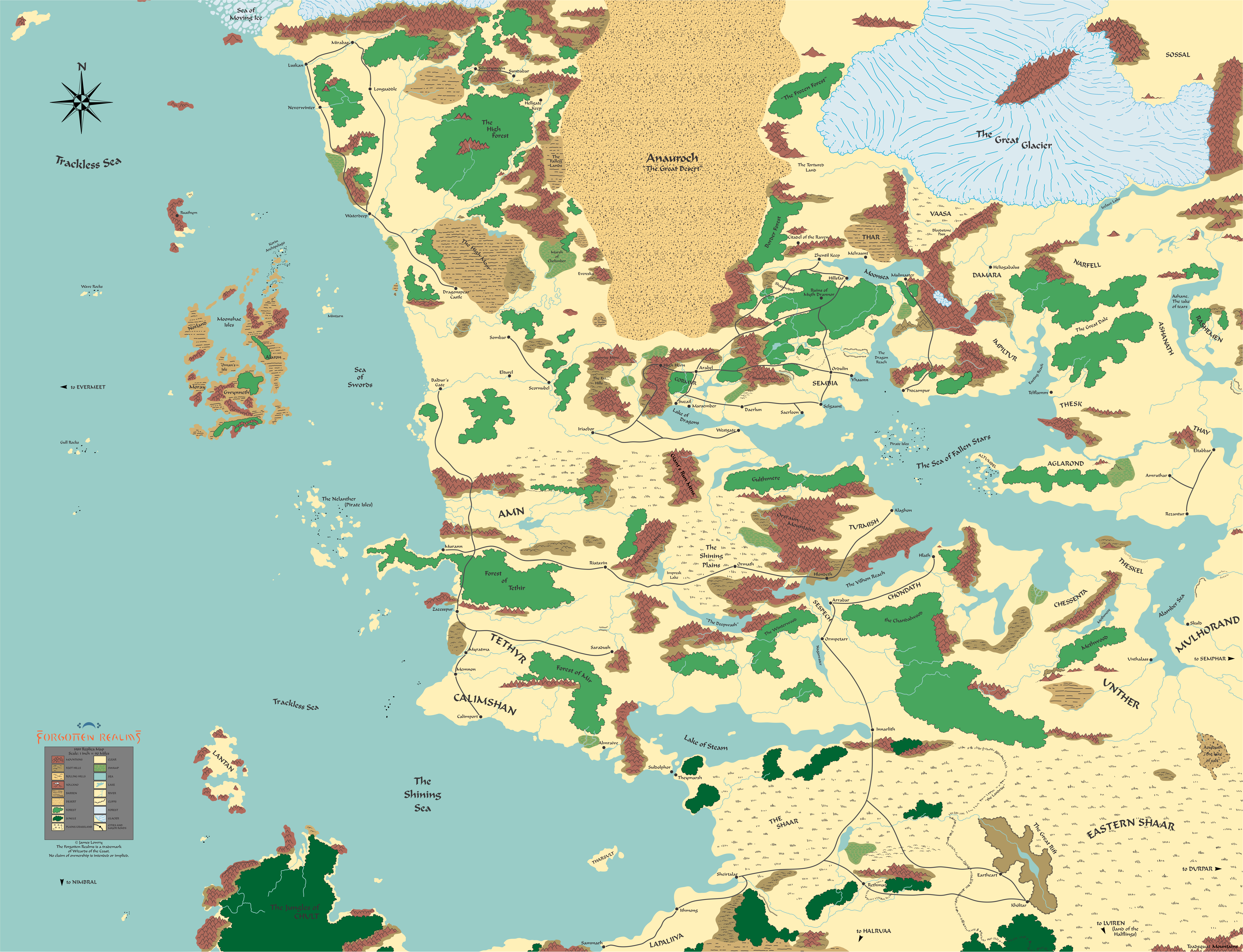
The other pair gave a zoomed-in view of the central Realms at 30 miles/inch, covering from just south of Waterdeep (the center of Ed Greenwood’s first campaign) to the eastern shore of The Dragon Reach. This takes in the entire Sword Coast which has provided the locale for many adventures, and all of Cormyr and the Dales, which was area of Greenwood’s second campaign. This also fit with one of the main conceits of the Cyclopedia, which was that it was written/compiled by Elminster, working in Shadowdale, so entries closer to there are longer and more accurate, detail and accuracy falls off away from there, just as the detail of the maps fades away from the second set.
This let the set be wide ranging without being without detail on anything. It also was an invitation to DMs to add their own details. Start your campaign in some place that Elminster didn’t know much about, and make up your own setting while borrowing from an existing greater tapestry. Or, set it in Cormyr, or the Dales and have lots of backup material from the get go. This “be everything to everyone” sense is part of what made the setting popular. It was a big, living place, and you could see the life, but it didn’t have to be your life. The other major success is Greenwood’s natural inclination as a storyteller. He’d spent the last several years providing fun bits of lore and explanations in Dragon magazine, and this is just a broader stage for him to tell stories in.
Discussion ¬