

The Indian Mutiny
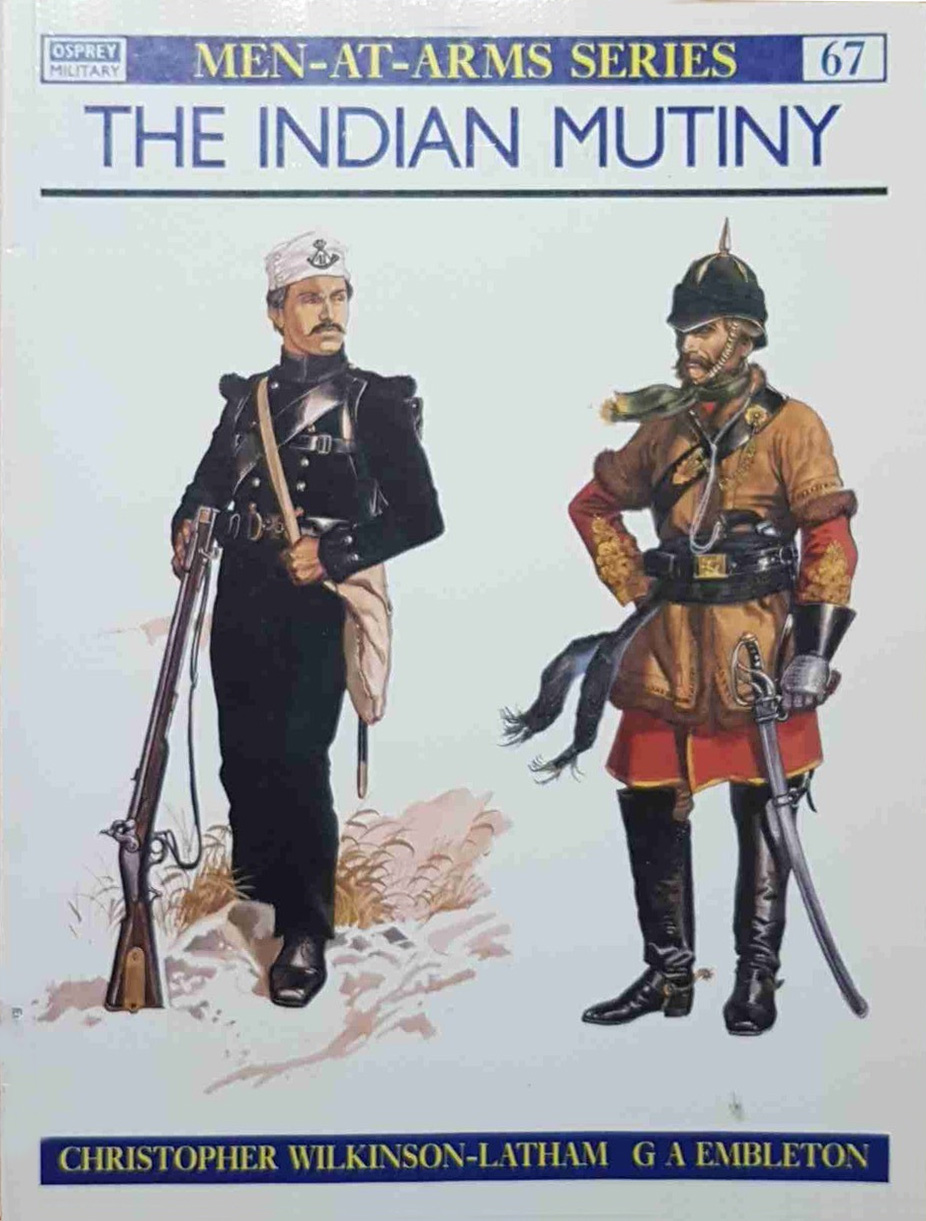 This is an older Osprey Men at Arms book, and has a few characteristics related to a 1977 release.
First, it is something of a light guide to the history of the Mutiny. This would be better in an Essential History (which they did in 2002), but at this stage many MAA books were light histories, instead of being more specialized on the troops.
The color plates are early Gary Embleton, in the older ‘fashion plate’ style with just some hints of background. For what they are, they’re fairly good, and the usual good description giving all the details of equipment types, sources, etc., and there’s a small box giving the facing (detail) colors for all the native regiments. There are seventeen black-and-white photographs reproduced, some of prominent people, but mostly showing troops in actual dress, and a couple of locations. There’s a good amount of period art reproduced in B/W as well, which is also handy, and all of it shows fairly well for 1970s reproductions. There are also maps of Delhi, Cawnpore, and Lucknow.
The main text is pretty much “the Indian Mutiny in four sieges”. The introductory section goes into the rising tensions of the mid-1850s, but avoids any easy answers as to the actual cause of the Mutiny. Then we get a section on Meerut, where the crisis begins, and the mutinying troops move to Delhi, which is naturally the second section. This is the biggest section, and then there’s sections for Lucknow and Cawnpore, the latter of which gets a couple paragraphs to wrap things up.
Overall, it is by no means a bad history, especially for the page count. Neither is it truly a good nor sufficient one. It is almost entirely looking at the British side, and does not get into any of the weeds of causes, blame, or even what the Mutiny hoped to do. It covers the central actions well enough, which for an early MAA title is to be expected. But much more is needed. On the arms and equipment side, I would expect that Men-At-Arms 268, The British Troops in the Indian Mutiny 1857-59, would be a superior replacement.
Discussion ¬