Rindis.com

All my hobbies, all the time
  • Home
  • My Blog
  • Games
  • History

Categories

  • Books (503)
  • Comics (10)
  • Gaming (917)
    • Boardgaming (673)
      • ASL (154)
      • CC:Ancients (83)
      • F&E (78)
        • BvR – The Wind (26)
        • Four Vassal War (9)
        • Konya wa Hurricane (17)
        • Second Wind (5)
      • SFB (78)
    • Computer games (162)
      • MMO (77)
    • Design and Effect (6)
    • RPGs (66)
      • D&D (25)
        • O2 Blade of Vengeance (3)
      • GURPS (32)
  • History (10)
  • Life (82)
    • Conventions (9)
  • News (29)
  • Technology (6)
  • Video (49)
    • Anime (47)
  • Writing (1)

Patreon

Support Rindis.com on Patreon!
Become a patron at Patreon!

Other blogs:

RSS Inside GMT

  • Foxes and Lions (Part 3): Military Matters, Captains, and Condottieri June 12, 2026

RSS Playing at the World

  • Playing at the World 2E V2 Arrives May 5, 2025

RSS Dyson’s Dodecahedron

  • Cyberstyle 8.5 June 13, 2026

RSS Quest for Fun!

  • The Expense Post May 24, 2026

RSS Bruce Heard and New Stories

  • Pain, Exhaustion, and Morale in D&D BECMI June 7, 2026

RSS Chicago Wargamer

  • The 2 Half-Squads - Episode 310: Cruising Through Crucible of Steel January 27, 2023

RSS CRRPG Addict

  • The Search for Freedom: Undistinguished Destruction June 13, 2026
SF&F blogs:

RSS Fantasy Cafe

  • The Leaning Pile of Books May 24, 2026

RSS Lynn’s Book Blog

  • Booking Ahead/Weekly Wrap Up June 14, 2026
ASL blogs:

RSS Sitrep

  • Cardinal ASL Sins March 18, 2026

RSS Hong Kong Wargamer

  • FT114 Yellow Extract After Action Report (AAR) Advanced Squad Leader scenario April 16, 2025

RSS Hex and Violence

  • This still exists? March 25, 2025

RSS Grumble Jones

  • AAR Slides for Schwerpunkt SP96 Husum Hotfoot June 5, 2026

RSS Desperation Morale

  • How to Learn ASL March 16, 2025

RSS Banzai!!

  • October North Texas Gameday October 21, 2019

RSS A Room Without a LOS

  • [Crossing the Moro CG] T=0902 -- Rough start July 18, 2015
GURPS blogs:

RSS Dungeon Fantastic

  • GURPS DF Session 224, Felltower 141 - Second GFS exploration June 15, 2026

RSS Gaming Ballistic

  • B-Scale: Damage That Scales from Tardigrades to Kaiju June 5, 2026

RSS Ravens N’ Pennies

RSS Let’s GURPS

  • Review: GURPS Realm Management March 29, 2021

RSS No School Grognard

  • It came from the GURPS forums: Low-Tech armor and fire damage January 29, 2018

RSS The Collaborative Gamer

  • Thoughts on a Town Adventures System January 18, 2022

RSS Don’t Forget Your Boots

  • GURPS Supers Newport Academy #6: “Old Friends, New Again” June 7, 2026

RSS Orbs and Balrogs

  • Bretwalda - Daggers of Oxenaforda pt.4 - Fallen King May 27, 2017

Expansion of Gold

by Rindis on August 18, 2020 at 12:00 pm
Posted In: Computer games

This is the fifth in a series of reviews looking at the evolution of Europa Universalis IV. See the previous reviews here:
Europa Universalis IV: A Fantastic Point of View
Wealth of Nations: National Trade
Res Publica: A Tradition of the People
Art of War: Reform-Minded Patch

Paradox went back to the New World for the fifth expansion to EU IV. Instead of the North American focus of Conquest of Paradise, the new one, El Dorado, would focus on Mesoamerica and South America, and it would re-work exploration instead of settlement.

It was released on February 26th, 2015, alongside patch 1.10, and patch 1.11 followed on March 8, along with the free “Women in History” DLC.

Exploration
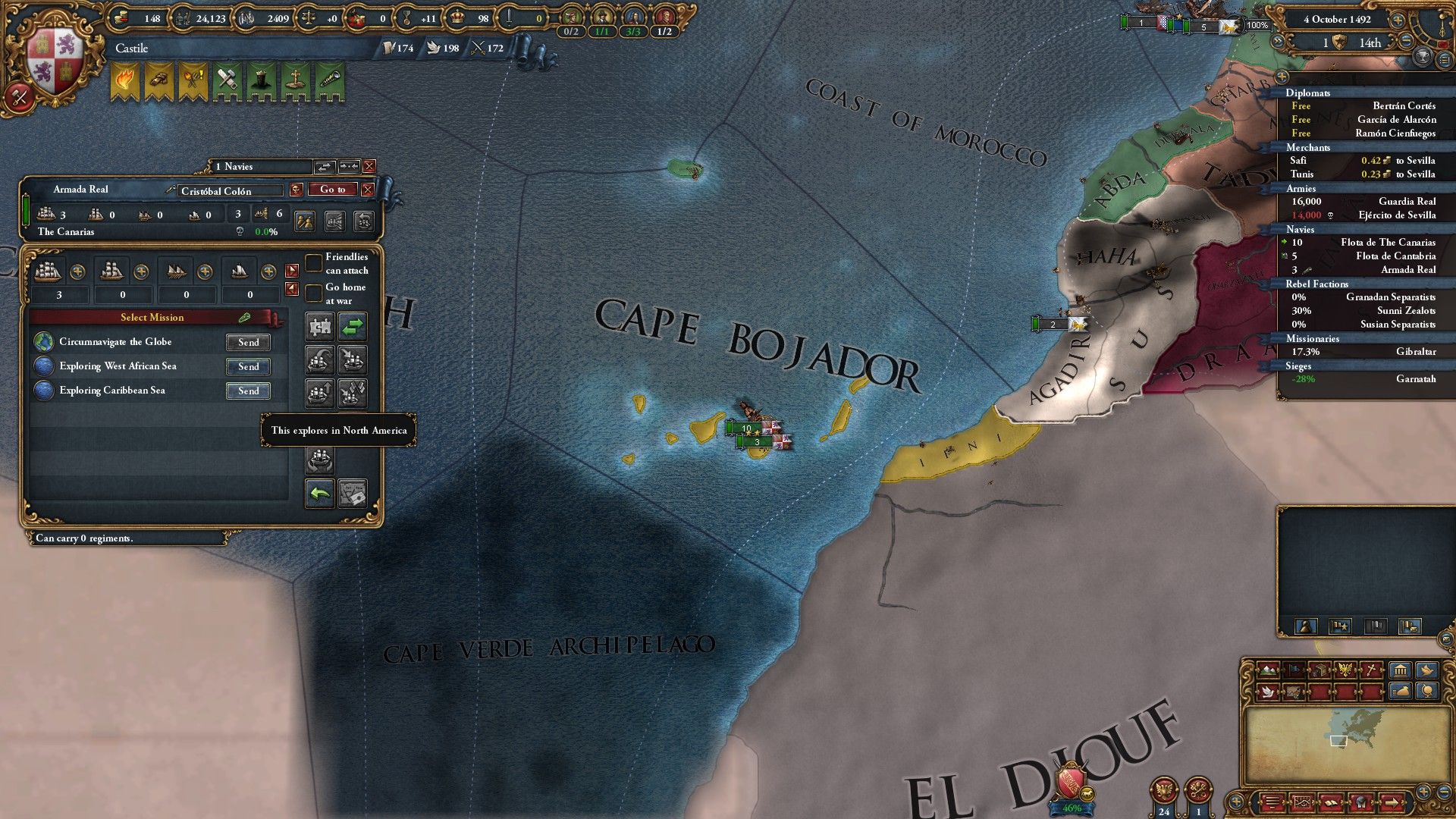
With a focus on the New World, exploration mechanics were re-worked for the expansion. Without El Dorado, it still works the same; get Quest for the New World, hire explorers and conquistadors (instead of admirals and generals), and have them command forces that can slowly uncover new areas.

With the expansion, you never ‘explore’ just by walking into terra incognita (outside of ways that everyone can always do it; notably marching around the interior of a country you’re at war with). Instead, you assign explorers and conquistadors to exploration missions.

An explorer will get options to explore the ‘waters of x’, which will send out his fleet to uncover all the sea zones of a region. Once at least some of these are known, he can ‘chart the coast’ of that region, which will uncover all the coastal provinces there.

These require a fleet of at least three light or heavy warships to do, and once one of these missions is started, it cannot be recalled (you do get a notice when it comes back home). So a lot of control is taken away, and as these only work within your colonial range, it might be difficult to target the area you want. But it takes a lot of micromanagement out, and the ships do not suffer attrition while on these missions (unless the explorer dies, at which point there might be very high attrition on a fleet a long way from home).

Conquistadors can go exploring on their own, which works pretty much like the usual auto-explore command in any game, though the army will halt to rest and replenish troops if too many are lost to combat against native populations.

And finally, explorers can attempt to circumnavigate the world. This takes a slightly higher tech level, and the fleet will take normal attrition. However, the first nation to complete the mission gets 100 prestige, with other nations getting 10 if they do it later.

All of these missions have extra events attached to them, especially the conquistadors. Their auto-explore is actually hunting for the seven cities of gold, and in addition to to the normal dealing with the natives, getting lost, and other exploration events, they may find clues and actually try to find one of the legends of the New World, with a (small) chance of succeeding.

A final note is that a country that builds up a colonial nation first gets a ‘claim’ on all the provinces of that region. Well, assuming you’re Catholic, and only other Catholic nations will care. It’s meant to represent the effects of the Treaty of Tordesillas. Generally, the AI will abide by these claims, and violating them causes relations penalties; though conquering territory from native nations is still fair game.

Religion
With more attention on the New World, three new religions were added: Nahuatl, Mayan, and Inti, displacing some of the generic Animist religion that had been used. They have bonuses roughly similar to Animism, and that’s it.

Unless you have El Dorado, in which case they all have similar enhanced mechanics. Notably, they all have five reforms they can pass for fairly good bonuses. Passing one is difficult, and resets everything that was needed to pass it. For instance, a Nahuatl country needs five vassals, and positive stability to pass a reform, but doing so lowers stability and releases all the vassals. Once all five are passed, the religion as a whole can be reformed (if there’s a Western nation on its border), which will basically ‘Westernize’ the country, bringing its tech level up as is done for other methods. Each one also has a unique extra mechanic:

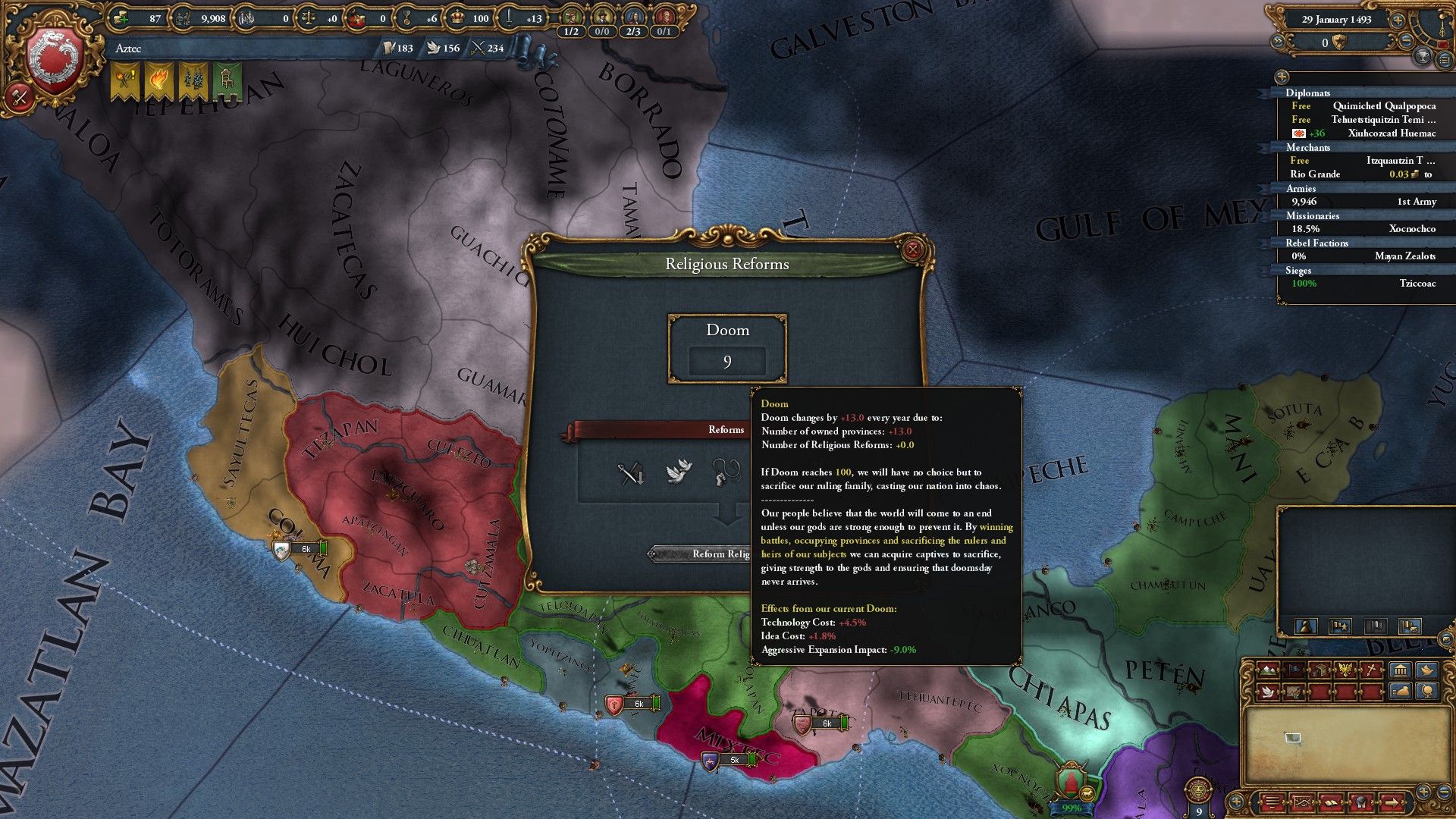
Nahuatl has Doom, representing the Aztec belief in a series of sacrifices to empower the gods to keep the world from ending. Doom is a counter that slowly goes up, technologies and ideas become more expensive, and at 100, the royal family is sacrificed, eliminating the current ruler and heir in favor of a new 0/0/0 monarch. Large battles and sacrificing monarchs can reduce Doom.

Mayans don’t have an overt mechanic, but have to (directly) control 20 provinces to pass a reform. Doing so splits up the country, releasing nations, or transferring provinces to other bordering nations.

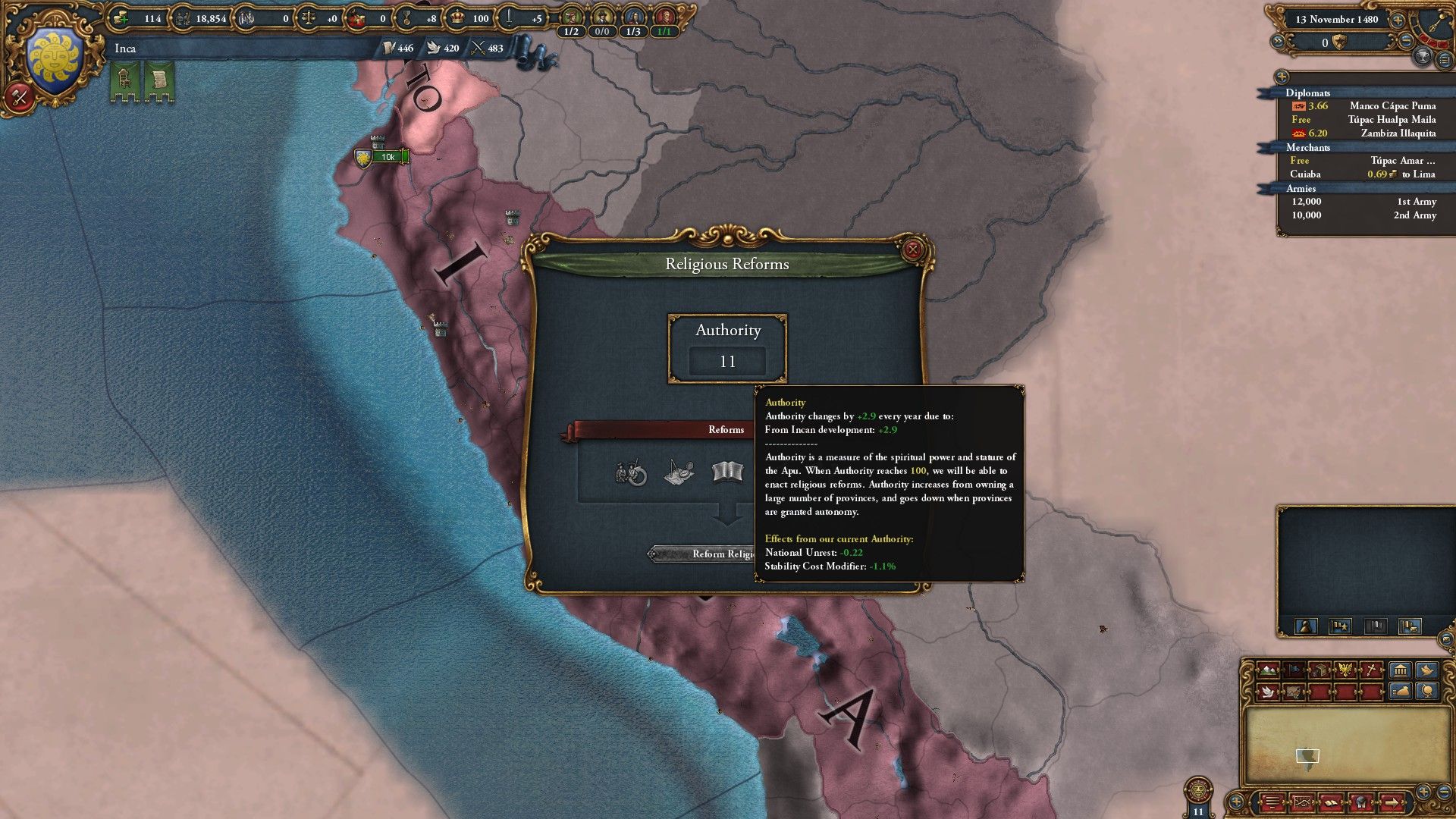
Inti has Authority, representing the current power of the Sapa Inca worshiped as a god. Authority is gained from having a large, prosperous nation, and decreases stability cost and unrest. Once it hits 100, a reform can be passed… which lowers Authority to 0, and starts a civil war with pretender rebels.

All three are neat ideas, and are guaranteed to cause instability in the region, especially in Mesoamerica, where the competing states won’t just conquer each other as they specifically need vassals. And naturally, someone has to lose, and since each Nahuatl nation has its own Doom counter (a universal one might be a little more reasonable), sacrifices of reigning monarchs are common.

Liberty Desire

The colonial nations introduced with Conquest of Paradise had a new stat, liberty desire. As of patch 1.10, all vassal nations now use this. Originally, it was just to allow for colonial revolutions, but now any sufficiently unhappy vassal state can rebel. Since one of of the modifiers for this score is just how powerful all the subjects of a nation are (taken together), it’s also a serious brake on just establishing a handful of powerful vassals, who will then act as a buffer against all the other powers, while you concentrate on one or two things.

Below 50% liberty desire, a vassal is loyal, and will act as vassal states always have in the series; always joining wars with the leading nation, and being a good little servant. Over 50%, and they are disloyal, which causes them to stop paying taxes, and only defend themselves in wars. Also, other countries can promise to support their independence. At 100%, the nation is rebellious, and will actively seek opportunities to successfully rebel.

Trade & Treasure Fleets
Trade came in for another round of tweaks, with some general rework of inland trade power. Also, colonial nations now generate an extra merchant for their parent country if they’re large enough (10 provinces). These can be used anywhere, but the obvious intent is to put them into New World trade centers to steer the trade to your own European trade centers for collection.

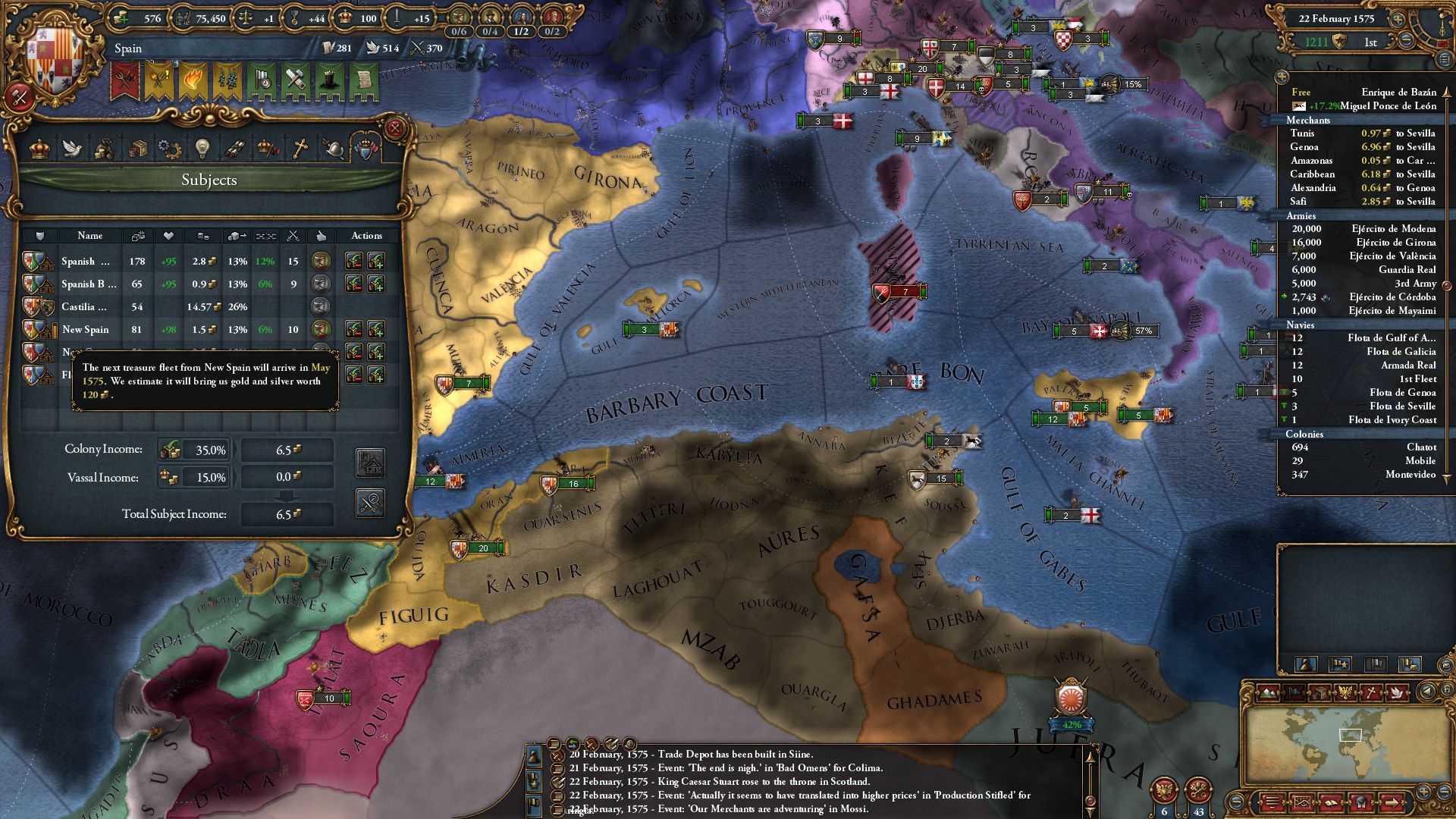
With the expansion, treasure fleets were added to the game. Sort of. Colonial nations with gold-producing provinces now store up gold and send it home as one big lump sum. It technically travels down the trade routes to the overlord’s trade capital, and it can be intercepted by privateers, who will whittle away at the amount of gold depending on their trade power in the nodes it goes through.

Once it arrives, the receiving nation gets the money, and inflation, as if they’d gotten it in a peace deal. With them coming in regularly, it can really start causing real inflation problems, instead of the more usual modest problems from gold provinces. Overall, it’s a neat idea, and the use of privateers is good, but it’s not obvious to anyone but the receiving nation that anything’s happening. And of course, since it’s not really on the map, they can’t be directly captured or disrupted by an enemy nation in a war.

Nation Designer

Another addition of the expansion is a custom nation designer. You choose a capital province, and then build out a nation from there, including the territory, culture, religion, traditions, etc. This all uses up a budget of points, which can be set to nearly any level. There’s achievements connected with it that all have a set budget to use, but more usefully, everyone in a multiplayer game can be set to get the same number of points, and then create ‘equivalent’ nations to play with.

I haven’t really used it, but the interface for it is pretty good.

Women in History

This was a free DLC that automatically gets downloaded as part of the Steam copy of EU IV, though it could be disabled in the launcher. Mostly, it adds events for countries to get historically prominent women as possible advisors. This also means that female portraits for all advisor types were also added, and they can, very occasionally, show up without the specific events.

It’s a nice bit of adding a bit of awareness of how much women have added to history, and not even so much in the background. I’m not quite sure why Paradox did it as a DLC instead of adding it straight to the game files; presumably so it would be easier to talk about the fact that they did do it. At any rate, I will say it feels a little odd, because its mostly fixed people at a fixed time, which gets back to the acting out history style of the first two games of the series.

Conclusion

For some, the Nation Designer is the headline feature, and reason enough to get the expansion. I don’t care for things like that (if I had a particular alternate-history to explore, maybe, but then I’d need to adjust more than one nation), so I pretty much ignore it.

As far as filling out the New World, I like it a lot better than CoP. The new religion mechanics are interesting (well, Maya not so much), and make the dynamics of the Aztecs in particular much more in line with history. Exploration is a mixed bag, seemingly taking some of the wonder out as explorers do things on their own, but taking micromanagement out with it, with all the attrition-watching that was needed, is overall worth it. If you get lots of colonial nations the number of extra merchants gets out of hand, but a few extras are a great boon for steering trade from your colonies to your home port.

The main patch is mostly notable for the rework of vassal relations, which gives that system a lot more character, and I think it was really needed. On the other hand, it saw the second rework of inland trade nodes, and this one was way too heavy handed with a flat extra 50 trade power or not.

Overall, the game improved again, and the free Women in History DLC is a nice addition. Assuming you’re not interested in the Nation Designer, I give El Dorado a limited recommendation: it won’t do much if you’re not exploring, and it’s a good, but not essential, addition if you are.

└ Tags: EU IV, Europa Universalis, gaming, Paradox, review
1 Comment

Reform-Minded Patch

by Rindis on June 11, 2020 at 12:00 pm
Posted In: Computer games

This is the fourth in a series of reviews looking at the evolution of Europa Universalis IV. See the previous reviews here:
Europa Universalis IV: A Fantastic Point of View
Wealth of Nations: National Trade
Res Publica: A Tradition of the People

After Res Publica, a fairly small update and expansion, Paradox scheduled a larger expansion, and the biggest overhaul to EU IV yet. Art of War concentrated on warfare, with new events and mechanics for the Thirty Years War and the Napoleonic period. It was released with patch 1.8 on October 30, 2014, which included some massive overhauls of major mechanics in the game.

Patch 1.9 was a major patch with no accompanying expansion (this every-other major patch pattern became the general procedure for EU IV) that was released on December 19th, and did more re-works of the game. This review looks at both patches and the expansion.

Country Update

While different, the EU IV world map was naturally based on EU III’s, and was more detailed in Europe than anywhere else. Patch 1.8 increased the number of provinces by about half, and added a large number of new nations in all corners of the world. Some of these are only ‘potential’ countries; ones that can exist only by revolt or being released by a larger country, but many represent smaller nations that couldn’t be represented on the old map, or just better research on an area.

In addition, a number of new tradition sets were created, mostly for sets of these new countries, but overall the variety and individuality increased substantially. Finally, more dynamic historical events were added for all sorts of countries, enhancing that system overall.

Patch 1.9 then added the idea of disasters. There were a number of large-scale bad events that could affect a country, seemingly randomly. Now, they were surfaced to the user, making the game a bit more controllable, and feeding into the feel of this iteration being a game. Generally, all countries are eligible for the ‘peasant revolt’ (low manpower and stability) and ‘civil war’ (low legitimacy), while some countries have special ones (England can have the War of the Roses and the English Civil War disasters).

When the preconditions for a disaster are met, the clock starts ticking down to it. If the conditions go away, then the disaster stops, otherwise it fires once the clock ends. Peasant Wars have always been a more common one (especially for the AI), and as an example, force stability to -3, cause additional unrest, make stability more expensive, and creates a couple peasant armies for an immediate problem while the unrest and negative stability cause more.

This is one place where I feel too much is being surfaced to the user, as these are the types of events that, at best, are only obvious in retrospect. That said, getting stuck in a poor position, and watching the clock tick to an even bigger problem certainly does add its own brand of tension to the game.

Revolt & Unrest

Speaking of revolts, those changed too. The province-by-province check for revolts every month, that had existed since the original game was replaced by unrest. This is pretty much figured the exact same way, but it does not cause revolts in itself.

Instead, the province’s prominent revolt type is figured (independence, religious, pretender king, etc.), and all the provinces with a positive unrest towards that particular type add together for a chance of progressing a revolt. Then that is checked each month, and when it does come up, that revolt gets 10% progress, which is displayed in a few places. Once progress hits 100%, then an actual revolt happens with a decent army or two.

This makes revolts something of a ‘mini-disaster’, where you can see the problem coming from some time off. The listing of factions will even tell you, on average, how long it will take a revolt to occur based on current unrest and progress. If an in-progress revolt loses all support (i.e., the respective provinces go to negative unrest), it will lose 10% progress each month until it goes away, so solving a problem for a month or two will set it back, but not instantly get rid of it.

A final adjustment is that revolts that start on an island have been a very small problem as they can’t spread, and take control of more territory. Now a revolt that has control of everything it can reach will automatically try to move to a non-connected nearby province, without needing sea movement or anything, just a decent amount of time.

Autonomy and Clients

One of the things revolt risk did was cause lower taxes and recruiting, as the population was resisting the government’s efforts. This did not get taken over by unrest, and instead these factors are now reduced by autonomy.

Autonomy is a new measure of how much attention a province is paying to the central government expressed as a percentage; manpower and income from the province are both reduced by the amount of autonomy, which generally goes down a little each month while the country is at peace, and the later government forms tend to have bonuses to autonomy reduction.

Naturally, newly conquered territory will have fairly high autonomy to start with, though reconquering core areas and inheriting in a union will result in minimal, if any, autonomy. The big thing is that you can also raise or lower autonomy in an area, which will lower or raise unrest in the province. So, take a new province, raise autonomy, which reduces unrest, and then peace will eventually bring autonomy back down again. Or, lower autonomy to exploit a rich province, and garrison the area to put down any revolts that crop up.

Also, releasing independent nations has always been a way of splitting off troublesome areas, or creating a buffer. But, it requires an appropriate possible nation in the area, and that may include areas you don’t wish to let go of. With AoW active, custom client states become possible in the late game (emulating Napoleon’s many reorganizations of the map of Europe). They’re set to be fairly loyal, and get their own traditions, in addition to their territory and name being entirely at the whim of the creating nation (well, the territory has to be contiguous).

Wars of Reformation

The Reformation came in for its own major overhaul. Generally, events would fire to randomly convert provinces to Protestant or Reformed, causing chaos and potentially making conversion a smart idea for smaller central European states.

With the new patch, instead there would be centers of reformation that would actively try to convert other provinces nearby, going for more of a proselytizing model. This makes the entire process much less random, and ensures that anyone near one of these centers will have to deal with the problem for some time to come.

Generally, three centers show up for the Protestants, and then another three for Reformed (with the first of each as an event, and the other two being ‘rewards’ for the first countries to convert to the new religion). The process can be stopped, by conquering the province and converting it (which will destroy the center), but that’s not easy either.

AoW also introduced religious leagues. These are coalitions that form to enforce, or change, the religion of the Holy Roman Empire. To start with, the Emperor must be Catholic; but there’s no restrictions on the electors, and if one of them goes Protestant, then he automatically forms the Protestant League, which can declare war on the emperor to force the official religion of the HRE to change. Once started, anyone (regardless of religion) can join the leagues, but religious tension is what starts them.

Liberty, Equality, Fraternity

Along with the Thirty Years War, the French Revolution came in for some serious attention. The Revolution was of course one of the major points of events in the original two games, In III, there had been the separate Revolutionary Republic and Empire government types, which had event chains as pre-requisites for them, and some very powerful bonuses, along with plenty of events to make sure that such a government would end up at war with most of the rest of Europe.

Now, a Revolution disaster was added which could happen to any European country that was in dire straights in the late 18th Century, making them the revolutionary target (France gets a customized French Revolution disaster). The lead ‘unhappy’ country gets to be the target of the events that bring about the revolution, changing the government to Revolutionary Republic, and changing the national symbol to a tricolor (many countries have the colors defined, and the rest get random colors picked for them).

Of course, all the relations problems of the old system are kept here, with the Revolutionary government getting a casus belli to ‘spread the revolution’, while everyone else gets reactionary modifiers to put the anti-monarchist upstarts down.

Naval Affairs

Art of War had a few tweaks for the military, the biggest one being the ability to just upgrade ships to modern types with a single click. You still pay the standard construction cost, and the ships are reset to minimum morale and durability, but it’s instant, and saves all the trouble of retiring old ships to stay under your naval limit while building the new ones.

Even better (and really needed), the expansion allows the ability to mothball fleets. Generally, it was common to set naval maintenance to minimum during peacetime in previous EU games. This can save a fair amount of money, and you don’t generally need the morale while at peace. Except now, trade protection with light ships suffers with lower maintenance, so mercantile nations can’t afford to do that (and possibly still can’t afford a regular fleet). Mothballing basically sets maintenance to minimum for selected fleets, so your light ships can still do their thing (along with any anti-pirate patrols you end up needing), allowing big ship and galley navies to not strangle the economy any more.

A final option is the ability to sell surplus ships to other powers, though I’ll admit I haven’t played around with it, and don’t know how eager the AI is to take your old castoffs. Also, as part of the big map expansion, trade was reworked with a more stable pricing scheme, and three new trade items were added.

A final naval convenience is that transporting armies was made simpler in the expansion. If you give an army an order to march across a body of water, the game will now ask if you want to use your transports automatically. And then it will send them out, pick up your troops (automatically dividing the army if it’s bigger than the transport fleet), and ferry them over. It’s not perfect, as it’ll try to do this when the waters are contested, and you need to ‘sneak’ across away from patrolling enemy fleets, but it’s a big convenience when it can be used.

Conclusion

Just in terms of the patch, 1.8 was a great improvement for EU IV. The new Reformation mechanics feel a lot more natural, and let you see whether or not you’re likely to be in the path of religious controversy. The new revolt mechanics aren’t as dramatic, but affect you no matter when/where you play the game as, and was just the beginning of PDS re-thinking core mechanics that had been there from the beginning. EU IV changed a lot of things in the interests of a better game, and this showed that the process hadn’t stopped.

The new map of course added a lot of content. If you’re stuck in Western Europe, you won’t see the changes, but everywhere else saw some major changes, and loads of new nations (and potential nations), adding even more life away from the ‘bright center’ of the game’s roots. The amount of work to update the timeline files for all the extra provinces and counties must have been massive. As much as I say I’m not a fan of patch 1.9’s disasters, they are in line with the rest of the features of EU IV, and I can’t really complain.

The expansion is also big, with a lot of nice things in it, though the out-of-expansion changes are still big enough to get all the top billing. Much of it is paying for convenience, and despite the features, nothing is really essential. It certainly makes you happy to be able to just automatically ferry troops, or any of a half-dozen other things. Content-wise there’s also a lot in the events, but they’re hard to pick up on. So there’s no one ‘get this now’ feature, and I only recommend this to dedicated players.

└ Tags: EU IV, Europa Universalis, gaming, Paradox, review
 Comment 

A Tradition of the People

by Rindis on April 10, 2020 at 12:00 pm
Posted In: Computer games

This is the third in a series of reviews looking at the evolution of Europa Universalis IV. See the previous reviews here:
Europa Universalis IV: A Fantastic Point of View
Wealth of Nations: National Trade

During development of Wealth of Nations, PDS had mentioned merchant republics as being too small and vulnerable, even though they tended to be fairly small and long-lived in history. So the next project was considered a ‘mini-expansion’ and focused on republics in general. Res Publica was released on July 16th, 2014, alongside patch 1.7 for a minimal $5 (most expansions are $15, and ‘small’ ones are $10).

Getting Ahead in the World

One important patch change was a reverse in direction. Like in previous games, being behind your neighbors (or just other members of your tech group) in technology grants a bonus to your progress. Whereas before it had been a bonus to budgetary investment per country and tech, in EU IV it is a reduction in power cost from the most advanced neighbor you have.

This was initially a 5% (30 power) decrease in cost per level, but in patch 1.6 this was decreased to 2.5%. In patch 1.7, it was changed back to 5%, the maximum possible bonus was increased (though it’s really hard to get past the old limit), and the worst tech group penalties were removed. Various Far Eastern and African groups actually had penalties to power generation, effectively lowering their base 3 power per group, and these were removed to give everyone the same overall power generation, though non-Western countries still pay more for technology.

The idea had been to discourage lagging behind in technology for the cost bonus by reducing that, but now, they rewarded staying on top of technology. Any time the next Administrative or Diplomatic technology would be ‘ahead of time’ (each level has a target year, and it is more expensive before that point), you get a +20% to production or trade efficiency, giving a nice boost to income for keeping up with your studies.

An extra addition to the patch were three new idea groups (one per category). This also meant adding new policies for all the new combinations, and brought the number of choices up to seven per category.

Focus, Pinkie, Focus

The most useful expansion feature isn’t republic related: With the expansion, you gain the ability to set a national focus. This is done from the main Monarch Power display on the government tab. Activating one gives you two extra power points per month in the chosen field, while you gain one less in the other two.

It’s a nice bit of flexibility, and kind of a shame that it’s not in the base game, as there are times when one area is starved for points (especially Administration), while the others are doing well. The cost is that it can only be done every 20 years, but some countries will start focused, and are ready to change or remove focus from the start.

Factions

The idea of the faction system for Ming China from EU III: Divine Wind had been retained, but the principles changed a bunch. There were still three factions, and now they were tied directly to the three power types of the government. However, factions no longer prevented you from being able to do things. Instead, they each give two bonuses and one penalty.

Unlike before, faction influence isn’t subject to large shifts due to ruler ability and domestic policies (which no longer exist), but the military faction gains influence from army tradition, and the diplomatic faction gains influence from navy tradition, while the administrative faction gains influence from stability. In addition, you can spend monarch power to give influence to a particular faction.

Patch 1.7 reworked this so that factions are associated with particular government types (for modding purposes), and added factions to merchant republics. These are of course different from China’s factions, granting bonuses around goods, and trade instead of extra advisors and diplomatic reputation.

Republics

As briefly mentioned in the main review, republics have republican tradition. This is a measure of confidence in the government, and replaces legitimacy for monarchies. It is a more limited mechanic, with fewer things affecting it (though there are a number of events that directly touch it), and only a couple things that it affects.

The primary effect is that not being at full legitimacy increases stability cost. High tradition also reduces overall revolt risk, with the same maximum of legitimacy (-2%), but at minimum tradition, there is only an elimination of that bonus, instead of it swinging all the way to the +2% penalty that a monarchy has to deal with.

Republics generally elect (player choice) a new president every four years, with the base stats being one point each in two categories, and four in the one that he focuses in. Re-electing the previous president boosts him by +1 in each category (e.g., becomes 5/2/2 depending on his initial focus), but reduces tradition by 10. Tradition generally increases by +1 per year, so constantly increasing the stats of one president leads to an erosion of six points per election.…

There are, of course, events that give a choice between tradition, and losing money and the like, so the path of a stable democracy can be rocky. On the other hand, there can be stability-boosting events at a cost of tradition, and that’s a pretty good deal if you can afford it.

If tradition gets and stays very low, a republic can turn into a Despotic Monarchy. With the Res Publica expansion, this will instead be the unique Republican Dictatorship government, which will last until the current dictator dies. At that point, it’ll either go over to Despotic Monarchy, or if tradition is back up (probably through events, as it doesn’t raise on its own at this point) it goes back to the previous republic form.

Merchant Republics

An extra bonus for Merchant Republics in the expansion is that they can now create trade posts. These generate a bonus to trade power and naval force limits, with a limit of one per trade node, but must be ‘built’ in an owned province that isn’t in the country’s main node. However, despite what it seems, it’s not considered a building, and only costs Administration power (no money) to build, and is buried away in the trade section of the main province interface (though the existence of one does show up in the trade map mode with all the other modifiers).

This gives merchant republics a reason to develop a network of far-flung territories. Better yet, they continue working if the governmental form changes, but of course, there can’t be any new ones at that point.

Dutch Republic

As something of a follow up to the previous expansion, the Netherlands got more customization with this one. They can now choose (through event) to take the unique Dutch republic government form.

This gives them a slider, showing the relative power of the Statists and the Orangists. This shifts with every election (and, of course, events), and with the Orangists in power, the ruler rules for life, but doesn’t cause the republic to fall (though it will cause tradition to stop growing), and there is another election on his death (and events might kick them out of power). Statists act like a normal republic, though the Netherlands can always have royal marriages with other countries no matter who is in charge.

The primary government bonuses are to trade and heavy ships, the Statists will boost naval capacity and trade power, while the Orangists boost army capacity and stability.

As with most of the unique governments, it’s a fairly flexible form, and the bonuses are certainly good compared to early-game governments, and competitive with later ones.

Elective Monarchy

In 1444, Poland is leaderless, with a 0/0/0 interregnum, that can be solved in a few ways. The easy (and historical) one is to form a personal union with Lithuania, becoming the leading partner with Lithuania’s Kasimierez Jagiellon as the head of the monarchy. With the expansion, this will then fire an event to change the government type to the unique elective monarchy.

On the surface, this is a fairly good government, with bonuses to manpower, revolt risk, and vassals (which Poland starts with two of, plus Lithuania). On the other hand, the succession gets… complicated.

As the nobles vote for who succeeds to the throne, they are vulnerable to outside influences. Other countries can use a diplomat to canvas for a successor from their dynasty. Each month the diplomat is kept on the job there is a small chance of picking up a vote for that country’s candidate. You can spend legitimacy to gain votes for the Polish candidate, which should make it fairly easy to guarantee a native king given the scale of the voting, but there are events that seem to fire fairly often that will reduce his votes.

As a country that successfully supports its candidate, you get prestige, very good relations with Poland (a temporary +100 boost, as well as the normal +25 ‘same dynasty’ modifier), and a good amount of monarch power in all three categories. And once this happens to Poland they lose one diplomat (that hurts) and have a higher than normal cost to reduce inflation or war exhaustion until it can find a way out of the elective monarchy.

Finally, there’s a number of historical events that will fire related to this government, that tend to curtail power. Poland is given lots of possibilities with the setup of Poland-Lithuania, but there’s a lot of challenges too.

Conclusion

It’s hard not to recommend anything this cheap (and 50% off sales are fairly frequent), but… there may not be a lot here. National focus is the big ‘useful to everyone’ feature, and generally worth the money by itself… but it is also available through the later Common Sense expansion, so if you go for that big one, there’s no point getting this just for the focus.

On the other hand, if you want to play as any of the merchant republics, the trade posts are handy, and the extra mechanics for the Dutch are nice, and the electoral monarchy is also interesting, so there lots of good small reasons to buy this small expansion.

└ Tags: EU IV, Europa Universalis, Paradox, review
 Comment 

National Trade

by Rindis on March 6, 2020 at 12:00 pm
Posted In: Computer games

This is the second in a series of reviews looking at the evolution of Europa Universalis IV. See the previous review here:
Europa Universalis IV: A Fantastic Point of View

After taking a look at the New World in Conquest of Paradise, the EU IV team next decided to enhance the new trade system, and provide more gameplay options as opposed to the pure… ‘set up’ focus of CoP. The second expansion, Wealth of Nations, was announced in January 2014, and was released on May 29th, along with patch 1.6, which featured a new launcher to manage DLC and mods the same way on all systems.

Religion

Religion got two upgrades: Chrisianity and Islam each got a third at-start branch (Coptic and Ibadi, each with one nation of that religion) as part of the free patch, along with Sikhism appearing around 1500 in India.

Reformed (Lutheran) Christianity and Hiduism also got enhancements with the expansion. PDS felt that many players in Western Europe were sticking with Catholicism or Protestantism, and just clearing out the second wave of Reformed Christianity, so they got an extra mechanic on top of the regular religion bonus (and as the Dutch were the primary Reformed power, as well as a trading powerhouse, they figured it was appropriate for the expansion). Reformed countries produce fervor, and can then spend their fervor points on trade, war, or stability bonuses. All of this is on a per-month basis, and generally activating a bonus will drain points faster than they come in, but its easy to turn them on and off, and once a Reformed state gets going with high prestige, they can maintain one while occasionally turning on a second bonus.

With the expansion, Hindu states have no native religion bonus at all. Instead, each ruler, after he takes the throne, can pick one of six gods to follow, each of which has its own religion bonus. This makes a Hindu state nicely flexible, as it can concentrate on what looks to be needed for the next couple decades depending on which god is chosen.

Rivals

A new diplomatic concept in base EU IV is that of rivals. Each country can declare up to three other countries as rivals, which will give you permanently poor relations, but you get more prestige for fighting rivals, demanding their territory is easier, and other rivals of the country will be friendlier to you.

Rivals must be approximately the same power as each other, so decisively beating a country can remove it as a valid rival, and doing so several times certainly will. They also have to be relatively close, though as the power of the nation goes up, so does the distance of allowable rivals.

Patch 1.6 added power projection to this to give countries a better reason for declaring rivals. Power projection ranges from 0-100, and increases military morale and trade power in proportion; at 25 it also enables an extra military leader without military power upkeep, and at 50 or above grants one extra monarch power point each month in all three categories. Just having all three rivals will tend to make power projection float at about 30, while declaring wars, taking provinces, and other means of proving that your country is superior will temporarily push it up, while the opposite will push it down.

The concept of rivals was a good step forward for the diplomatic system (especially as the AI was made aware of ‘historical’ rivalries, and tends to emulate them, bending the game in traditional power-politics directions without hard-scripting), and the addition of power projection nicely turned it into something that can’t just be ignored. The bonuses aren’t game-breaking, but they are a nice combination of handy boosts.

National Policy

Idea groups also got a boost in this patch. Every pair of idea groups not in the same category has an associated policy now. For instance, offensive ideas and expansion ideas unlock the ‘pioneer policy’, which causes you to automatically discover every province adjacent to one of your colonies, allowing for much faster or easier discovery of the interior of a continent.

The first catch is that this only becomes available after every idea in both idea groups are purchased. The second, and bigger, catch is that enacting a policy costs one monarch point per month from a particular category. Most of them provide a general, reasonably powerful modifier, unlike the more situational bonus mentioned above.

This makes them very much a late-game enhancement. It will take a while just to have a policy available, and of course taking the bonus will slow down development in other ways. But once idea slots are filling up, one of the bigger needs for monarch points is winding down, and policies become more attractive.

Trade Practices

As a ‘trade’ expansion, its bigger features do center around that. The biggest feature is trade companies. As a non-Asian (and non-African) country, you can start one of these in any coastal trade node region in Asia (or Africa) that you have provinces in. Generally, there are penalties to such provinces so that you won’t get much tax or manpower from them, and forming a trade company guarantees this, but increases trade power (which is the main thing you do get). If you can dominate trade in the node, you even get an extra merchant. At the same time, trade companies increase goods production for all the native-controlled provinces, making the node more valuable overall.

Note that despite the somewhat independent status of the operations of such companies in history, these are not independent states like the colonial nations. These act purely as as a modifier on the node and your territories in it, leaving all wars and trade patrols under your control.

The other interesting option opened up in the expansion is to use privateers. Slightly oddly (in that it makes sense from a game perspective), this doesn’t involve hiring civilian ships, but is another separate mission for light ships. It’s the opposite of the protect trade mission, in fact. Instead of giving you trade power, privateers give trade power to a ‘pirate’ faction (at an increased power rate), effectively taking market share, and money, away from other countries. This makes it something to do when you can’t get any traction of your own, or maybe when someone is making a killing in a node that you can’t get anything out of (possibly by being downstream of you).

Conclusion

As a patch, 1.6 included a number of definite improvements to the UI, and other features that made it a nice incremental step forward.

As an expansion, Wealth of Nations is much more limited. The little additions to two religions were nice, but it feels odd that just two should get this treatment. This would change in the future, and now it feels odd that you have to get a number of unrelated expansions to get enhanced mechanics for everything. Given that they didn’t know where it would end up, it’s understandable, but still annoying.

Trade companies are the biggest expansion feature, and an interesting counterpart to the colonial nations in the free part of 1.5. I don’t think I can recommend this expansion to any but a completist, but the features are nice when playing in Europe with an interest in going East. A final nice note, is that the AI does a good job using all of these features.

└ Tags: EU IV, Europa Universalis, gaming, review
2 Comments
  • Page 3 of 3
  • «
  • 1
  • 2
  • 3

©2005-2026 Rindis.com | Powered by WordPress with ComicPress | Hosted on Rindis Hobby Den | Subscribe: RSS | Back to Top ↑