Rindis.com

All my hobbies, all the time
  • Home
  • My Blog
  • Games
  • History

Categories

  • Books (503)
  • Comics (10)
  • Gaming (917)
    • Boardgaming (673)
      • ASL (154)
      • CC:Ancients (83)
      • F&E (78)
        • BvR – The Wind (26)
        • Four Vassal War (9)
        • Konya wa Hurricane (17)
        • Second Wind (5)
      • SFB (78)
    • Computer games (162)
      • MMO (77)
    • Design and Effect (6)
    • RPGs (66)
      • D&D (25)
        • O2 Blade of Vengeance (3)
      • GURPS (32)
  • History (10)
  • Life (82)
    • Conventions (9)
  • News (29)
  • Technology (6)
  • Video (49)
    • Anime (47)
  • Writing (1)

Patreon

Support Rindis.com on Patreon!
Become a patron at Patreon!

Other blogs:

RSS Inside GMT

  • Coast Watchers – Session Report – “The Airfield” June 5, 2026

RSS Playing at the World

  • Playing at the World 2E V2 Arrives May 5, 2025

RSS Dyson’s Dodecahedron

  • Cyberstyle 8.4 June 6, 2026

RSS Quest for Fun!

  • The Expense Post May 24, 2026

RSS Bruce Heard and New Stories

  • Pain, Exhaustion, and Morale in D&D BECMI June 7, 2026

RSS Chicago Wargamer

  • The 2 Half-Squads - Episode 310: Cruising Through Crucible of Steel January 27, 2023

RSS CRRPG Addict

  • BRIEFs: Black Crystal (1982), Creepers (1982), Chitei Tanken (1982) June 8, 2026
SF&F blogs:

RSS Fantasy Cafe

  • The Leaning Pile of Books May 24, 2026

RSS Lynn’s Book Blog

  • Booking Ahead/Weekly Wrap Up June 7, 2026
ASL blogs:

RSS Sitrep

  • Cardinal ASL Sins March 18, 2026

RSS Hong Kong Wargamer

  • FT114 Yellow Extract After Action Report (AAR) Advanced Squad Leader scenario April 16, 2025

RSS Hex and Violence

  • This still exists? March 25, 2025

RSS Grumble Jones

  • AAR Slides for Schwerpunkt SP96 Husum Hotfoot June 5, 2026

RSS Desperation Morale

  • How to Learn ASL March 16, 2025

RSS Banzai!!

  • October North Texas Gameday October 21, 2019

RSS A Room Without a LOS

  • [Crossing the Moro CG] T=0902 -- Rough start July 18, 2015
GURPS blogs:

RSS Dungeon Fantastic

  • Felltower House Rules Examined June 7, 2026

RSS Gaming Ballistic

  • B-Scale: Damage That Scales from Tardigrades to Kaiju June 5, 2026

RSS Ravens N’ Pennies

RSS Let’s GURPS

  • Review: GURPS Realm Management March 29, 2021

RSS No School Grognard

  • It came from the GURPS forums: Low-Tech armor and fire damage January 29, 2018

RSS The Collaborative Gamer

  • Thoughts on a Town Adventures System January 18, 2022

RSS Don’t Forget Your Boots

  • GURPS Supers Newport Academy #6: “Old Friends, New Again” June 7, 2026

RSS Orbs and Balrogs

  • Bretwalda - Daggers of Oxenaforda pt.4 - Fallen King May 27, 2017

The Battle of Lagos

by Rindis on December 20, 2024 at 12:00 pm
Posted In: Boardgaming

After Demonlord, Mark and I made a long-overdue return to Flying Colors. We went to an early battle (Seven Years War) from the Deluxe set, which meant ginning up some new counters, as the Vassal module still hasn’t incorporated those. (Also, the British commanders you’ll see are wrong, but they have the right stats.)

The Battle of Lagos starts with a British line bearing down on the French fleet, and a second British force will arrive a few (variable) turns in. The French are already outnumbered, but have the only first-rate ship in the battle, everything else is third or fourth-rate. (I wish I had appreciated this much earlier.) The scenario notes that the French are outmatched, and offers a variant with five more French ships, but the second British force is guaranteed to come in on turn 2. Looks interesting, and I think it’s worth a try, but we stuck with the historical version. (I will note the French are already deep in a corner of the map, and the extra ships will probably give even more maneuvering headaches.)

I volunteered to take the French, and Mark got going since the British start with the initiative. We tried the optional defensive fire rule (i.e., firing at movement), and I opened up as HMS Culloden approached to do 2H, and she fired on Téméraire for 3HR. Then HMS America did 3H to Centaure.
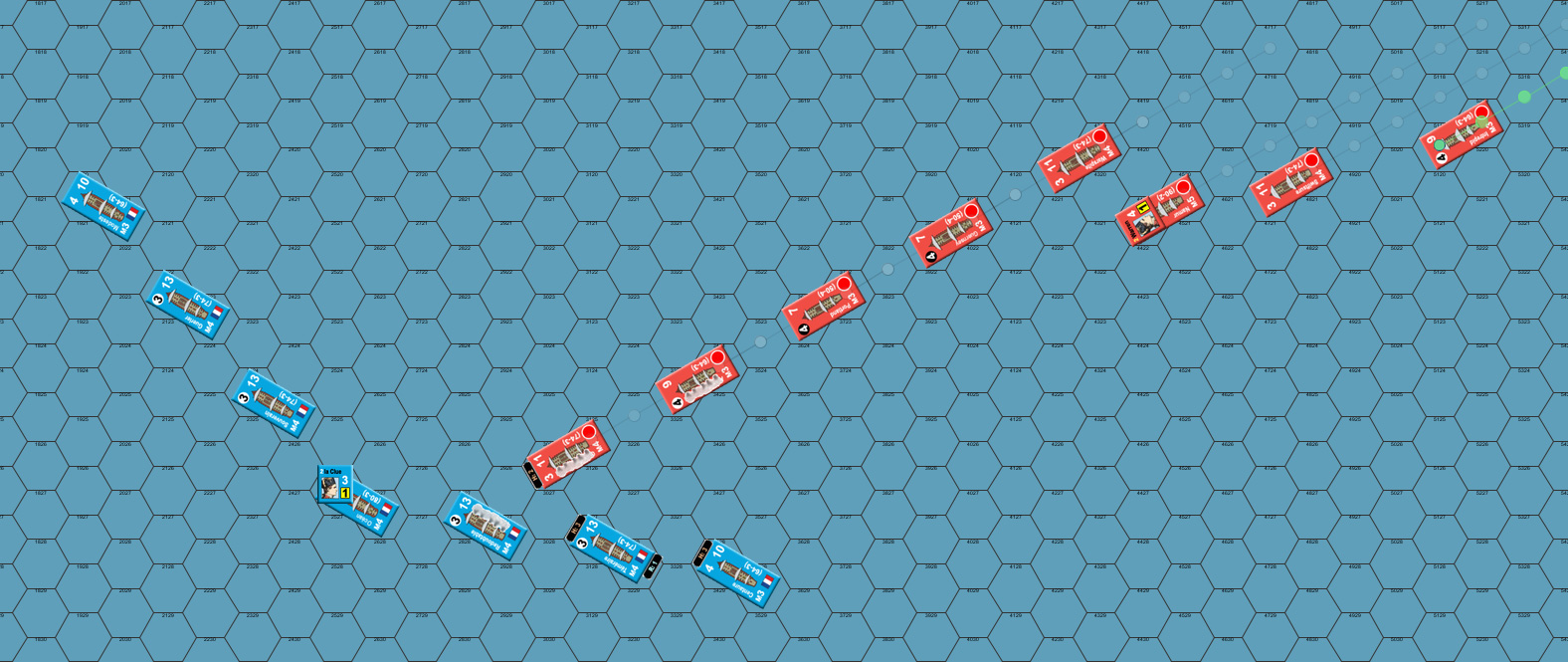

After British movement. Wind is from the top of the map.

The immediate French problem is that they are beating against the wind, and are practically immobile with 2 MPs. I wanted to run the French line up, and then turn to parallel the British line reaching with the wind, and so declared a ‘turn in succession’ order with the lead Modeste. (I might have been better served to just turn everyone for a running battle as is, and used sideslips to tighten up the windward side of the fleet.) Téméraire and Centaure returned fire during my activation, doing 4R to Culloden and 3R to America respectively.

Mark kept the initiative for turn 2, and Culloden and Téméraire fired on each other during a range 0 pass-through, doing three hits to each other (rigging to Culloden, and hull to Téméraire). Redoubtable fired the off-side at her, doing 5HR. America took 3R from Centaure, and did 2HR to her in return. Portland could only manage a partial broadside (the British line was backing up…) for 2HR on Centaure. Téméraire tried a rake during her activation, but rolled a 9, still doing 6H to Culloden, flipping her to damaged and setting her on fire. Centaure had nowhere to go (with 2 MP and America directly in front), so she tacked through the wind, getting off a fresh broadside for 2R on Portland, but breaking the turn in succession.
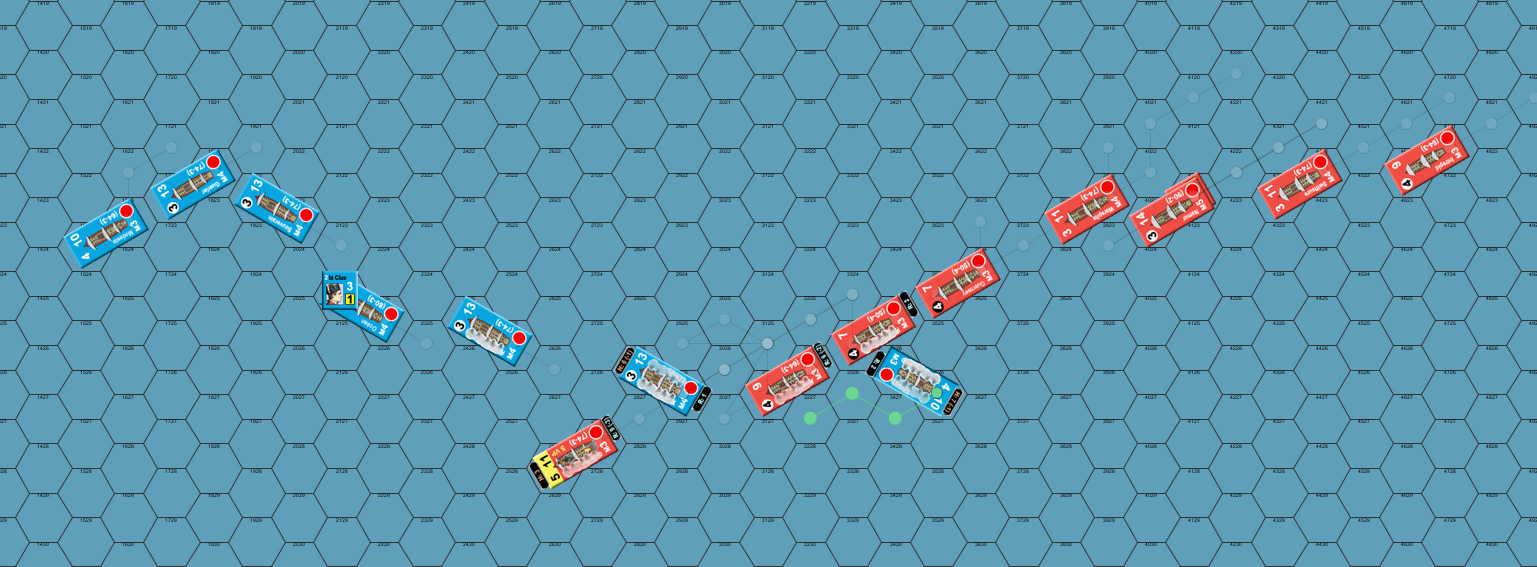

At the end of turn 2.

The British reinforcements showed up for turn 3, but there’s no great instructions for their arrival (just the east edge of the map), so Mark worked out a sailing order for them to start arriving in a compact line ahead under full sails. My lead two ships and Centaure were out of command for turn 3, while La Clue kept control of that part of the line that hadn’t turned yet. Mark retained initiative (on tied rolls), with Culloden firing on Redoubtable for H, and being reaction fired on by Téméraire for HR, and later movement reaction from Redoubtable for 2H. America raked Téméraire (our first successful rake attempt—mine had been hampered by being largely bow rakes) for 4H, while America raked Centaure for 4H (flipping to damaged) and fired on Téméraire for 2HR. Then Guernsey and Warspite fired on Centaure for 5HR, and 6H, sinking her (max hull damage, and sunk when we got to the end of turn check), while Guernsey also did 3H to Téméraire.

There was no more fire for the rest of the turn, but I turned my existing formation to get in line with the parts that turned early, and tried to get ready for a more formal pair of lines hitting each other. I caused myself trouble, but we didn’t realize it until a little later. I’m not sure just when we noticed, but there is a provision for masking a friendly ship, that keeps them from firing that broadside for the entire turn. This affected Océan, the first-rater, at a time when she was finally getting a chance to get into action (though still a bit far out, and I probably wouldn’t have fired that turn anyway). It also affected some of Mark’s ships, as his formation had gotten pretty muddled.

The British kept the initiative for turn 4. Redoubtable and Portland exchanged broadsides, taking 1H and 2R respectively. Guernsey raked Téméraire for 4HR, Namur did another 6H, and Swiftsure and Warspite both did R, leaving Téméraire four hull left.
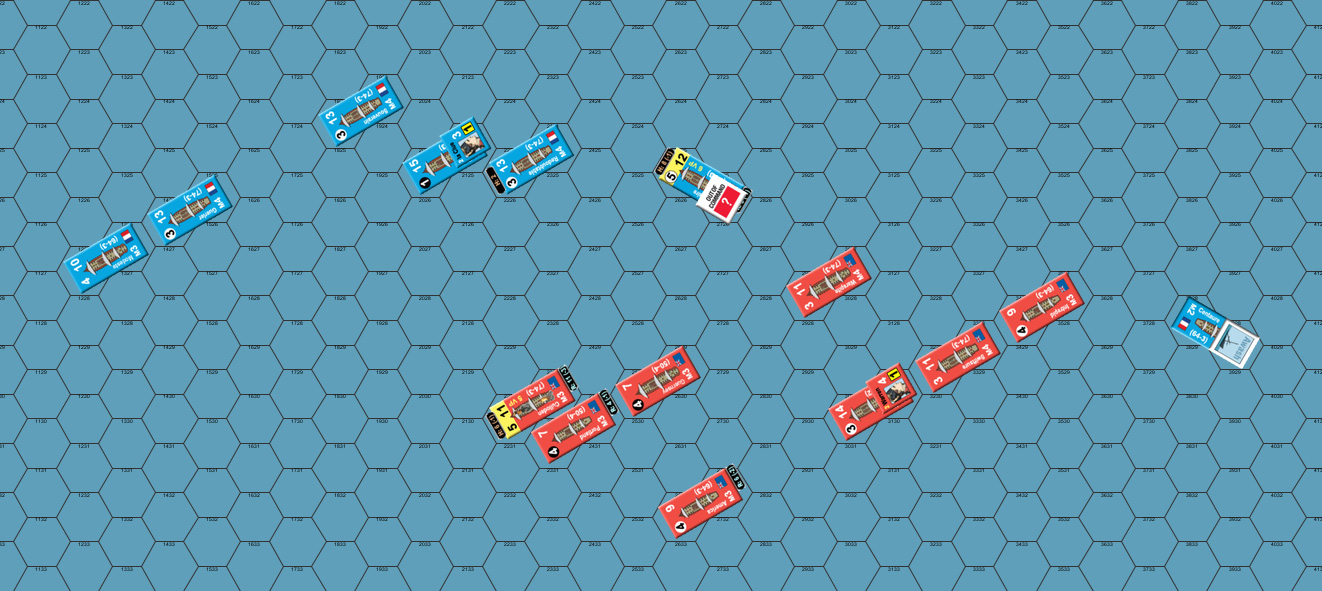

After British movement. Fired counters are to show masked broadsides; as showing it directly on counters would interfere with ‘first broadside’ tracking.

The French turned due south for my activation, hoping to cross the British “T”, though I did underestimate just how long it would take to accomplish. I was able to separate everyone out during the maneuver though.

The British still had initiative for 5, and they jockeyed for better positioning, with the only fire being Warspite into Téméraire for R and Culloden at Redoubtable for no effect. In my activation, Modeste did R, Guerier 2R, Souverain 2RH, and Ocean 3RH to Portland (leaving her at 12 rigging hits), while Redoubtable was unable to harm Culloden. Culloden finally extinguished her fire, just as the French fleet broke and ran.

With one ship sunk, and another damaged, the British had 7 VPs. Having only damaged one ship, the French had 2.5 (doubled for British Audacity, and halved again for breaking).

Afterword

The best thing about the game was the reminder that we need to play Flying Colors more often. The game is a lot of fun, and boils things down for fleet actions pretty nicely. The scenario’s lopsided, but this is mentioned in the description, and the real problem the French have is the lack of maneuvering that beating into the wind causes.

If things had gone another turn or two, Portland would have been in trouble, as a likely continued focus of French fire; at least until dismasted. After that would be Guernsey or America‘s turn, the latter having taken 6 rigging hits already. That said, Redoubtable would have taken a beating in turn, possibly along with Océan. It would certainly have been interesting to see a first-rate in the middle of all those third and fourth-raters. The second British fleet was still at least two turns away, and this is under full sail. Their real contribution was causing the ‘outnumbered by at least two to one’ modifier for the break check.

The turn in succession rules still need a lot of work. They assume everyone is in a very consistent straight line, and the French, as can be seen, aren’t set up like that here. The ships can’t get as close to the ‘turn’ counter as the rules stipulate. We worked with the idea that they would all turn as they hit the proper column, which seems to fit things fairly well here. The bigger problem is that the entire maneuver gets called null and void as soon as one ship fails it. When Centaure was forced to turn (one way or the other) because of imminent collision, all the ships ahead of her in line suddenly had no formation, which is just nonsense. Sure, if there had been ships after Centaure, they should be out of the command, but not all the ones still in an unbroken line to the turn in succession marker.
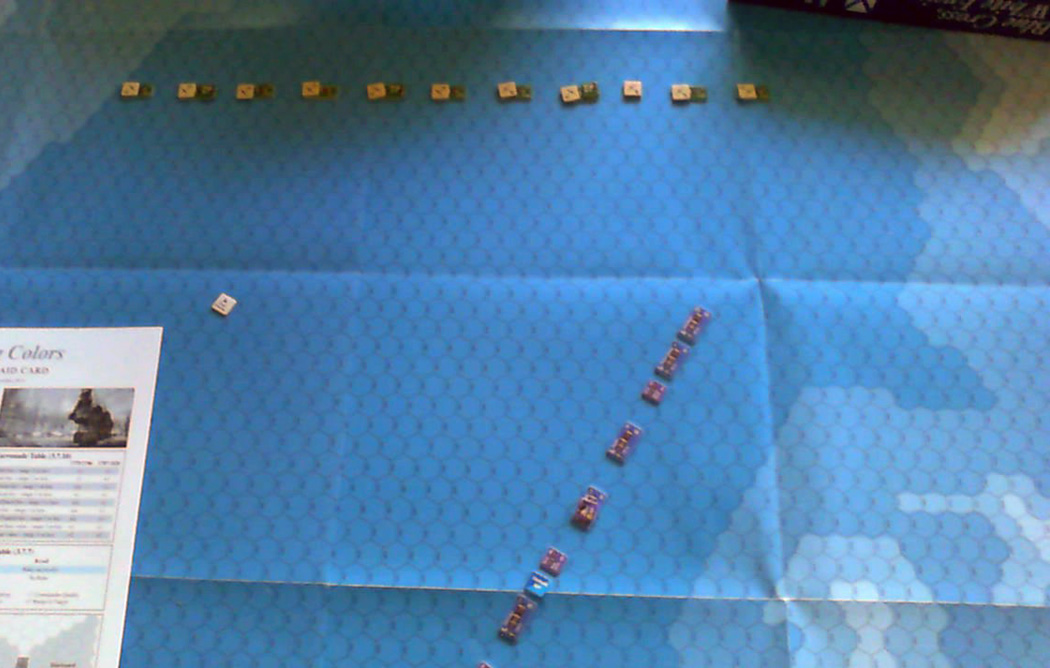
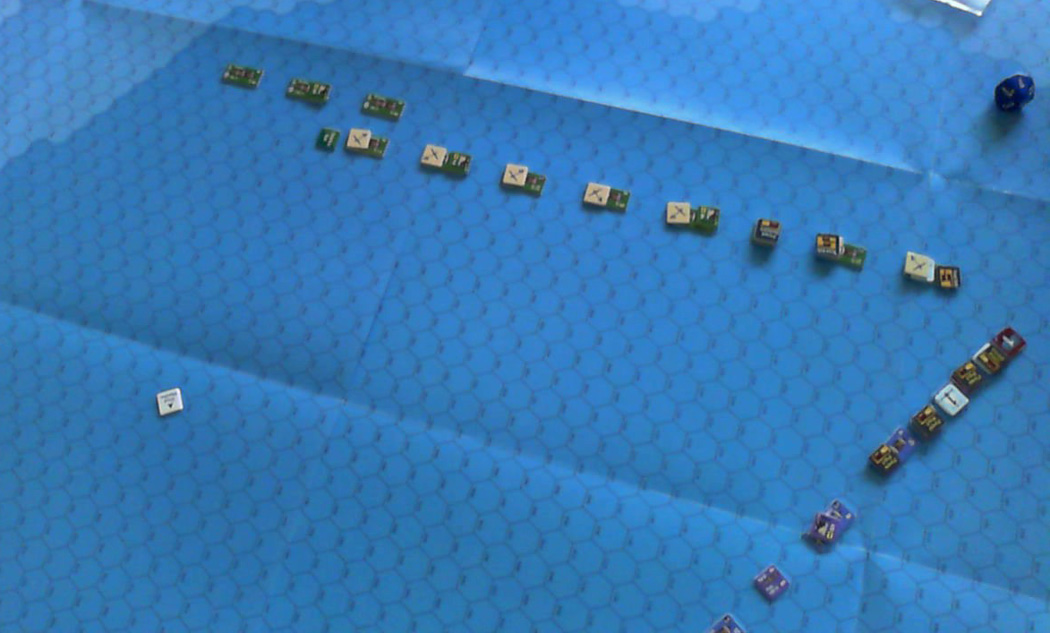
└ Tags: Flying Colors, gaming
 Comment 

Revel Bay

by Rindis on June 26, 2016 at 12:00 pm
Posted In: Boardgaming

Patch came over yesterday to try out GMT’s Flying Colors series through my copy of Blue Cross, White Ensign. I discovered at the last minute that I had missed a sheet while punching and clipping it, so I was a little under-prepared, and picked the Battle of Revel as a relatively short battle with relatively few units. It features a Russian fleet at anchor as a much larger Swedish force sails towards it (with over half the fleet trailing off off-map to enter along the same line as the at-start fleet). After a little back-and-forth, Patch ended up taking the outnumbered Russians.

My initial plan was to continue on course, and then turn to break the Russian line between the first and second ships and then… well, I wasn’t too sure what I’d do once through, since the edge of the bay would be right there, but the continued string of Sweedish ships would keep coming to let me concentrate power at that forward point.

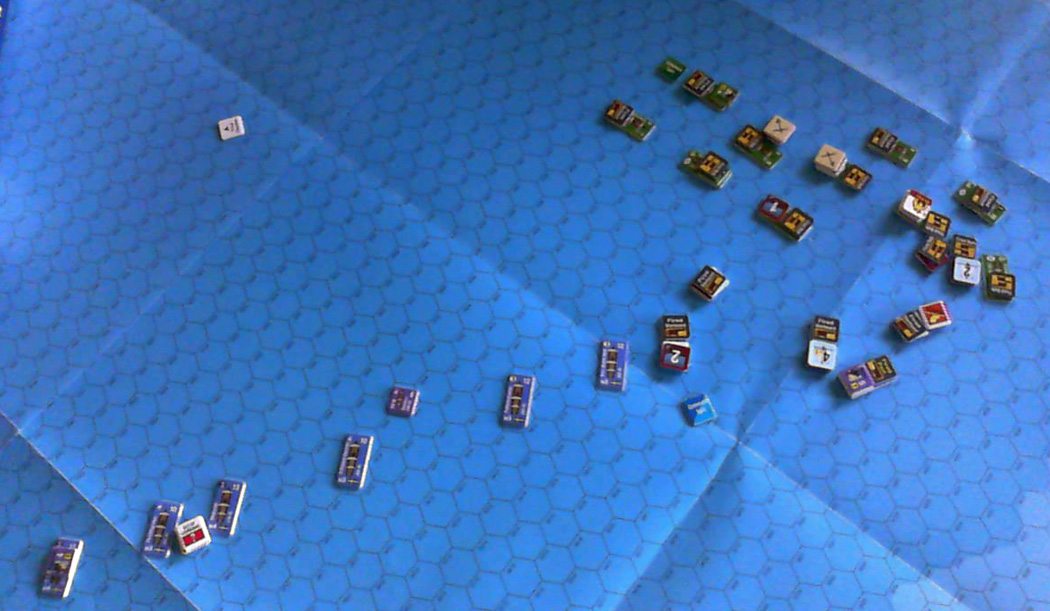
Revel-1
After the end of the first turn. I’ve backed sails a couple times with the lead ships to have a more solid ‘punch’ once I started getting into range. Note that the light blue are shallows, and the even lighter blue areas are automatic grounding (effectively the coast).

That plan started going wrong on the second turn, when the wind turned two point (120°) clockwise, meaning that my line was now beating against the wind (thanks to the breezy conditions, this meant a speed of three for the entire line). Since the wind was now coming from the rear of the Russian fleet, there was no way to turn to make speed, since the only options would carry me away from the Russians. Only one ship got in range on turn two, and the range didn’t start getting close until turn 4. Patch had been content to sit and let things develop, but slipped anchor on his rearmost three ships at this point, and started sailing them towards the emerging melee.

During all of this, most of the marked Russian advantages started showing themselves. In this scenario, Audacity is 2 for the Russians and 0 for the Swedes, so Patch was generally firing two columns higher, and being at anchor gave him a +2 for all the die rolls. Also, the Russians have a special rule that allows them to fire twice out the same side, so long as they don’t do it in the same activation. All this is fairly needed in their situation, but it did mean that each ship was firing twice when mine could only fire once. Finally, as I was firing into the wind, I was generally firing at the rigging against anchored ships just to improve my odds of hitting anything, while Patch was firing at the hull.

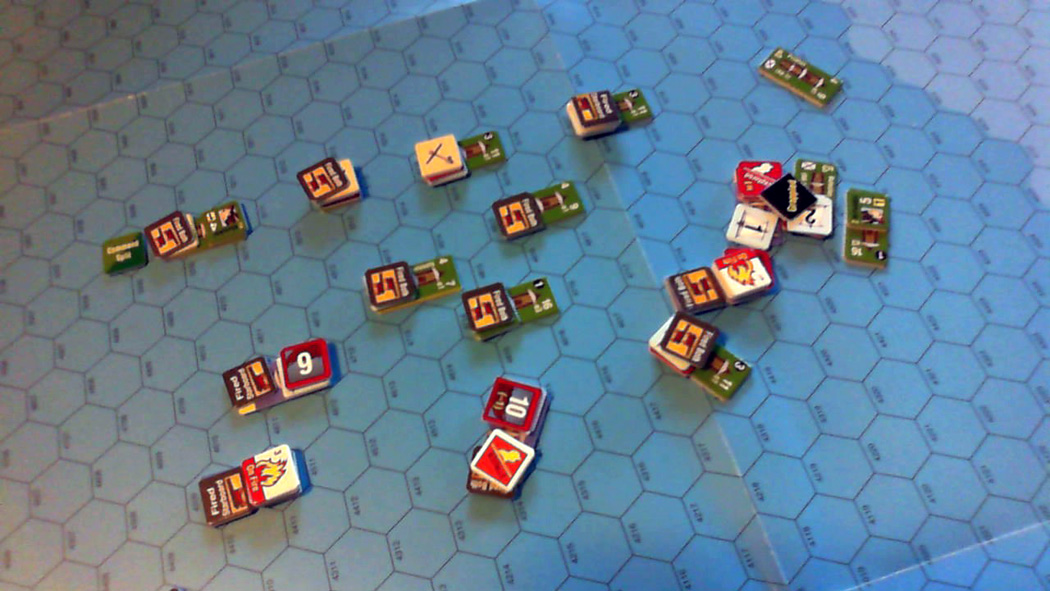
Revel-4
End of Turn 4. My lead ship would anchor on the next turn to deliver broadsides while partially out of the Russian’s arc.

I abandoned formation on turn 5, leaving the forward commander to control by proximity for the rest of the game. I slowly fed in ships, getting them beaten up, as Patch broke off a second squadron to slip anchor and sail towards the fight that I was already losing. On turn eight, the wind finally shifted again, after five turns of staying steady, turning another point clockwise to put the entire Swedish line In Irons! Most ships turned to port to beat against the wind toward the rear of the Russian line, while Patch’s advancing squadrons were slowed by needing to beat against the wind themselves.

Revel-9
End of Turn 9. One ship has struck it’s colors and another will follow in a couple turns. This one will get captured by Patch.

The last Russian advantage is that they have two 1st Rate ships, while everything else present is 3rd or lower. Neither of them  is near the front of the line, but when Patch’s mobile squadrons came up, I started taking an even higher firepower drubbing (though it was nice to be getting fire that wasn’t constantly at +3). I forgot to check to see if my fleet broke off after my first ship struck it’s colors, but at least it’s low odds (I had plenty of undamaged ships) and it was getting near the end of the scenario anyway.

Revel-12
End of Turn 12/Game. Yes, those are my ships on fire, though Kir Ioann was on fire for a couple turns.

I think I did better than the Swedes did historically (a ‘handful’ of Russian casualties), but still did not actually get to the point of dismasting or flipping any Russian ships over as ‘damaged’ (some were getting close). The wind just absolutely killed my ability to do much; I needed mobility and didn’t have any. The Russians got 22 VPs:

Dristigheten – Captured
Dygden – Sunk
Riksens Stander – Sunk
Gota Lejon – Struck
Aran – Damaged
Camila – Damaged
Froja – Damaged

About a third of the Swedish fleet never got to the combat, and another third never even got on the board, as they have to enter in one place, in one direction, and the wind was directly against it for the end.

Patch says he enjoyed the game and would like to play again, which makes me very glad. He’s never really had the naval bug, and this is the first time he’s played a Age of Sail game. I certainly enjoyed it a lot, though it got depressing towards the end as more and more Russian ships got involved, and I just couldn’t do anything. I’ve been wanting to try out my set for the last month or so, and am happy I finally did.

However, there are a surprising number of places where the rules and charts still need some clean up. The sequence of play is never given in the charts (just near the beginning of the rules), and the various parts of the end-of-turn status checks are hidden in other rules rather than put where one can find them for that particular segment. A number of modifiers on the charts could do with an explicit reference to it’s particular rule. The modifier for a black or white background on the rate is looks like it says ‘+1 [to] Rate value’ instead of ‘+1 [if] Rate value…’ at first glance (I’d say “White­ background Rate value if base­ fire­powe­r is shade­d”, or better, “Shaded base firepower with white background Rate value”). Actually, I’d like a cheat sheet of all the various different symbols associated with the relative rate value. Finally, taking 6 hull hits increases the relative rate by one, but the counters say ‘-1’ and only start at 7 hull hits (I suspect it used to be a -1 firepower modifier instead of +1 rate, but the counters need updating).

└ Tags: Blue Cross, Flying Colors, gaming
 Comment 

Cape Henry

by Rindis on March 3, 2013 at 1:39 pm
Posted In: Boardgaming

Mark came over yesterday, and we played a game of Flying Colors. Mark had played it once before with Jason, so he picked the second scenario (Cape Henry) to introduce me to the system. I decided to stick Mark with the outrageous French accent, and took the British.

In fact, I’d only managed to read up through the movement section of the rules ahead of time, so the beginning went very slow, as I tried to sort out just how combat worked. Thankfully, the opening is somewhat simple, with the French line reaching (really, broad reach) directly towards the British line, which is beating against the wind toward the French line.

Not liking the idea of cruising my line right down the similarly-equipped French line trading broadsides all the way, nor the fact that I had a mere 2 movement while beating, I started wearing the leading elements of my line to port to rake the French as they approached. However, this left them out of command for a couple turns, as I overestimated my ability to get a commander in range for a group command (especially as the commander with the higher range was in the rear). However, things degenerated into a pretty dense melee with the leading ships, so that my out of command ships were always adjacent to an enemy at the start of their move, and got to fire normally.

Both of us stuck to our national ‘strengths’, with me firing at the hull, and Mark going for the rigging, so that even my ships that were now reaching didn’t have much movement, as their rigging was too damaged. On the other hand, I was taking lots of raking shots, and getting good die rolls, and the leading two French ships were forced to strike their colors rather than sink.

I was just starting to reassert proper command over my leading elements, having driven the Royal Oak into a gap in the French line, and reasserted command, when turn 5 came up, and the wind adjustment check. The roll shifted the wind two points (of a hex map; 120 degrees) clockwise. This meant that suddenly my main line was running with the wind, and the French line was taken aback. This changed the nature of the battle immensely. The rear portion of the French line wore to starboard, and beat against the wind toward the initial, and continuing fighting for the rest of the game. I reached the French flagship with mine on that turn, and the only two 2nd line ships nearly crippled each other with very little input from the rest of the battle.

Mark was finally dismasting my ships while I struggled to get my line re-sorted and effectively fight back. The lower chances of striking the colors from a dismasting helped, as only one of three ships actually did (and that was on the third turn of rolls). Mark’s third ship had been heavily damaged, but managed to get out of the action before I could get its hull points to zero, and the modifiers for that kept it from striking the colors.

The scenario ends at turn 8, and I won on VPs at that point, 10.5 to 8. Mark had been having to roll for his fleet breaking the final three turns, but the odds of that were low. I also had to roll on the last turn, as one ship finally struck the colors. So for the final act of the game, both of us rolled ‘2’s (with the fleet breaking, and granting a decisive victory to the other player on a ‘0’), and Mark had a -1 on his roll…. Very close there.

At any rate, the game was fun, it seems to be a very good system that captures the flavor of Age of Sail naval combat quite well. We used the status markers all day, and didn’t have to write anything down, which was very nice. The markers got a little crowded, but the fact that the ships are 1″x0.5″, giving them room for two stacks of markers makes it work out, at least at this size of battle. It took all day (10 to 5, with lunch), but that was after a very slow start, and the later turns were going very fast as we continued getting used to the modifiers.

└ Tags: Flying Colors, gaming
1 Comment

©2005-2026 Rindis.com | Powered by WordPress with ComicPress | Hosted on Rindis Hobby Den | Subscribe: RSS | Back to Top ↑