

Quiberon Bay
After raiding a henhouse, Mark and I went to Flying Colors for our next Sunday game. We went for the battle of Quiberon Bay, from Ship of the Line (or Deluxe, which we have); it’s a large early battle, using two maps, and some shoals which cause automatic grounding. The weather is breezy, so all movement is at +1, and there’s a special rule that says whenever you fire with the wind (leeward), there’s a 1 in 1000 chance of immediately sinking. This seems to be to replicate the sinking of Thésée and the capsizing of Superbe during the battle, but it seems too rare to come up.
Both sides have three admirals, and the overall commander for the British is Hawke, with a range of 8, and 4 quality. The British fleet is partially headed across the T of the French fleet at start.
I had the British, and won initiative to let the French go first, and get closer before I started moving. They all just moved forward, running with the wind, while I started turning further in, beating against the wind to try and get closer. The next turn, I turned back to reaching, and parked myself in front of the French fleet, but the first section started turning to parallel my course, still eight or more hexes away. The rest turned the other way, headed towards the rear of the rest of the British fleet, and I turned to intercept.
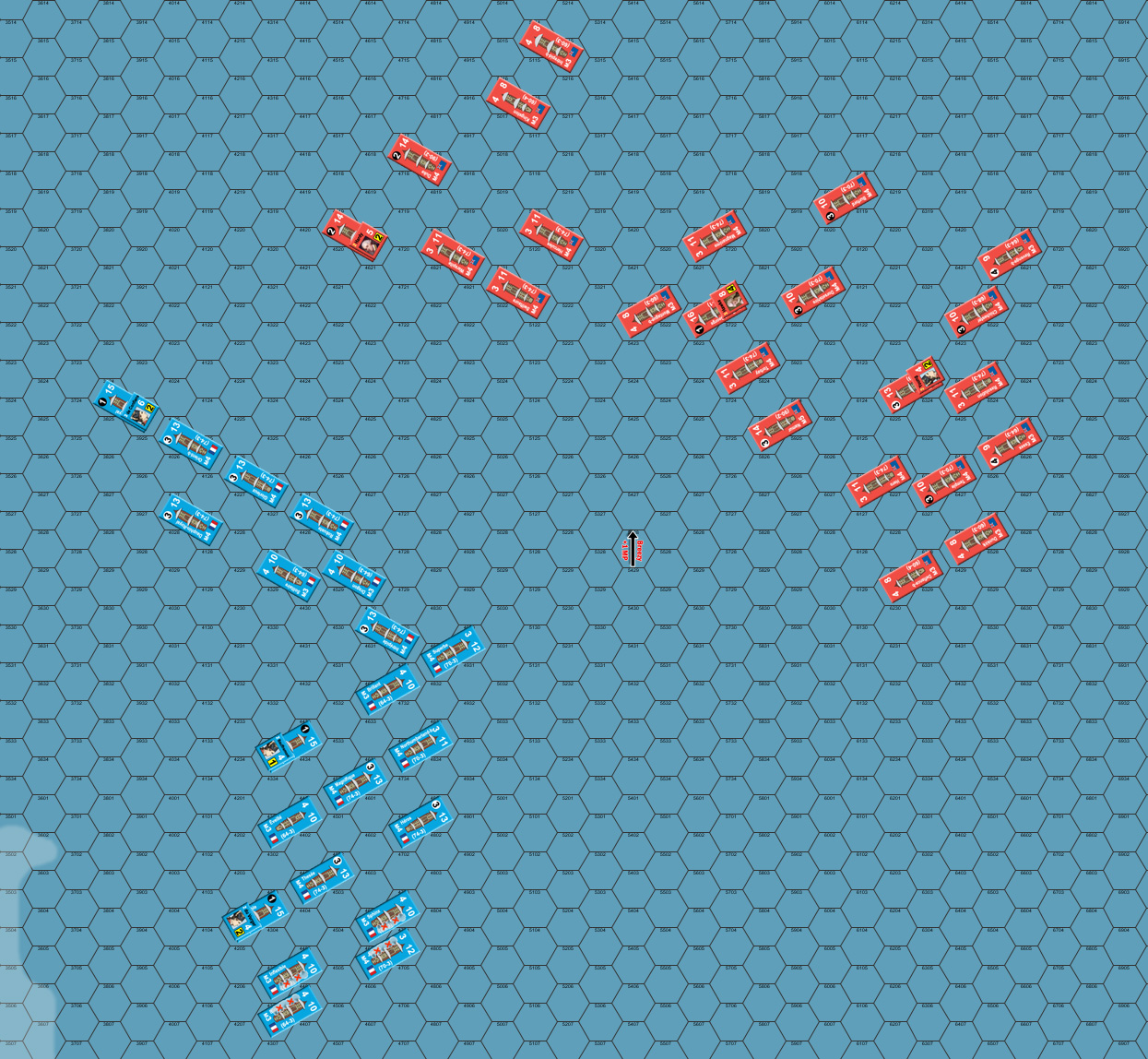
The northern elements continued at distance for turn 3, with both sides slowly getting a more coherent line. A couple French ships turned around to join that formation for the next turn. And they continued at range then. But, the rest of the fleets finally came into contact on turn 4, with Northumberland (French…) becoming damaged after taking four close-range broadsides (it could have been much worse, as three of those had minimal rolls). Nothing else was quite that extreme, but Héros took a lot of hull damage and caught on fire, while HMS Hero and HMS Defiance took heavy rigging damage.
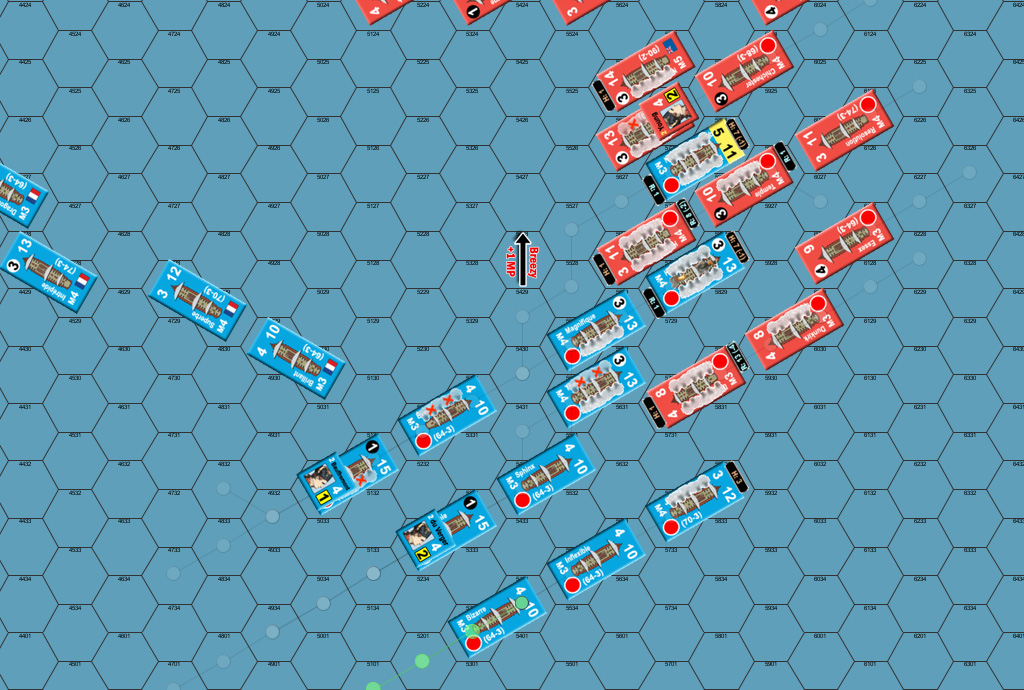
With that area getting too crammed with ships to usefully bring any more in, Hawke’s section ended up turning to starboard to parallel the main French line at ranges ranging from 4 to 11 hexes, and HMS Montague (the closest) put a broadside into Superbe for 2H, and she returned fire for 1H. Hardy beat into the wind to get closer to the French line.
The French got initiative for turn 5 and started off with Bauffremont. Northumberland absorbed another two broadsides (the first was another low roll for minimal damage) to sink (well, at the end of the turn) and catch on fire after dealing out single hits with her broadsides. Ironically, HMS Hero and Héros exchanged fire, with the latter becoming damaged, while Hero was dismasted after further fire from Magnifique.
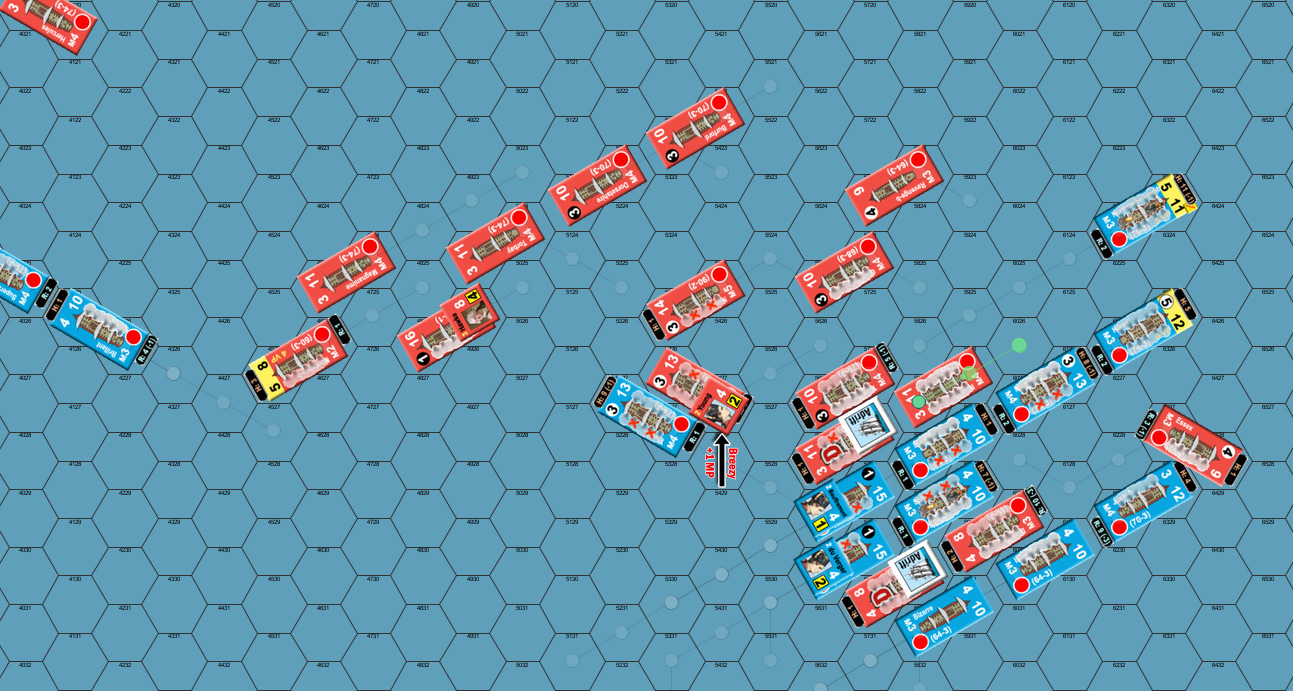
Hawke maneuvered closer to the rear of the French line, finally prompting fire which I had to take on my rake line. Thankfully, French fire was largely not up to it, and HMS Montague took 4HR on the way in, and did 3RH to Brilliant. De Conflans started a turn in succession to starboard, bringing the main line wrapping (eventually) around the separated British element under Hardy. Brilliant was able to rake HMS Montague for 6H, making her damaged. Hardy came in on HMS Union and took 4H on the way in, but did 4R. HMS Warspite did another 3R while Dragon did 2R to her.
Then things got crazy as de Verger went, and ships were way too crowded. Thésée had to turn around, putting her in front of the oncoming British, but dismasted HMS Defiance in the process. HMS Royal George fired as she came up getting a bow rake to do 6H. HMS Defiance and Dunkirk fired on Sphinx doing 7HR and catching on fire while doing 3RH to HMS Dunkirk. Juste sideslipped into closer range, taking 8RH and doing 4R to HMS Dunkirk. Inflexible did another 3RH to HMS Dunkirk.
Young went next, but there wasn’t a lot of movement, as two ships were dismasted, and HMS Dunkirk was in sternway since she lost three movement to rigging damage. HMS Mars pulled alongside Thésée to do 3H (this also meant the formation was going to be broken up, and the area would be under group command—with a lot of French ships to trace around). HMS Essex tacked around to avoid the pileup ahead.
Afterword
Northumberland sank, my two dismasted ships had support right there, so they didn’t need to check for striking. But then the French fleet broke off. It was a little tempting to ignore the roll, as things were going to get very interesting, but it’s also very in character for the French, who were more interested in preserving their fleet. Also, there’s plenty more games to get to. Breaking off is an automatic win for the British, but VPs were 8 British to 6.5 French also.
One rules annoyance that took most of the game to figure out: The rules for breezy conditions mention that it ‘adds one to the Weather Change die roll’, which, since a weather change happens on a roll of 0 (and 1 in this scenario via SSR), means the weather can’t change (or, in this scenario can on a 0+1 roll) if it’s breezy. This just didn’t make sense, but near the end I realized that they mean the Wind Adjustment Roll, i.e., the roll after finding out that the weather is changing, and the +1 makes it less likely the result will be ‘no change’. I think. The rule is quite clear on using the “wrong” terminology.
It’s a large scenario, but certainly interesting enough. The breezy conditions adding movement is very nice, and adds more options for beating against the wind. The shoals to the NW were starting to loom large in both our thoughts, which dictated our maneuvers in the main line of battle.
Discussion ¬