Rindis.com

All my hobbies, all the time
  • Home
  • My Blog
  • Games
  • History

Categories

  • Books (514)
  • Comics (10)
  • Gaming (928)
    • Boardgaming (682)
      • ASL (155)
      • CC:Ancients (84)
      • F&E (78)
        • BvR – The Wind (26)
        • Four Vassal War (9)
        • Konya wa Hurricane (17)
        • Second Wind (5)
      • SFB (83)
    • Computer games (162)
      • MMO (77)
    • Design and Effect (6)
    • RPGs (68)
      • D&D (28)
        • O2 Blade of Vengeance (3)
      • GURPS (32)
  • History (10)
  • Life (82)
    • Conventions (9)
  • News (29)
  • Technology (6)
  • Video (51)
    • Anime (49)
  • Writing (1)

Patreon

Support Rindis.com on Patreon!
Become a patron at Patreon!

Other blogs:

RSS feed: Inside GMT Inside GMT

RSS feed: Playing at the World Playing at the World

  • Playing at the World 2E V2 Arrives May 5, 2025

RSS feed: Dyson’s Dodecahedron Dyson’s Dodecahedron

  • Isle of the Abbey September 29, 2026

RSS feed: Quest for Fun! Quest for Fun!

  • The $139 Board Game August 7, 2026

RSS feed: Bruce Heard and New Stories Bruce Heard and New Stories

  • Of Vassals Badmouthing and Sucking Up September 30, 2026

RSS feed: Chicago Wargamer Chicago Wargamer

  • The 2 Half-Squads - Episode 310: Cruising Through Crucible of Steel January 27, 2023

RSS feed: CRRPG Addict CRRPG Addict

  • Citadel: Try Ignorance October 7, 2026
SF&F blogs:

RSS feed: Fantasy Cafe Fantasy Cafe

  • Anticipated 2026 Speculative Fiction Book Releases, Part 2 September 17, 2026

RSS feed: Lynn’s Book Blog Lynn’s Book Blog

  • Can’t Wait Wednesday: The Stars Look Like Home by TJ Klune October 7, 2026
ASL blogs:

RSS feed: Sitrep Sitrep

  • Fireweed Sale August 7, 2026

RSS feed: Hong Kong Wargamer Hong Kong Wargamer

  • FT114 Yellow Extract After Action Report (AAR) Advanced Squad Leader scenario April 16, 2025

RSS feed: Hex and Violence Hex and Violence

  • This still exists? March 25, 2025

RSS feed: Grumble Jones Grumble Jones

  • Grumble Jones Annual Halloween Scenario GJ165 Trollskremd October 1, 2026

RSS feed: Desperation Morale Desperation Morale

  • How to Learn ASL March 16, 2025

RSS feed: Banzai!! Banzai!!

  • October North Texas Gameday October 21, 2019

RSS feed: A Room Without a LOS A Room Without a LOS

  • [Crossing the Moro CG] T=0902 -- Rough start July 18, 2015
GURPS blogs:

RSS feed: Dungeon Fantastic Dungeon Fantastic

  • DF Felltower - Caps & Limits Draft October 4, 2026

RSS feed: Gaming Ballistic Gaming Ballistic

  • Harmonized Loot Schedule (HLS) September 22, 2026

RSS feed: Ravens N’ Pennies Ravens N’ Pennies

RSS feed: Let’s GURPS Let’s GURPS

  • Review: GURPS Realm Management March 29, 2021

RSS feed: No School Grognard No School Grognard

  • It came from the GURPS forums: Low-Tech armor and fire damage January 29, 2018

RSS feed: The Collaborative Gamer The Collaborative Gamer

  • Thoughts on a Town Adventures System January 18, 2022

RSS feed: Don’t Forget Your Boots Don’t Forget Your Boots

  • GURPS Supers Newport Academy #8: “Invitation to the future.. of the 1970’s: Part II” August 2, 2026

RSS feed: Orbs and Balrogs Orbs and Balrogs

  • Bretwalda - Daggers of Oxenaforda pt.4 - Fallen King May 27, 2017

Game Projects

by Rindis on May 13, 2026 at 12:00 pm
Posted In: Gaming

I’ve written on this elsewhere, but I have a number of game design ideas that I hope to turn into something a bit more fleshed out. This post is meant to be a bit more comprehensive to serve as a place I can to to remind myself what needs doing:

JumpWar: This is a new game based off of Metagaming’s Warp War. It’s extensively re-cast, but the skeleton of the ship construction system is still there. I’ve got a full rule set written, and a Vassal module put together. I want to get some testing done, and then put together a physical copy, and finally get to a GMT Warehouse Weekend to show it off.

UR1 “The Admiral’s Game”: This is an extensive rework of SFB campaign “The Admiral’s Game” from Advanced Missions, inspired by reporting on “Day of the Eagle Comes Early” twenty years ago. It’s complete and has had some use. I’m still trying to decide what a good submission format to ADB would be, since it is still an existing campaign structure.

The Commodore’s Game: The initial idea was a SFB campaign where actually move ships around at a higher level. This is effectively the never-done Chapter V, and therefore an auto-reject from ADB. However, I’ve been thinking of turning it into it’s own game (which needs a new title). The general idea is to use the task force concept from Great War at Sea, and form groups which then go interact on the main board. That part is half-written; I need to rework away from SFB and come up with a battle resolution system; presumably a simple one.

6R1 “Federation vs Empire”: This is a Federation & Empire scenario for a big war between the Federation and Klingons. Annoyingly, the war from “Errand of Mercy” has a (poor) scenario already, but this is plotted to be Federation wargames over the next decade so it can bridge the era from the Four Powers War to the General War with odd experiments. I have an OOB that needs clean up, and I need some way to give the Klingons a chance against the Fed economy.

To Boldly Go: This is the design I most need to do some real work on. I’ve got initial notes, but need to figure out the main activity systems. At any rate, it is a space exploration game. Grid of large hexes, random tiles on them. They tell you what you can look for, and you pull random chits for resources which you claim to sell off or develop.

Tactical Game 4: I’ve got a page of notes on the main system. The idea is WWII tactical using cards (representing elements of your force) and tokens so that things take time to happen, and it’s not everything at once, and it’s not random order (chit pull). I don’t have any plans/ideas for the rest of it, so I don’t have a path to a complete system.

NSFB: I’m starting to gather ideas for a Star Fleet Battles-like game. In the long run, I’ll want to figure out my own setting (going away from Trek means it probably won’t sell, alas), but I also need to start figuring out the main points. Tactically, the job is to keep the constant impulse movement and weapons angles intact as the main source of tension. Some less combat-oriented activities would be good, but I doubt I can do much about that. Right now, have better weapons evolution, somewhat more stately maneuvering, and an acceleration system are the working ideas.

GATR: This is the concept of a points-based RPG. I like GURPS, but combat is too detailed, and I’m not a big fan of 3d6 resolution. I figure to go to the TSR Action Table concept, and do everything through that. Try to get combat to ~3 seconds per turn, ditch defensive rolls for just modifying the attack roll downward. There’s a number of places the abilities need major re-writes. The question is how to get through the mass of stuff I don’t want to rewrite. But, RPG desire has been rock bottom for the last couple of years.

Down In History: I just came up with the title. Vague idea stage. Grand strategy medieval history game. The main thing is you draw random cards to represent the king of your country, and that tells you what you can gain VPs for right now. Conquering someone? Building a good economy? Useful, but getting points is likely to require throwing it all away. Generally, play is to be aligned behind personal motivations and not long-term logical ones.

Fox-Kin Tactics: Way back when I discovered Final Fantasy Tactics, I did get some thoughts for a game like it. I never got to a point of worrying about a system, but it was going to deal with the Fox-Kin city states about a generation before Orither. A shipwreck lands a human in the area, and contact is established with the outside world as they suddenly become a good way stop for trade, and money starts flowing through….

└ Tags: game design, gaming
 Comment 

Inventing the Renaissance

by Rindis on May 9, 2026 at 12:00 pm
Posted In: Books

Ada Palmer’s title doesn’t cover everything that’s in this book. In fact, what the book covers is probably too large for any one title, and it is to her credit that it isn’t too large for any one book.

First note: this book is written in a very atypical tone. Instead of just laying things out, describing events, sources, relationships, with a third-person voice that minimizes the author, Palmer takes a very personal, first person voice here. This annoyed me at first, but does allow some very useful bits. Notably, she talks about the work of history, and how theories are established and rejected over time. You know, just like in ‘hard’ science. Also, she talks about her own experiences in academia; a notable early bit is about going to a symposium and noting the different populations in different panels. This also leads into a discussion of how the questions we start with determine a lot of the research and writing done, and how gender segregated various parts have been (though it is getting better).

She also leverages the first person to make all sorts of current “meme” comparisons, which may end up “dating” this book well before its time. But, she also works in an apt comparisons, like the boardgame Siena which she rates as the best Renaissance-themed game she knows of for its depiction of Fourteenth Century social climbing. I’m afraid I’ve not played it, but I know I’ve heard the name before, and it sounds like the goals are properly aligned with the history it wants to show.

This is after some early admonitions to not trust the author, at least not too much. Palmer is very up front about the fact that there will be other books on the same shelf as hers that have different conclusions, and the bulk of them will be just as valid as hers. This was a nice early bit of expectation management, and does get a lot of follow up, for the first half of the book at least, about the different answers that can be found on a number of subjects or people.

This flows back into the talk of theories, namely, “just what is the Renaissance?” There’s some time spent with various definitions in the middle and just how they aren’t satisfying for various reasons. However, there’s the seed of an answer all along: the Renaissance was a self-conscious attempt to create a golden age. A lot of our current thoughts actually go back good advertising that started at that time. And the eventual definitions late in the book do relate to that bit of propaganda and its goals.

The longest part of the book is a series of fifteen mini-biographies (some famous, some quite obscure) that all intersect and deal with Florence. The latter is almost an odd choice, as she’s already shown that the association of the Renaissance with Florence is more self-fulfilling prophecy than actuality; but there’s a reason why it happened in the first place. But the real point is to move back and forth over a few decades, coming at some of the same events from different angles. I don’t think this works out as well as hoped, and it is decidedly the densest part of the book.

It’s not bad, mind you, just not as good as the rest.

Then we get into some of the current (or close to) historical thought on the Renaissance, and current definitions. This leads us back to exclusions, and figuring it out by what did it turn into and how. Eleventh Century philosopher Peter Abelard shows up early, and then becomes a recurrent figure here; so much so that his presence is verbed for the last parts of the book. Not only was the Renaissance a self-proclaimed effort to create a golden age, but the major (intellectual) project was to find forgotten and mistranslated wisdom from prior ages and integrate it all into one syncretic world view that would naturally solve the world’s ills. What could go wrong?

Well, it didn’t work, for one. The advice the umanisti gave didn’t help, the better known the ancient writers became, the more evident their contradictions became, and the more obvious their lacks in the face of all the new things coming from across the Atlantic became. From there we get a whirlwind tour of philosophical thought that could become a new Connections miniseries.

The book largely ends with a discussion her own classroom exercise dealing with the crisis year (in Italy) of 1492. It’s the type of thing that more classes really should have, as a practical demonstration that, among other things, people haven’t changed that much. The various members of the class all have roles of people around the papal election that year, and it’s aftermath, the First Italian War. There’s plenty of room for things to be different, but the pressures are such that someone invades Italy in the aftermath. Further philosophical discussion brings all of this to a relation with current events.

It’s an amazingly wide-ranging book. Just looking at the table of contents (“19. Rome: The Eternal Problem City”) will give you some idea of the ride you’re in for. And it leverages being unusual to very good effect.

└ Tags: books, history, reading, review
 Comment 

Thirteen (Plus) Histories

by Rindis on May 5, 2026 at 12:00 pm
Posted In: Books

I’ve read a good number of history books over the years, and I thought I’d take the time to list my recommendations of some of the best of the best I’ve come across, with links to my fuller reviews. I mostly look at military history, so there’s a decided weight here, and not being in academic circles, these are mostly ‘general reader’ books, but there’s plenty of very good ‘period pieces’, and some very good more detailed studies.

Song of Wrath by J.E. Lendon — This is a good look at the first of the four “Peloponnesian Wars”, trying to reconstruct the societal meaning around it all. It’s impossible to say he’s right, but it’s still a worthy theory.

Empires and Barbarians by Peter Heather — This one of my favorites even on this list. Peter Heather takes a look at the “Age of Migrations” using modern migration studies to inform his view. It’s also something of a sequel to his The Fall of the Roman Empire, which I’ve yet to read, and I have Rome Resurgent on my ‘to read’ list, though I wasn’t nearly as happy with The Restoration of Rome, it is still worth a look.

Shadow of the Sword by Tom Holland — Another of my favorite of favorites. Holland does an excellent job with the start of Islam, and has enough to say that he circles around the subject a few times, easing you into the view he gives of events. His Persian Fire isn’t this good, but is well worth reading too.

The Norman Conquest by Mark Morris — Morris presents nearly a century of history to show just various factions came to be pushing the English throne in different directions in 1066. It continues through Domesday, but the value is all the background given. His later The Anglo-Saxons is also recommended, though part of it is covered here, and I think better done in this version.

The Hundred Years War by Johnathan Sumption — Be ready before starting this, because we’re talking nearly 3,600 pages of text on the Hundred Years War (not including indexes, notes, bibliographies, etc). However, it is very much worth it, and a clear, detailed, look at a subject that you often just get a couple “exciting” corners of. His earlier book on The Albegensian Crusade is also good, but this is the main event.

Inventing the Renaissance by Ada Palmer — I’m actually still in the ending sections of this book. It’s very unusual, with a very personal tone as Palmer talks to us about various subjects. It was a little off-putting at first, but she uses this change up well, as she guides us through the historiography of the Renaissance and her own experiences with research and symposiums. It’s worth it for the latter, and that’s still the least of what it’s got to say.

Empires of the Sea by Roger Crowley — A well written and paced account of the sieges of Rhodes, and Malta, and the battle of Lepanto, showing warfare in the sixteenth-century Mediterranean. Crowley is an engaging writer, and is always worth reading, and I especially recommend City of Fortune. Ernle Bradford’s The Great Siege is also good for Malta, but most of it is in here already.

A Dragon’s Head and a Serpent’s Tail by Kenneth M. Swope — You don’t get to hear much of the 1592 Japanese invasion of Korea, and Swope has a good book looking at it from the Chinese point of view. There’s a sequel, but it’s locked behind scholarly low-volume high prices so I haven’t read it yet.

Crucible of War by Fred Anderson — This is a surprisingly wide-ranging book on the French and Indian War. Even if you think you know enough, there’s plenty in here, and its all well put together.

A Country of Vast Designs by Robert W. Merry — The Mexican-American War is under-discussed, and this book is really more about Polk’s political career. So, you see how it ties into Oregon and his tariffs, but the war is seen distantly. A Wicked War takes a (deservedly) much more negative view of events (Vast Designs is too close to Polk for proper perspective), but has problems. The Training Ground has good views of the combat, but I spotted some big errors, and worry about what I didn’t spot, and only Vast Designs even begins to have any Mexican viewpoint in it.

Centennial History of the ACW by Bruce Catton — Catton is one of the best writers the American Civil War has had, and I recommend any of his books, but the Centennial Trilogy of The Coming Fury, Terrible Swift Sword, and Never Call Retreat are overall his best. (My absolute favorite passage is the final chapter of Glory Road.)

Dreadnought by Robert Massie — A massive book covering about sixty years of European political history. The main thesis is that in around 1850 Britain and the Germanies were fairly close. In 1914, Britain and unified Germany went to war. Massie does an amazing job navigating the personalities and events that lead to the collision. All his books are very good, but this is by far his best.

Playing at the World by Jon Peterson — There’s now an expanded two-book set, but I’ve just read the original massive tome. Pop culture is somewhat ignored in more academic circles, leaving it to write its own histories. Peterson has applied a lot of rigor and detective work to a history of the start of RPGs, and spends time to go into some theoretical thoughts why the first was inevitably a fantasy RPG, and background on the history of wargaming. He’s gone on to a couple of other books around the same subject since, but I haven’t gotten to them yet. Shannon Applecline’s Designers & Dragons is also a good overall history of RPGs, and worth finding their own details in.

└ Tags: books, history
 Comment 

Pylos and Sphacteria 425 BC

by Rindis on May 1, 2026 at 12:00 pm
Posted In: Books

Thucydides’ classic account of the Peloponnesian War(s) hits one of its dramatic moments (of many) with the siege of Sphacteria. It gets a lot of attention in his history, and William Shepherd spends a lot of time quoting it in this book.

But, there is much more here. First of all, he takes time on occasion to get into the weeds of translation, giving the original Ancient Greek term, and its fuller definition so that we have much better context for that passage. This is in addition to good old fashioned expanding on the text and trying to get at some of the things Thucydides glosses over.

First, we get a fifteen-page background to the actual campaign, which is then followed by the Campaign formula of looks at the armies, leaders, and plans (another fourteen pages). This starts feeling a little excessive in a 96-page book, but does mean it stands alone, and you don’t already need any grounding in the period to understand; it is all laid out for you, and it is well written and presented.

As always, there are maps, starting with one showing the theater of the wars and major battles in the lead up to this campaign, and then one focused on the Peloponnese for the last few years. Then the campaigning along the eastern Adriatic, and finally one of the focus of the book: Pylos, the harbor there, and the island of Sphacteria. This last is essential, and what you will have the most trouble finding elsewhere. There’s then two even more focused maps, one of the main naval battle, and showing the locations of fortifications during the siege (this one feels primitive compared to the others), and then one isometric “showpiece” map for the final battle on Sphacteria.

In addition to the maps, you get all the usual Osprey visual reference. Much, especially at the start is the usual pictures illustrating arms and armor, including some full color pictures of Olympias, the Hellenic Navy’s reconstructed trireme. The real value is in a large number of photos of the area, particularly of Sphacteria, taken by the author. It has to be treated with some caution, as the landscape, and especially the shores have changed a lot in nearly 2500 years, but generally it seems things haven’t changed a lot, and it really helps to get a sense of what the Athenians and Spartans were dealing with.

The part that always gets me is that the Athenians sail around to aid Corcyra, leaving a contingent at a corner of Pylos. The Spartans notice and attack, and are beaten off, and then the Athenian navy returns, and takes control of the waters around Pylos. And suddenly there’s this Spartan force trapped on Sphacteria. The rest of this has been on the mainland, but now we have Spartans on a just-offshore island.

The blink-and-you-miss-it moment is that the Spartans decided they needed to occupy Sphacteria, for a number of good reasons: The channel between it and the Athenian camp on Pylos is very narrow, so it might control access to the Spartan camp and the fleet drawn up in the harbor. If the Athenians were driven away from the fresh water on the mainland, there was a spring on Sphacteria. And it’s a good lookout point.

But the Athenian fleet largely goes south around the island into the harbor and defeats the Spartans, and suddenly this force is cut off. It’s too big to feed easily, even sneaking supplies over at night. Too big to pull off the island. And too big for the Athenians to easily defeat on land.

So we get negotiations; no one wants to let go of an advantage once gained, so that goes nowhere. Reinforcements get sent, and the Athenians finally assault the Spartan camp. Shepherd shows this wasn’t easy either, and the battle was only won by a combination of good tactics (using light troops to harass the enemy, keep him off balance, and unable to get any telling blows in), and getting another force up a cliff side unexpectedly. The Spartans had a good reputation at the time as well as today, and the only thing more surprising to the Greek world than the Athenians defeating them on land, was the Spartans surrendering.

Shepherd does a very good job with all of this, showing how the campaign fits into other events, and demonstrating just how all the events worked. There’s the usual studied look at possible numbers and basic logistics, though it is impossible to go into any detail here.

└ Tags: books, Campaign, Osprey, reading, review
 Comment 

Muddy Volturno

by Rindis on April 27, 2026 at 12:00 pm
Posted In: Boardgaming

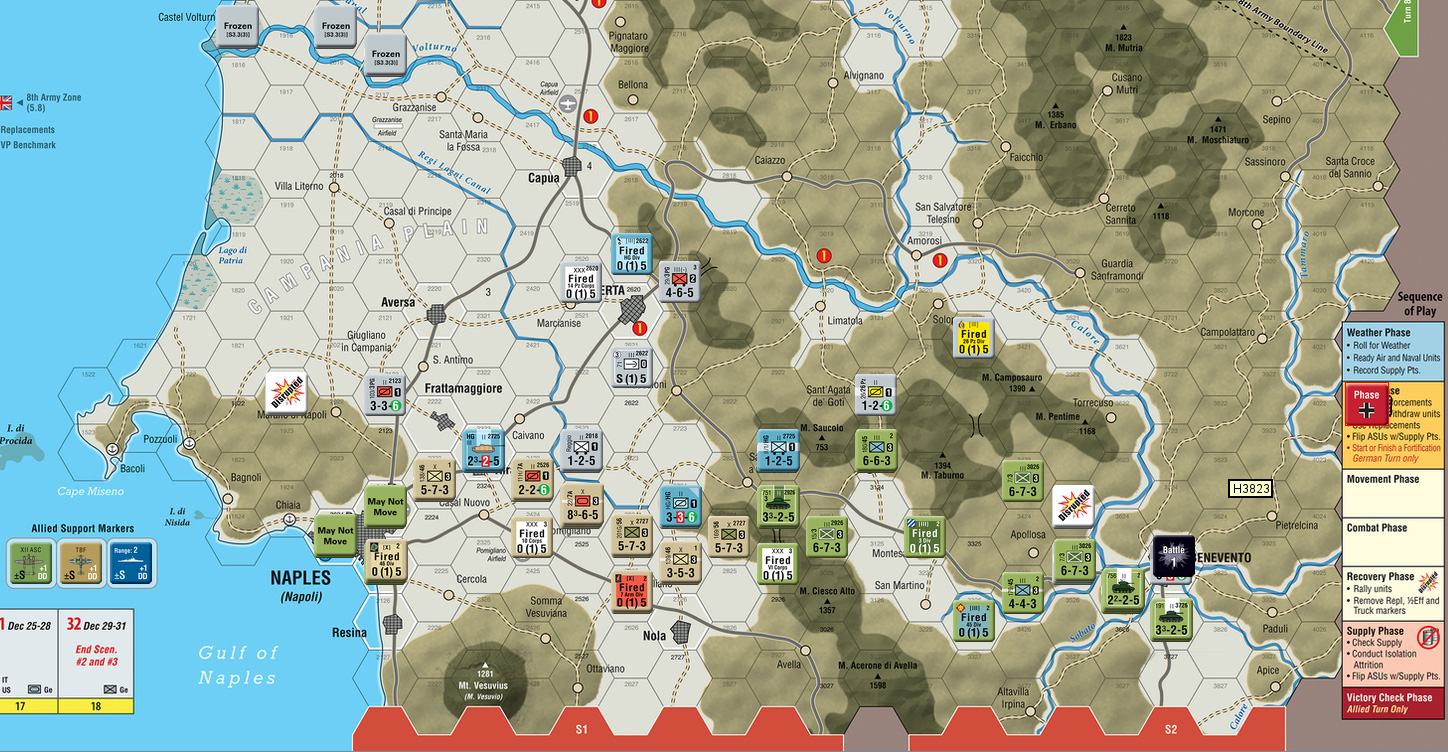
After trying out Chitin I, Mark and I decided to get back to the ZOC-bond system and do the short scenario for Italy ’43, “Crossing the Volturno”. This is a seven turn scenario (compared to the 32-turn full game), and effectively only uses about the bottom third of the map. It also leaves out the fortification building important in the main game.

I got the Germans, who aren’t doing too badly at the start of the game. Both sides have somewhat thin line as fighting moves onto the map. The main thing is the Allies have already taken Naples, and the 82nd Airborne is stuck garrisoning it until one regiment with released on turn 11, and the other two are removed on turn 19.

I moved to interdict the roads out of Naples, and reshuffled in the plains to make a 3:1 attack on the British armor starting in 2224, getting a DR2. The bulk of the British 46th division arrives in the second half of the turn, and moved up to hold the line near Naples while 56th Division attacked just past the line of the canal, only getting an AR1. The Americans attacked south of the pass in the center, and got an A1/D1, which forced me north of the pass.

The second turn’s weather was rain and mud; the German “reinforcements” for the turn are a pair of battalions of the 3rd Panzergrenadier Division are released from a mid-map position, and went to help hold the area north of Naples. I didn’t do more than rearrange things a little. Meanwhile the Allies get their divisional artillery, and the bulk of the American 45th Infantry (one regiment starts on map). A regiment of the 3rd crossed over a mountain ridge to get around the pass I was holding, and got an A1/D1 against a recon unit holding the flank of the nearby valley.

The turn 3 weather roll went forward two columns, going to “B”. Clear weather with good Allied supply and support, but the next storm front was moving in fast. The Germans get a motorized regiment from the 3rd PG, but also remove two battalions, which hollowed out the center of the line a bit. Still, the terrain is good, and I took a replacement in there, letting me keep a line on the river west of Benevento, hoping the mountains would keep too much else from happening. The Allies get their corps artillery, and started driving north in more earnest; another hop across a ridge (we were using the 1/2 effectiveness rules, being used to them from earlier games) put the Americans in the rear of my east line, which suffered a DR2. In Benevento, the 34th Infantry tried to take Benevento, but only got part of it in a “partial” determined defense. The British got an exchange while trying to cross the canal in their sector, and the 82nd Airborne drove my blocking unit away from Naples with naval support (they can’t move out, but they can attack).

The weather held clear for turn 4, evening out the earlier skip. The Germans withdraw a recon unit—the one that is holding Benevento at the start of the game, and had just held on to it here. However, I had no ability to move a new unit in, and was busy trying to pull the 26 Pz out, with their recon circling around to hold a road junction on the east flank, while the motorized regiment from last turn moved to cover the center. The bulk of the American 34th Infantry Division arrives (most of a regiment of it is on map at start, with a final battalion of that arriving on turn 2), and took Benevento. The main American push was NW out of the central valley for an EX, and the British finally got over the canal with a DR2, and got an A1/D1 just north of Naples.

Turn 5 saw the weather advance two columns to cloudy “D”, grounding US air support. The Germans get a motorized battalion from the 3rd PG, which I forgot to move after concentrating on the south. With the initial lines broken, I had real problems, pulling back on the plains for a loose line, and down the Calore in the east. The 26’s recon had to go back to block the central pass, while the motorized regiment went west to help cover a couple units that couldn’t get very far with all the British in the way. Herman Goring did a counterattack to get two units loose after the British advances, and a A1/D1 got them safely behind the middle canal. The British get a brigade of the 56th Infantry Division in Naples, and the British pushed me off the west part of the plains with a DR2 and DR4. The Americans were stopped in the central pass with an A1 against my recon unit, but forced the east flank with an A1/D1.

The clouds continued on turn 6, keeping US air support grounded. It was time to largely pull back behind the Volturno, though I stayed south on the hills. The Allied advance nearly overwhelmed my line, and would have with better weather and slightly better luck. The British got a DS against my independent motorized battalion holding Capua, with a breakthrough across the Volturno getting an A1/DR2. I had to do a determined defense in the open, with only elite units and artillery as an advantage, and held the hex on a very good roll. Over in the hills, a DR2 took out my position in front of the next bridge, and breakthrough put the nebelwerfer unit into full retreat. All of this left the motorized regiment trapped south of the Volturno with no bridge access. The Americans got an A1/D1 near Limatola, but couldn’t advance over the bridge, and an attempt to clear that got an A1. The east flank got an A1/D1 to continue moving up the Calore.

Afterword

Turn 7 weather advanced two columns to be rain and mud. This pretty much halted the Allied advance for the last turn, as all the artillery supply had already been shot off, and the -1 column (and German artillery) kept there from being any good attacks. A series of ‘1’ die rolls only sealed the deal.

Now, I wasn’t in a great situation, as on turn 7 the entire 26th Pz Division pulls out, though some of them were in dire straights already. I did get a motorized battalion and the 3rd PG divisional artillery, which helped hold the inland side of things.

Mark had only gotten four victory points (Benevento, Caserta, Amorosi, and the inland bridge over the Volturno), so it was a convincing loss for the Allies (who need seven). However, if he had gotten across the Volturno on turn 6, and taken the Capua Airfield, the fighting north of there could have been fierce. Also, “mere” rain would have made turn 7 a lot easier. On average, it seems the weather should be going clear on turn 7, so we were running a little behind that.

Mark presumably needed to be a bit more aggressive in the middle, though I can’t point to any obvious places it was needed. Still, it was great fun like all the ZOC-bond games, and this scenario really carries forward the feeling of Salerno ’43. The fortifications of the longer game will make it feel different.

└ Tags: gaming, Italy 43, ZOC-bond
 Comment 
  • Page 7 of 319
  • « First
  • «
  • 5
  • 6
  • 7
  • 8
  • 9
  • »
  • Last »

©2005-2026 Rindis.com | Powered by WordPress with ComicPress | Hosted on Rindis Hobby Den | Subscribe: RSS | Back to Top ↑