Rindis.com

All my hobbies, all the time
  • Home
  • My Blog
  • Games
  • History

Categories

  • Books (503)
  • Comics (10)
  • Gaming (917)
    • Boardgaming (673)
      • ASL (154)
      • CC:Ancients (83)
      • F&E (78)
        • BvR – The Wind (26)
        • Four Vassal War (9)
        • Konya wa Hurricane (17)
        • Second Wind (5)
      • SFB (78)
    • Computer games (162)
      • MMO (77)
    • Design and Effect (6)
    • RPGs (66)
      • D&D (25)
        • O2 Blade of Vengeance (3)
      • GURPS (32)
  • History (10)
  • Life (82)
    • Conventions (9)
  • News (29)
  • Technology (6)
  • Video (49)
    • Anime (47)
  • Writing (1)

Patreon

Support Rindis.com on Patreon!
Become a patron at Patreon!

Other blogs:

RSS Inside GMT

  • Coast Watchers – Session Report – “The Airfield” June 5, 2026

RSS Playing at the World

  • Playing at the World 2E V2 Arrives May 5, 2025

RSS Dyson’s Dodecahedron

  • Cyberstyle 8.4 June 6, 2026

RSS Quest for Fun!

  • The Expense Post May 24, 2026

RSS Bruce Heard and New Stories

  • Pain, Exhaustion, and Morale in D&D BECMI June 7, 2026

RSS Chicago Wargamer

  • The 2 Half-Squads - Episode 310: Cruising Through Crucible of Steel January 27, 2023

RSS CRRPG Addict

  • BRIEFs: Black Crystal (1982), Creepers (1982), Chitei Tanken (1982) June 8, 2026
SF&F blogs:

RSS Fantasy Cafe

  • The Leaning Pile of Books May 24, 2026

RSS Lynn’s Book Blog

  • Booking Ahead/Weekly Wrap Up June 7, 2026
ASL blogs:

RSS Sitrep

  • Cardinal ASL Sins March 18, 2026

RSS Hong Kong Wargamer

  • FT114 Yellow Extract After Action Report (AAR) Advanced Squad Leader scenario April 16, 2025

RSS Hex and Violence

  • This still exists? March 25, 2025

RSS Grumble Jones

  • AAR Slides for Schwerpunkt SP96 Husum Hotfoot June 5, 2026

RSS Desperation Morale

  • How to Learn ASL March 16, 2025

RSS Banzai!!

  • October North Texas Gameday October 21, 2019

RSS A Room Without a LOS

  • [Crossing the Moro CG] T=0902 -- Rough start July 18, 2015
GURPS blogs:

RSS Dungeon Fantastic

  • Felltower House Rules Examined June 7, 2026

RSS Gaming Ballistic

  • B-Scale: Damage That Scales from Tardigrades to Kaiju June 5, 2026

RSS Ravens N’ Pennies

RSS Let’s GURPS

  • Review: GURPS Realm Management March 29, 2021

RSS No School Grognard

  • It came from the GURPS forums: Low-Tech armor and fire damage January 29, 2018

RSS The Collaborative Gamer

  • Thoughts on a Town Adventures System January 18, 2022

RSS Don’t Forget Your Boots

  • GURPS Supers Newport Academy #6: “Old Friends, New Again” June 7, 2026

RSS Orbs and Balrogs

  • Bretwalda - Daggers of Oxenaforda pt.4 - Fallen King May 27, 2017

End of a Great Journey

by Rindis on February 10, 2026 at 12:00 pm
Posted In: Computer games

This is the thirteenth in a series of reviews looking at the evolution of Crusader Kings II. See the previous reviews here:
Crusader Kings II:
The Second Crusade
The Old Gods: That Old-Time Religion
Sons of Abraham: A Little of Everything
Rajas of India: My Elephant for a Kingdom
Charlemagne: Back in Time
Way of Life: The Short Way
Horse Lords: For the Horde
Conclave: Lords of the Realm
The Reaper’s Due: Crusader Kings: Pandemic
Monks and Mystics: Secret Mystic
Jade Dragon: Off-Panel Dragon
Holy Fury: Expanded Fury

After Holy Fury came out, development continued on Crusader Kings II. There were no more expansions planned, but Paradox supported it with three more major patches, each of which added a new major feature to the game.

Patch 3.1 came out April 2, 2019, patch 3.2 on May 28, and patch 3.3 on October 19. The game became permanently free as of the release of patch 3.3 as part of the push for the just-announced Crusader Kings III, though you still have to pay for expansions. This review will look at the content of the last three patches, and give my recommendations for the best expansions.

Great Works

The focus of the first post-expansion patch was great works, monuments. They constitute a fourth type of special holding (along with trade posts, forts, and hospitals), and can be built up in stages. There’s a number of different types (temples, statues, etc), and they all generally have four stages which then provide a constant monthly bonus for the possessor. There’s a number of generic and unique features that can be added to them as structures in the holding.

There are new game rules to overall turn off great works, and to turn off or restrict the historical ones. And yes, a number of historical ones exist in the game from the start, including such things as the Great Pyramid and the Hagia Sofia.

This is largely a later game feature for after technology and new buildings have increased the income and money available. It most resembles the hospitals as an extra structure that can consume a lot of money. However, it also borrows ideas from Stellaris: Utopia with its four-stage megastructures. The bonuses granted aren’t as big, but with the extra structures, can be more flexible.

The Iron Century

The 3.2 patch focused on a new bookmark, exploring a “missing” century between the standard 1066 start and The Old Gods 867 start. The particular date (936) is set for the crowning of Otto I of Germany. He is at that point the most powerful of the successors of Charlemagne’s empire, but is far from the ruler of the Holy Roman Empire that would dominate much of European religious and secular politics for centuries.

In Africa, the Fatimids are just getting going, and the Abbasids are still a major power in the Near East. Much of the Balkans and the Black Sea coast is under the Bulgarian Empire. Hungary is a large and growing state, but still a century away from the tribes truly settling down under a more feudal system.

England is in good shape under Aethelstan, and the Battle of Brunaburh is but a year away… if the historical coalition of other powers combines to challenge him.

Overall, I don’t think this bookmark is quite as exciting as 867, but as ever there’s a lot to explore, and I’ve only scratched the surface.

Monarch’s Journey

The third post-expansion patch coincided with the announcement of Crusader Kings III, and the base game became free at that point.

The patch introduced what would be a temporary feature. Every other week, a ruler was picked by the design staff, and featured in the start game menus. Players were encouraged to play the game as that character, and try to achieve certain goals. These goals then generated points that would unlock extra portrait cosmetics in CK III.

It was a neat idea, and a good way to keep interest up while CK III was being worked on. Unfortunately, it was all shut down later, and while you can look up what the challenges were, and find the character in-game to do the same thing, there’s no easy way to it, and no reward or tracking.

Expansions

As this is the end of my series of reviews of Crusader Kings II, it is time to give overall advice on the best expansions to get for the game. Paradox has since officially broken up their expansions for various games into different categories, but that came as CK II’s time was ending and I unofficially break their expansions up into three categories: scope expansion, event, and personal (all the music, portrait, and unit model add-ons that I don’t cover would be a fourth category; if you’re into the game, I generally recommend the portrait assets and the main-line music ones).

The early add-ons were generally scope expansion DLC. These generally accompanied a patch that made the game bigger, and make your options much wider. Similarly, your first couple expansion purchases should be in this category, as they can take you far afield of 11–14th century Christian Europe. The biggest highlight is The Old Gods, which lets you start in the wilder world of 867, and lets you play as a pagan ruler, either to try and reform your religion to resist the wave of “world religions” sweeping across all else, or converting to one at an opportune time.

Sword of Islam doesn’t do much besides let you play as a Muslim ruler, but that is important by itself, and the mechanics and events around it are well done. Rajahs of India and Horse Lords are similarly placed as letting you try out more unusual positions, and are well done, but are only must-gets if you have an interest in that part of the world. Charlemagne mostly just gives the 769 start date, but it isn’t nearly as interesting as The Old Gods, and I largely rate it as skippable. The Republic gives you a very different style of play, and didn’t really get a lot of attention with later updates, but I do actually recommend it, other than that there are plenty of better options.

The event DLC mostly add… events. Some of it is bigger items, but they tend to have a large number of random one-off events that you may not see that often. The over three hundred new events of Sons of Abraham make it the clear winner in this category, though this includes a lot of “supernatural” events, and you will need to set up the rules if you wish to skip that side. I also highly recommend The Reaper’s Due as a very good replacement of the (already good) wounding and sickness system, and for its enhancements to contagious disease handling.

Legacy of Rome is good… but outside of retinues, you won’t notice unless you’re playing in/as the Byzantine Empire. Holy Fury has some very good additions to crusades, and the new coronation decisions for Christian kings is great, but is overall kind of limited. Jade Dragon is also largely just an interface for dealing with off-map China, and a skip unless you’re playing in the east (which means having Horse Lords or Rajahs of India first). Finally, Sunset Invasion is a completely ahistorical DLC. I do like it, but only get it if you feel a need to introduce an equivalent to the Mongols to western Europe (for most purposes, playing in 867 with The Old Gods will do nicely, but if you’re actually getting a couple centuries in on your plays, you might want the Aztecs showing up).

The personal DLC are generally later releases, but may be the early ones to consider, as they open up more options for the person you’re playing as. Way of Life is the winner here, adding a lot of great options without complicating the game unduly. Conclave is also very good and recommended, but is a little more complicated, and will tend to tie your hands as the council gets in your way. Monks and Mystics is a good idea, but quickly wore out its welcome for me.

As a final reiteration, the game is complete and very good all by itself, and a new player should not get any expansions until used to the base game (and making sure it’s one you want to invest even more time time in). By that point, you should have an idea of what category of expansion interests you most. Personally, I think the essential collection is The Old Gods, Sword of Islam, The Reaper’s Due, Way of Life, and Conclave, but those are all optional as well.

Conclusion

Crusader Kings II was a surprise breakout hit for Paradox. The higher standard of presentation with the Clausewitz 2.0 engine helped get people to notice, and the improved interpersonal systems of the game gave it a good “medieval soap opera generator” ability while HBO’s Game of Thrones series was coming out.

It was also the game where they shifted gears to lots of little expansions from the more traditional big packages. This also was the right choice, mostly because the new method lets you skip anything you don’t think is interesting enough, instead of having to get the earlier expansions to be able to use the later ones. The number of DLC they generate per game has since come under attack, but overall, it’s a good way to do business and enjoy a game.

The funding of further development through expansions also let the game grow and change over time, though CK II stayed closer to its original play than some later games did. There were some big changes early on (to province looting and the such), but the major systems were modified rather than completely rewritten for the bulk of its seven year life span. And those initial systems were very good. I still need to spend real time with its successor, CK III, but it is hard to believe they did a rewrite anywhere near as good as the change from the original game.

The biggest missed opportunity is the holdings. They are a great way to subdivide a map without having to actually subdivide it ad infinitum, but this was never really explored. A few counties are split between owners at the start, but there’s no support for just taking that one city in the peace deal. The special holdings were a good addition, but they too remained a mechanical ad hoc solution.

Since the game is now permanently free, there is absolutely no reason not to check it out. Some people accuse it of just being a spreadsheet (they’ve obviously never played Out of the Park Baseball), but is much closer to a more common ‘dudes on a map’ style game, just with lots of personal dynamics thrown in. The limitation is that these are all very mechanical dynamics, but the series is one of the few games where that actually works. Give it a try, and see how it feels when you discover your disloyal court is trying to murder the one vassal who likes you.

└ Tags: Crusader Kings, gaming, Paradox, review
 Comment 

Relics of the Expansion

by Rindis on November 27, 2025 at 12:00 pm
Posted In: Computer games

This is the eighth in a series of reviews looking at the evolution of Stellaris. See the previous reviews here:
Stellaris: Paradox Among the Stars
Leviathans: There Be Dragons Here!
Utopia: No Place Among the Stars
Synthetic Dawn: Synthetic Intelligence
Apocalypse: Colossal Expansion
Distant Stars: Distant Expansion
MegaCorp: Omni Consumer Expansion

The next Stellaris expansion after the economic rework of MegaCorp was a story pack focused around archaeology and mysteries of the past. Ancient Relics was announced on May 14, 2019, and was released, with patch 2.3, on June 4th.

The Dig

Stellaris has always had the idea of past civilizations, and precursor empires. Some of the events from these talk about conducting archaeological digs, but were handled abstractly in text. Now, many of them moved to an actual new mechanic for conducting a dig.

When surveying a planet or other body, it is possible to discover an archaeological site (and some can appear later with certain events). There’s actually a fair number included in the base game, but Ancient Relics expands on the number, and changes the rewards (see below).

To explore a site, a science ship must be sent which will continuously work on it, kind of like for anomalies, but it takes a flat 90 days, and then a roll is made for progress. When that roll succeeds that “chapter” of the site is done and you get a notification, and after making any needed choices, it moves on to the next chapter.

Depending on the site, there may be one to seven chapters to get through. Also, each chapter has a difficulty, which subtracts from the die roll. The level of the scientist on the ship is added to it, and a good roll will add clues, which also add to further rolls, and will push the final roll towards the higher total needed to complete the chapter.

Also, Ancient Relics adds two new precursor empires, which are both only found through archaeological sites, and will reward the player with a relic when finished.

I am really happy with the dig sites. I mentioned in the initial review about wanting to see reasons to go back and pay attention to already surveyed areas, and this fits that bill. I generally start exploring these when physical exploration is winding down, and they keep science ships in operation into the middle game. For that purpose, they do generally run out too soon, but it’s still a good addition. Also, the mechanics are actually taken straight from sieges in Europa Universalis IV, just simplified a bit, and rolling a d10 instead of d14, and work very well in this new context.

Relics

To go with a whole new mechanic for discovering things, there is a whole new type of item to discover. Relics are singular items that get their own UI page (tabbed from the traditions display).

They can be considered trophies that can be gotten for certain events or “achievements”, including several of the precursor chains. They all have a passive ability, but also have an ability that can be triggered for an instant bonus, that usually takes influence to activate. Most of these are available with the expansion, but some are in the base game, and a few need other expansions.

There are also minor relics which can power a number of decisions. They act like another strategic resource, and are only available with the expansion. Most archaeological sites will reward minor relics for completing chapters, but these are replaced by energy and the like without the expansion.

The minor relics can be sold, or used to promote an ethic, to help find a precursor if the chain had gotten stuck. There have been other uses since, but they’re handy at this point, if often ignorable.

Relic Worlds

Finally, there was a new category of world introduced. It uses the flexibility of the new district system (introduced in the previous patch) to good effect.

The idea is that it is a former ecumenopolis (city-world) that has fallen into ruins (think Trantor as seen in the Mule’s time). This makes it handy, as it will have a decent habitability for anyone. It will generally have some good features, which may be blocked by expensive projects to remove. They will also usually have an archaeological site associated with them. Finally, they boost research, and can have some strategic resource production.

One of the major ways of finding one is an event chain that requires the expansion to see, but the other is a base-game precursor reward, so you can get one without the expansion. Also, ecumenopolises are a MegaCorp-only feature, but you can enact a decision to restore the relic world to one, and that does not require MegaCorp. However, relic worlds are very handy in their own right, so I’ve never bothered.

Archeostudies

Much later (patch 3.7) Archaeostudies would be added to the game, needing Ancient Relics to get access to. This is a new technology specialization that enable a number of unique buildings and ship components.

The general idea is to study minor relics for clues to the different advanced technologies of past civilizations.

The results are easiest to explain for ship construction, where there are versions of the main-line weapons with a different mix of trade-offs that are generally a bit better than the highest-tech version of that weapon. These components add a minor artifact cost to the ship. This allows a more powerful late-game navy than usual, but you become dependent on having a continuing source for a new strategic resource. I’ve only fiddled around with the option, but it’s a great idea, and helps give a purpose for some of the large stockpiles of minor artifacts you can end up with.

Extras

As a small expansion that introduces a lot of focused content, there’s only a couple of new options added to base mechanics, and they came later:

There is a new ascension perk, archaeo-engineers (thanks to the patch 3.7 addition), that strengthens the bonuses from archeostudy ship and starbase components, as well as lowering costs for them.

And there is a new origin (which was a feature added in patch 2.6). Remnant civilizations start on a relic world with ruined arcology blockers that generate random techs when cleared, and they already have the root archeostudies technology. This origin is also available through Federations, though most of the bonuses aren’t available that way, so it’s not worth using without Ancient Relics.

Conclusion

The idea of working with the buried past of the galaxy was exciting enough that I bought this expansion upon release, and was not disappointed.

Now, the basics of the archaeology system are in the base game, so you don’t really need this expansion. But, it does expand the number of digs available, and a pair of new precursors adds some needed variety to that event chain. I do recommend this as an early purchase when you’re still figuring out the base game, but want a bit more content.

└ Tags: gaming, Paradox, review, Stellaris
 Comment 

Europa Universalis V

by Rindis on November 11, 2025 at 12:00 pm
Posted In: Computer games

Paradox’s latest game has been out for a week, and I’m actually going to go through my thoughts. It’ll be years before I get formally reviewing it.

It might also be that long before I’m past ‘first impressions’.

First off, I’ve been a bit disturbed by Paradox’s current trend towards more and more complicated systems. Part of what made EU IV a great game is they practiced great parsimony in major systems. Much of the game centered around monarch points, and many major decisions revolved around how to spend those. Since launch, more and more extra things got added in, most of which were dissociated from that. I actually consider the game was at its best around a couple years after release. After that, it’s much more mixed for whether any particular mechanic was worthwhile, and especially the more I have dealt with the mission trees, the less I have liked them.

EU V is massive, and much more complex than its predecessors. Despite the fact that I would prefer a more ‘game first’ design, it is well done, and I am enjoying it, even though I’m still barely getting my feet wet. This may be just the enjoyment of an especially long Chick Parabola, but I think the replayability will be there too.

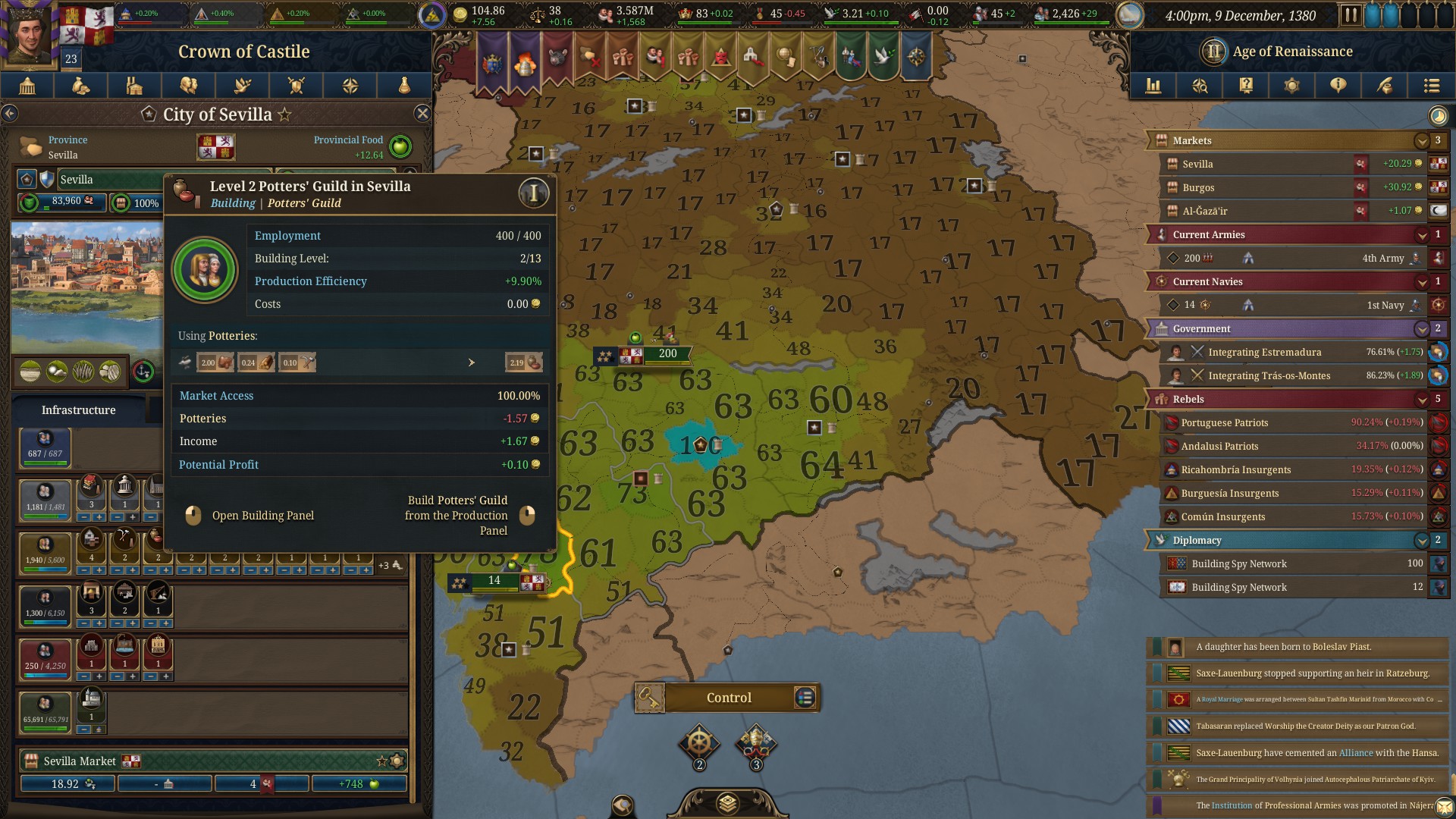
The first thing I noticed is that the production and trade system has been scrapped and replaced with the much more detailed one from Victoria III. It’s a good system, and a nice elaboration of the earlier versions’. But a game about the 19th century is about industrialization, and showcasing all the changes that brought is part of the point. Trade flow, as seen in EU IV is part of the point of the Age of Exploration, so I really liked EU IV‘s trade network (with some notable problems). Obviously, trade will open up with longer distances available later, but I don’t think it’ll have the same kind of impact.

On the other hand, its a really good system for mucking around with internal improvements, and feeling good about building everything up. That makes it a good system for the local end. Unfortunately, there are some missing bits of information. The market each province is attached to is dependent of market availability, the ease of travel to each one. But, there’s no map mode showing how all that works out, i.e., how the pull to each market happens. Being able to find “dead” areas would be good for seeing if you want to start a new market, or just focus roadbuilding, but there’s no way to tell that I can find.

Warfare is familiar, but has changed. One thing I appreciate is that you do not have standing armies (or at least tiny ones) at the start of the game. Instead, you call forth levies for the vast bulk of your forces. Presumably, these are much less capable than the regular military units you can build, and become more penalized as the game goes on. Combat itself has changed for the first time since EU III. Namely, they now break it into a center and two flanks (like the CK series), which act somewhat independently. It’s a bit more detail, but I’m not sure how much difference it will really make.

Conquest on the other hand, seems to be a lot more punishing. The process of making a new territory in any way useful is much harder and slower so far. Also, the EU IV version made it pretty clear what you needed: a ruler with good administration, to get the monarch points to kick off the process. Here, you have to assign integration to the cabinet, and there’s a hard limit on the number of actions you can do. Worse, you can’t concentrate on one location, but must spread attention across an entire state (…which encourages just taking a bit of a state at a time, not what I think Paradox has in mind), which slows it down. And strangely, this process is ruled by military ability instead of administrative.

The government mechanics are more of an evolution of… later EU IV‘s. With monarch points gone, there’s nothing nearly as direct to tell you how things are going, but the effects of the people in charge can be felt. For instance, going from a reasonably competent king to a bad one has done much to my game. Revenues are down, I just discovered all the spare manpower of the kingdom has drained away….

Which is why I do like game systems over big sims. With a big sprawling game, there’s a lot to keep track of and juggle. Parsimony in systems means everything’s pointed the same way, and and it easier to see what is going on. As an additional problem, the game is fairly heavy, and it complains that what was a top-of-the-line graphics card five years ago isn’t good enough. One of the reasons why I like strategy games is that they don’t generally need big graphics cards.

While I did pre-order EU V, I was worried that it would be too much sim and too little game for me. Well, it’s one of those sims that you can really sink your teeth into, and spend way too much time with. But it is not a focused game in any respect; if you’ve played EU IV or Vic III and like them, by all means get this game. If you’re newer to big strategy games, this is probably way too much. I’d get EU IV or III first, though those are not good first-time games either.

└ Tags: EU V, Europa Universalis, gaming, Paradox, review
1 Comment

Diadochoi Doesn’t Have the Same Ring

by Rindis on October 30, 2025 at 12:00 pm
Posted In: Computer games

This is the sixteenth in a series of reviews of Paradox’s empire management games. See the earlier reviews here:
Europa Universalis II: A Tale of Two Europas
Hearts of Iron: Europa of Iron
Victoria: Nineteenth Century Essay
Crusader Kings: A Dynastic Adventure
Hearts of Iron II: Return Engagement
Europa Universalis III: A Whole New World
Europa Universalis: Rome: Make a Desert and Call it a Game
Hearts of Iron III: One Plus Two Equals Three
Victoria II: Same But Different
Sengoku: Shogun: Only War
Crusader Kings II: The Second Crusade
March of the Eagles: A Minor EU
Europa Universalis IV: A Fantastic Point of View
Stellaris: Paradox Among the Stars
Hearts of Iron IV: Heart of Production

In May 2018, Paradox announced that they were working on a new game. While the title, Imperator: Rome, was brand new, it was a sequel to the poorly-named Europa Universalis: Rome. The idea was to keep the main defining features of the original title (a combination of EU politics, Crusader Kings characters, and Victoria population tracking), while reworking other major systems and of course giving it a lavish presentation on the modern Clausewitz 2 engine.

Like all of Paradox Development Studio’s games, it is a pausable real-time empire management game. You can control any available country (big or small), and manage its military, diplomatic, and economic development, in a grand strategy game format. It starts 24 years before the previous game, in 304 BCE, and runs to the same end of 27 BCE. The scope is vastly increased, with the map reaching east through India (generally based on the final version of CK II’s map). Both the new map, and new decades help put an early focus on the diadochoi, or successor states to Alexander the Great, which are still major powers fighting each other as the game starts.

The game came out on April 25, 2019, and had two major (and sadly needed) patches before any extra content was done, and I will largely be talking about the state of the game as of patch 1.2, released on August 24.

Currency

One of the things you immediately notice about I:R is that it is currency/resource happy. This is actually not unusual for a Paradox game, but it is more noticeable here, as they aren’t tied into main game systems nearly as well as in, say, EU IV.

The primary currency is, as ever, money. Like in the CK games, the characters all have personal treasuries that can be spent on various events and projects. Unlike those games, governments also have their own treasury, that works like you’d expect, and decidedly as it does in EU IV or Victoria II. Taxation is collected every month, and spent on army maintenance, paying the various officials of the government, and then there’s hopefully a positive amount left to spend on city improvements, recruiting new units, etc.

Manpower works as in most of their games, and acts as a limiter to how much mayhem a country can get up to militarily. Bloody wars will drain this, and when it reaches zero, units in the field will stop getting reinforcements, and you’ll need to rely on mercenaries.

Stability is the usual (for Paradox) measure of internal cohesion, but instead of the discrete levels of the EU series, it is a continual sliding scale that adjusts a little every month. The ruler’s zeal will push it up a bit, and it will naturally decay to a mid-point, like prestige does in EU IV.

Aggressive expansion is the “badboy” rating that has shown up since early games, and has now gotten prominent enough to have a place on the top bar. High values will hurt relations with other nations, cause them to band together to stop you, and can cause domestic problems.

Tyranny is the internal version of aggressive expansion. It represents the effects of various “high handed” decisions, and accumulating lots of it will make various characters less loyal, and make civil wars easier to start.

Political influence replaces influence from Stellaris, or the diplomat ministers in EU IV. It is used to “pay” for diplomatic actions like creating claims on a province, and internal improvements. It comes from a few different places, but the main source is the loyalty of the holders of the top government positions.

Military experience rates the amount of practical experience your country’s military has and is used to purchase military traditions. This is generally dependent on the amount of experience the cohorts/units have, but war exhaustion will also drive it up.

War exhaustion is another statistic borrowed from earlier games (most notably the EU series, though Stellaris also uses a variation on it). Casualties and attrition in war will increase it, and so will raising regional levies, and being at peace will let it slowly go down again. As it goes up, it does contribute to military experience, but more noticeably it will increase unhappiness across the nation, and lower the ruler’s popularity, so that long periods of war exhaustion will at least lower production (of food, technology points, taxes, etc) as that is tied to happiness, and can promote disloyalty and civil wars.

In the initial release of the game, there were four other currencies that had already been removed or replaced by patch 1.2: Military power was used to pay for military traditions, and was generated by the ruler’s martial ability (replaced by military experience). Civic power was used to pay for technology improvement, and was generated by the ruler’s finesse (now paid for by money). Oratory power was used to pay for favors and the like with other characters and many diplomatic options, and was generated by the ruler’s charisma (replaced by political influence). Religious power was used to invoke omens, positive buffs that can be gained on occasion (now a free periodic ability), and was generated by the ruler’s zeal.

These last feel like the three pools of monarch power that are so important to EU IV, in that a better ruler generates these points faster. Unlike that system, they (except oratory power) just feed into one thing, and are not part of widespread central mechanisms of the game. On top of all the other things being tracked, this was one of the big failings of the original release, and had already been improved by their replacement.

Population

Population works largely like in Stellaris (pre-4.0), you only have complete “units” of population (pops), which each have a social strata (noble, citizen, freeman, tribesman, slave), a religion, and a culture. Sudden changes in status and population happen in warfare (pops may be killed, or forcibly taken to another city; also taking over a city generally reduces the status of some pops there).

Gradual changes also happen. Also akin to Stellaris’ model, there is either one pop growing, or one pop declining at all times in a city; as soon as one finishes, another starts the process. There is a particular ratio of the five types that population will tend towards over time (this ratio can be changed by a number of means), and this means there will be pops demoting or promoting to adjust towards the “ideal” ratio. Finally, pops will over time assimilate to the controlling empire’s culture and religion. Generally, one pop will be doing each at a time. All pops have a happiness, that in part depends on how their background is treated, and this assimilation will raise happiness in a conquered province as they become part of the mainstream.

Unlike Stellaris, pops don’t have set jobs to produce particular goods, and instead passively generate gold, research, and manpower (with the former two increasing with pop happiness). The upper classes generate research points, while the lower generate tax income (there are other sources of money, notably commerce from trade routes), and the middle ones provide manpower for the army.

This is still pretty close to EU: Rome’s model, but much more refined. It is a lot harder to see just what is going on, and what is really needed are some trends and projections on what is happening to the population. (Though not having access to those is certainly in keeping with that time period.)

Characters

Like the CK series and EU: Rome, most of the actions in this game are done by characters. They have four primary attributes (Martial, Finesse, Charisma, Zeal) that determine ability in various jobs, along with secondary attributes such as prominence, popularity, loyalty, and corruption.

There is a trait system, at about the same level of complexity as Stellaris’ (maybe less so). And in this game, they are grouped into families, and the most prominent ones expect to have a share in the government. If this is not met, the family is considered scorned, and will start losing loyalty. Also, in a Republic, they will start drifting to the populist faction, which tends to lead to populist-led governments, which have worse bonuses than the other factions.

The important element here is instead of everything revolving around the relationship of a character to the ruler as seen in Crusader Kings, it instead looks his loyalty to the state. Rulers may come and go, but they generally don’t cause immediate changes in loyalty. A popular ruler will generate loyalty, and republics have factions with loyalty depending on that. Disloyal characters will block efforts to hold them in check, and may band together in a civil war.

Government

There are three general types of governments, all of which have offices held by various characters. Like in EU: Rome, this is a combination of Crusader Kings and Europa Universalis (pre-Dharma) mechanical underpinnings. There’s subtypes with different bonuses and idea slots (essentially the same system as EU: Rome), but the general mechanics stay the same.

Republics have a senate with one hundred seats, where each seat is associated with a faction. However, they are not associated with particular characters, and the alignment shifting due to a number of factors, including the power of the leaders of each faction (which are characters). Each faction grants bonuses for being in charge, except for the populists, who increase the cost of everything.

Naturally, senate support is needed for a number of actions, like declaring wars. Prominent families generally feel entitled to a number of jobs within the government, and if they don’t get it, they start moving over to the populist party, eventually making them the major power block, and degrading the republic’s ability to get anything done.

And to better represent the elephant wolf in the room, the aristocratic republic sub-type has co-rulers (consuls). This lets the government get traits from both, and the higher attribute from either consul controls government modifiers. Also, they will probably be from different factions, allowing benefits from both. On the other hand, both consul’s corruption will potentially corrode the rest of the government. (Monarchies generally get the same effect with a consort.)

Monarchies just have a number of offices to fill, and allow the ruler(/player) to do as they want. Instead, they need to worry about legitimacy and the succession. A functioning republic will go through major changes every few years, but it won’t affect stability much. A monarchy has to worry about pretenders, which can become very acute whenever a ruler dies. There will always be a loss of stability and loyalty, and a new ruler who is not already popular may easily see a civil war break out.

Tribal governments consist of a number of clans, with one in charge of the nation as a whole (this, and much of the rest, is borrowed from CK II: Horse Lords). Instead of legitimacy, they use centralization, which at high levels can allow them to settle down into one of the other government forms. On the other end, a tribe can become a migratory tribe, allowing pops to turn into light infantry migrant cohorts, which can then settle elsewhere. These governments rely on the tribesmen strata, which will generally be happy, and more productive at the same things as freemen, but that leaves the government with little to no research. An oddity is that each clan will generally have its own retinue, but when the clan leader dies, it’ll devolve upon the state.

Know the Territory

Like all other Paradox games (other than Stellaris), the game uses an area map of territories. Each one provides a trade good (like in Europa Universalis), and produces a bit of food (even if not producing a food-related trade good). They are also the level population is tracked at, and they have a civilization level, which is a measure of the stability and infrastructure of the area, and will slowly grow towards the government’s maximum value (this is largely taken from EU: Rome).

Territories are grouped into provinces, which provide a higher-level organization to work with. The province the capital is in is automatically run by the ruler, but other provinces generally need governors, and policies can be set cause various bonuses in them (such as increasing happiness at the cost of taxes and goods, increasing pop promotion and demotion…). Provinces are also rated for loyalty with both that and governor (character) loyalty being separate ways for a country to descend into civil war, and cause even more problems for large states.

Provinces are also grouped into regions, though they are less important in game terms, though provinces in the home region do get a bonus to loyalty.

The territories are also rated as settlements, cities, and metropolises. Settlements can only have one building, but generally tend towards a high proportion of slaves, which makes them good for trade goods and food, as well as generating taxes and manpower. Cities get a higher population limit and generate trade routes and research with higher populations of nobles and citizens, and have a number of buildings (the exact limit tends to vary quite a bit). Metropolises are rare (the Mauryan capital of Pataliputra is the only one at the start of the game), and are generally just super-cities with stronger modifiers.

This all assumes the territory has been colonized by a semi-stable government. As you go north-east on the map, you run into areas that haven’t been, and have no recognized government. Once an adjacent territory grows populous enough, you can colonize it and claim it as your own. However, there’s also a good number of impassable territories, and some of them (and uncolonized territories) are considered barbarian strongholds.

These will gain barbarian power regularly, and as that goes up, they will spawn traveling barbarian hordes who will roam about the map looting and pillaging. Generally, they need to be hunted down and eliminated, and will provide new slaves, as well as prestige for the victorious general, but in the meantime, they will damage the civilization value of the areas they wander through.

Trade

Each trade good provides a bonus (like food types provide bonuses to growth). All the goods from a single state are pooled together, and their bonuses apply to every province in the state (food supplies work in a similar manner).

If more than one province provides the same good, then there is a surplus. These do have their own bonuses, but they aren’t as strong as the initial bonus for the good. So instead you can trade them from one state to another, like in the original EU:Rome. Like in the original, the number of trade routes is limited, and needs setting up at the start of the game. Unlike there, these also generate commerce, which shows as extra money income. Exports are encouraged as trading with a different country generates more revenue, and generates a third bonus related to the surplus ones, but generally on a different statistic.

Overall, the need to set up trade routes from scratch every game was one of the pain points in EU: Rome, and I’m disappointed to see it return here. The good news is that the computer is good about finding your surpluses and asking to import them, so you’ll get all the export bonuses easily enough, but finding who has the items you want and talking them into it is a real pain.

Technology

There is a technology system in Imperator: Rome, but it’s noticeably different from any other game they’ve done. (Actually, I can’t think of any game that does it like this. And do note this is as of patch 1.2; it would change in 2.0.)

There are four general fields (martial, civic, oratory, and religious), and each month a number of research points are generated. This is modified in each field by the finesse of the head researcher for that field (this is a set offices consistent across government types).

This generates progress in the field, which then turns into a new level. Each level gives a bonus related to the field (e.g., increased omen power for religious advances), and so is worthwhile in itself.

But, the primary effect is that each level unlocks three new advancements that give a permanent bonus. Note that these aren’t all new abilities, but rather modifiers like -10% attrition or +1 import route (in the capital). So, you don’t get to do anything new, but the country will get better at doing things over time. Getting the advances then requires paying money for them.

So, at the start, there will be twelve advances available (three in each field attached to level 0). Once those are bought up, nothing more will happen until roughly twenty years in, when the various fields should hit level one, and new advances become available for purchase. There’s twenty levels in each field, so there’s 240 separate bonuses to buy.

As mentioned under population and government, this is all powered by freemen, so tribal governments have trouble generating research at all, and the eastern countries often have problems generating them fast, so the western non-tribes (Rome, Carthage, et al.) will get ahead in research, and become much more capable as they start buying the new bonuses.

Military

Imperator: Rome armies rest on nine different types of combat units, six of which require provincial access to particular trade resources. Chariots instead require being part of a barbarian or Indian culture group. Naturally, there’s a detailed relationship between all the various types, which complicates things in ways hard to describe. However, light infantry and archers are what’s always available, and while the latter generally do better against other troop types, they also will lose morale faster.

Combat presents itself much like in Europa Universalis, but has important differences. Like other similar games, each unit (cohort) takes one space in the battle line, and largely fights the units opposite it. I’m not at all sure of the math, but morale values are fairly low, and individual units swiftly start retreating. The die roll added to results of each side is a d6, instead of the d10 used in other Paradox games, so there is less variance in results.

Cohorts can attack a number of squares away rated as mobility, so large armies with cavalry (to hit from the flanks) will do well, while both light and heavy infantry have staying power from reduced morale loss.

Past all this, there are military traditions, which are a bit like ideas from other games. There are seven different sets in the game, each tied to a particular culture group, and each one has three paths. You can only choose the next one in line in each path, but you can pick any path each time. Generally, a well-trained military gets you more more military experience with which to buy these, so keeping units drilled, or getting into lots of wars will let you get ahead on these. Getting to the end of a path also generates a second bonus.

Mercenary groups are available for those countries with a shortage of experienced troops. These are a bit like the ones in CK II, but they have a permanent on-map presence. Once hired, they start at 0 morale, and work up from there so you can’t just dump your newly-hired mercenaries on an unsuspecting enemy army.

Sieges work exactly like in Europa Universalis IV, except that the local food situation can affect how long a cycle lasts (with low food shortening it quite a bit). Also, like in EU IV fortresses exert a zone of control that can block enemy movement, and will automatically convert adjacent provinces.

On the naval side, Paradox actually goes into some of the arms race between the various Successors, with military traditions allowing the really big octeres and larger. Most countries, if they need a serious navy will build tetreres and hexeres, and the bulk of any navy will be the more famous biremes and triremes. Somewhat surprisingly, these latter don’t need any particular resources to build (I suppose it’d be too easy to lock someone out of any navy at all), while the others require wood to be available. Generally speaking, a ship will have a combat advantage against anything smaller than itself, but the small ships are much more maneuverable, allowing them to gang up on elements of a smaller heavier force.

Conclusion

The initial release of Imperator: Rome had plenty of problems. Performance was poor, and as seen, there were even more mechanics and currencies scattered around than as of patch 1.2. Sadly, while the bones of a good game were there from the start, there were some bad reviews (though, professional reviews were positive, and the others tended to leave me wondering if the person had ever played grand strategy games before). More to the point, it exceeded Paradox’s sales expectations, but engagement (play hours) was low.

It falls short of Paradox’s previous three games (HoI IV, Stellaris, and EU IV) because they all were at pains to keep the number of independent systems down, even if only by linking everything to one central mechanism. Release (1.0) EU IV in particular was a great study in how to create interesting decisions by having so many things come back to monarch power. Here, we got a mess of separate currencies for a mess of independent systems that don’t drive back to a central theme.

I do find it a worthy successor to EU:Rome, improving on some of that game’s shortcomings, and of course is on a great subject. Given the number of systems that were rewritten for the better in the first two years of EU IV, and Stellaris’ journey to 2.0 in its first year-and-a-half, and the clean up that had already happened in four months, I:R was worth some patience.

└ Tags: Imperator: Rome, Paradox, review
 Comment 

The War at Sea

by Rindis on September 4, 2025 at 12:00 pm
Posted In: Computer games

This is the fifth in a series of reviews looking at the evolution of Hearts of Iron IV. See the previous reviews here:
Hearts of Iron IV: Heart of Production
Together For Victory: Commonwealth of Iron
Death or Dishonor: Heart of Eastern Europe
Waking the Tiger: Heart of China

After Waking the Tiger, Hearts of Iron IV development moved on to the second major expansion, this time introducing a new design system for ships. Man the Guns was announced on May 19, 2018, and was released on February 28, 2019 alongside patch 1.6. Over a month later, patch 1.7 moved the game to 64-bit code, and near the end of the year patch 1.8 moved the game to the new unified Paradox launcher (talked about in the EU IV: Golden Century review).

Fuel

The biggest change in the patch to the underlying game was a change in resources. Oil is still one of the major resources produced in various parts of the world, but is no longer used in unit production. Instead, all oil a country gets a hold of is converted into fuel.

Fuel is a persistent resource; that is, it is stored until used. The revised UI has a small bar next to the fuel symbol showing what percentage of available storage is occupied, and will tell you how long until you fill it up, or how long until it is gone.

Regular infantry, cavalry, etc does not use fuel, but all mechanized formations do, aircraft do, and ships use large quantities of it. Like regular supplies, divisions will store a couple day’s worth internally, which they will consume if cut off from supply. If a supply zone’s throughput is overloaded, other supplies take priority, so fuel will start getting cut off first. When internal supplies run out, mechanized battalions will fight at 10% normal effectiveness. Aircraft consumption is based on the type of mission (“intercept” is efficient, while the long-range logistics and port strikes consume more), and will be at 25% efficiency while out of fuel, and ships are at 50% combat and 25% range (submarines get 20% of their normal torpedo attack).

All countries get a nominal base production of fuel per day, and then convert all the oil they have. Synthetic refineries produce fuel directly, and there are now five technologies that increase the fuel:oil ratio, as well as a new state-level building that stores it.

Overall, it’s a good change, and starts weaning HoI IV off of a resource model where having plenty of something at the start is of no help if you exceed production later. It can be irritating to have to worry about fuel just as there is more need to operate ships that consume lots of it in peacetime, but it is a much better model of the importance of oil.

BuShips

The major feature of the expansion is an all-new ship design system. Instead of just having a general ship type (e.g., 1936 battleship) that you can then add bonuses to in four different stats, you now add modules to a hull that provides base stats (kind of like in Stellaris, but it’d probably be better if it was even more like that system).

This does mean that there are a lot of extra technologies to research in the ships screen for various components. Most of the base hull technologies are faster than the complete ship verions, and there are fewer of them, as there is just one set of “cruiser” hulls, with “heavy” and “light” being purely determined by turret type (and type of armor now determines battleship or battlecruiser for heavy hulls—this should have been true for cruisers as well). This combination means that it takes just about the same number of days (assuming everything is researched at the base rate) of research to get through both versions (discounting some all-new bits, like mine warfare), and there was also an extensive rework to research bonuses in the patch.

The interface on this has a number of problems, starting with the fact that the slots and their contents are not well labeled (by the way, “fixed” slots are below the ship diagram, and optional/variable slots are above). Oddly, before you could, for example, pile more armor on a battleship, but here you can only use the available module types, so there’s only three discrete choices for battleship (or any other) armor now. When you get a new hull, your latest design on the old hull gets copied over to it, so that update is easy. But, if you have a bunch of specialty designs, you may need to manually go and re-create them on the new hull; thankfully, many specialist ships are probably meant to be second-line ships that you can keep on older, smaller, faster to produce, hulls. But if you are actively building and modernizing, for example, light cruisers and heavy cruisers, one of them will have to be updated by hand, at a high cost in naval experience.

The good news is that the patch also added the ability to do naval and air exercises. This of course will use up fuel, which is a problem for countries struggling with their oil supply, but means you can get peacetime naval experience with which to design these new ships.

Construction changed as well in the patch. Shipyards still do not use the efficiency mechanic of factories, but now there is a cap on how many can be designated to a particular ship. Capital ships have a limit of 5 shipyards, which puts a very hard limit on how fast a capital ship can be produced. A very interesting side note to that is that repairing a ship now also takes shipyards. Be careful as to what occupies the bottom of your naval production list, as they may be halted to repair damage from combat or a mishap during a training patrol.

I was one of the people excited for a more detailed ship designer, but the experience is underwhelming. There’s a number of problems, which generally boil down to a lack of obvious interesting decisions. You can put just about everything you want on a design, leading to very good generalist ships that won’t give you any trouble. It might be very slow to produce, but while the interface tells you the cost, it doesn’t tell you how that translates to build time. That said, once you think your way through a naval strategy, there’s plenty of room for specialty ships.

A good feature is that you can update older designs to use newer parts, and refit existing ships to that new design. Notably, most radar technologies now unlock a better radar module, which you could refit into existing designs. Fire control is a separate technology dependent on computing machine technologies and add bonuses to hit chances. You can refit much more than these, but they are force multipliers, relatively cheap, and were often refitted on ships historically. The real problem here is that refitting is done by finding a ship, telling it to refit, waiting for it to arrive and show up at the bottom of the build queue, and then (possibly) repositioning it in the queue, and reworking dockyard priorities. It’s nice to be able to do it, and generally takes no resources, but it needs some automation (e.g., telling the game to send one ship of a particular class in at a time to get new radar sets, or being able to refit a ship while its already under repair).

Enemy Mine

One thing that does increase the potential naval research time in the expansion is a group of nine new technologies around naval mines. The basic tech (that most countries should start with) allows the use of minelaying and minesweeping gear.

Generally speaking, both are best done by destroyers, though other surface ships can take the module. Two of the other techs allow submarines to deploy them, which allows for potentially sneaking into enemy waters to cause mayhem. Areas are rated for the general number of mines present, and cause enemy (but not friendly) forces to suffer ‘accidents’ and take a penalty to invasions on those coasts.

To help with the problems created by this, the expansion also lets you restrict your forces’ travel through a sea area. You can set access to either avoid or blocked, which will cause all non-manual sea travel to not go through there, possibly just to force trade routes to go through areas you have more control over, or to avoid places known to have mines or submarines operating.

In general, it’s a nicely done feature, but I’m reminded of Federation & Empire avoiding the entire subject because it’d boil down to if you have minesweepers along, you’re safe, otherwise you’re not. And despite the potential power of a solid minelaying strategy, most people (even multiplayer) ignore it… and so does the AI. It will never make more than a minimal effort at minesweeping, so this can be too easy of an advantage over it.

Big Happy Fleet

Naval organization was also completely redone for the patch. Paradox finally introduced a good amount of hierarchy for naval forces, which does help with distributing them. That said, the interface is is pretty difficult to decipher. Thankfully, initial naval forces are pre-distributed in the new scheme at the beginning, unlike land forces, which must always be arranged in armies and theaters manually.

Just like land forces, there are now naval theaters, which can be used for geographical splits, or just to organize by type (say, all the minelayers in a separate theater). Theaters can contain any number of fleets (which is the only level that uses admirals), which can then have task forces. Each theater always has a reserve fleet, which can contain task forces not assigned to a normal fleet, and can serve as a ‘holding pool’ of ships used to bring regular fleets back up to strength after losses.

One of the options in the ship designer is to assign an icon that symbolizes the design’s general role; this is important, as that’s how the task forces work assignments. You set a task force to have so many ships of a particular type, and a particular role, and the game knows to send ships of that type to it when some are missing.

This is all a big help—once you’re used to it. I’d say it’s harder to figure out at first, but with the separate patrol and strike force missions you can really make naval dominance work. However, production seems to get confused if there is more than one naval theater, and there is now an unfulfilled need for the logistics screen to tell you how many ships (especially destroyers and subs) are needed to fill out your task forces.

Britain Redux

Part of the patch was a rework of the British focus tree, though three extra branches are also added by the expansion.

The general rearmament branch got expanded and reworked in the naval section, and the Special Air Service was added for a bonus to the number of special forces formations allowed. With the expansion, the colonial branch can turn the Commonwealth into the Imperial Federation, a super-state of all or most of the Dominions (this will require a lot of stored political power for a series of decisions).

New to the expansion (and mutually exclusive with Reinforce the Empire) is a decolonization branch, which will dismantle the British Empire, but will grant more manpower at home (immigration of people who think they’ll do better there than under the new independent governments).

Then there is a pair of mutually exclusive branches, one of which is partially a rework of an old sub-branch that aimed towards war with the USSR. The overall branch is the historical appeasement policy, and is intended as a ‘play for time’, while getting rearmament going, and so includes focuses that construct coastal forts or other bases, and the Home Defense branch includes “Prepare for the Inevitable” for a permanent civilian factory boost.

The final branch is the full-on alternate history section, and the first sub-branch starts with Edward VIII staying King of England, while marrying Wallis Simpson, and leads to events causing revolts throughout the empire, which then must be stamped out with loyalist help. The second sub-branch is the Fascist route, which can kick off a civil war, but spending political power can avoid this, or at least put if off until winnable. The third is the Communist branch, which focuses on granting various concessions with trade unions in return for bonuses to help rearmament.

In addition, the patch included around seventy new countries releasable from current nations. Some of this was needed for the decolonization above, but the rest was put in just to be consistent with those.

New Deals, New Civil Wars

The American focus tree was also completely reworked for the patch. The main idea was to give the US player more to do in the early game, when usually it’s a case of sitting around, forced to do nothing while the war gets going. To this end, Congress was added with the patch, and current support can be seen in the decisions menu. Many focuses now require sufficient support from Congress, and there are plenty of random events as well as decisions that will adjust this.

Naturally, anything that needs Congress will expend political capital, sending members into opposition after getting it to pass. One of the effects of the Great Depression is -1 political power/day, so after picking a focus, at the start of the game, the only political power available for decisions and such is the extra 0.15/day caused by good stability.

The center part of the main tree is a series of mutually-exclusive focuses, starting with Continue the New Deal and Reestablish the Gold Standard. The former leads to the WPA branch, which has some economic bonuses and a research slot, and the other leads to the Adjusted Compensation Act, which does much the same, though the research slot takes longer to get to.

With the expansion, there are two further alt-history branches, with Suspend the Persecution leading towards communism from the New Deal, and America First leading towards fascism from Gold Standard. Both of these will cause a civil war if pursued, with somewhat different mechanics.

In the center there’s a second choice of The Neutrality Act, which focuses on the internal economy, and Limited Intervention lowers the bar for getting involved with what the rest of the world is dealing with, but is opposed by Congress, making it hard to do anything else. A few more things are available from either branch (such as Lend-Lease Act, though it’s harder to do on the neutrality side).

Overall, it’s a much better experience than the original focus tree, though the truly historical path is still a lesson in patience. The political shenanigans don’t really make up for it, but do give a fuller appreciation of FDR’s second term.

Extras

Two countries got all-new unique focus trees in the expansion.

The Netherlands have five national spirits with the expansion (only one, for Queen Wilhelmina, exists without it), greatly weakening its position. One is their version of the Great Depression (De Crisisjaren), which doubles all construction times. While the Netherlands sat out WWI, the carnage happening just across their borders made neutrality the only reasonable option, and so Aloof Neutrality also acts like The Great Depression in making it harder to join factions and the like, while Shell-Shocked Spectator of the Great War reduces recruitable population and factory output (surprisingly, they do not use some form of equivalent to the US’s Disarmed Nation or Undisturbed Isolation laws—the former seems particularly apropos). Finally, Weak Government lowers stability, and reduces political power.

They start with eleven civilian and four military factories, and three dockyards, the army is eight understrength divisions with a lackluster template (no support companies; but how would they produce supplies for them?), and only 70 recruitable population. What they do have is a large supply of oil from Curaço, aluminum from Suriname, and the Dutch East Indies, a sprawling puppet state (with no national spirits or other tweaks of its own) with its own seven-division army, a single dockyard and factory, and a lot of rubber.

There are three big focus trees, one starting with Abandon the Gold Standard (which they historically did late in 1936) which starts working off de Crisisjaren, and allows for improved industry, and can try to strengthen the military. Obtain Foreign Colonial Investments instead boosts the colonies, and can move the government to the East Indies if forced to capitulate in Europe, and Form New Government opens up a web of potential focuses to try and get protection from one of the nearby major powers. Extra fun bits are works to reclaim more land (which was indeed ongoing at the time), and the ability to flood provinces, which inhibit movement, and greatly aid defensive strength.

Mexico starts with eight civilian factories, three military, and two dockyards. Worse, while there’s good oil production, much of it is under the control of the US and Britain (thanks to the Oil Concessions spirit). Other signs of recent instability include Callistas, which reduces political power and construction, Politicized Army, decreasing planning, and making new leaders more expensive, and Caudillo Tensions, which lowers stability. There’s a surprising twenty-one divisions available, though most of them are really bare brigades, but there’s six regular divisions (infantry and cavalry) with support artillery, and most equipment is already in place.

There are three different civil wars brewing. Caudillo Tensions start “moderate” with a 150-day timer to go to “high”, and then another 150 days to go to a civil war. Various focuses will reset things, but the timer will continue until General Cedillo is supported or arrested in the focus tree, which are 3-5 steps down different trees, or the civil war happens and is defeated. (This last is all I’ve seen the AI manage so far.) The other two depend on the strength of the Catholic Church in Mexico, and can only happen if stability is less than 60%. Stability starts at 22%….

Finally, two extra features are the ability to play on as a government-in-exile (mostly meant for multiplayer), or get the benefit of veteran formations put together from defeated nations who you’re protecting. There’s also two new techs for AMTRACs, armored amphibious infantry carriers to help with landings, and two for amphibious tanks. Both are expensive to build and use, but handy if you have some serious naval invasions ahead of you. (Unfortunately, that last will need a separate template, whereas it might have been better to instead allow an armored battalion that is currently undergoing planning for a naval invasion to temporarily reequip with it. Instead, you’d need a duplicate template with amphibious tanks in place of the usual armor battalions, and switch a division’s template to it, and then back again once the invasion is secure and you’re driving inland.)

Conclusion

All of this came with even more knock-on effects than I have gone into already. For example, regular (as opposed to support company) artillery, anti-tank, and AA battalions are “towed”, and now those can be specified as being truck towed (motorized), so as to keep up with faster formations. This of course, eats up more fuel.

The increased number of alt-history paths for major powers does mean that things can go very strange if you don’t use the “use historical focuses” AI setting. However, Paradox also put in a new interface at this point which lets you direct what ideology each country can/will go to, which might be a lot to set up, but can keep things within bounds. I’d prefer a setting that makes historical paths more likely, but not guaranteed so that things don’t either always go down a historical path, or go completely wild.

The expansion itself is huge, and a mixed bag, with the headline feature (ship designer) not being nearly as good as I think it could be, but still worthwhile. Certainly avoid this expansion if you’re just learning the game. Get to know the base game before getting the ship designer and access to alt-history/faction versions of the US and Britain. Once you know the game, I do recommend the expansion if you’re ready to dive into the details of naval warfare. (I’d recommend getting the early country packs first instead, but they’re now part of the base game anyway.)

└ Tags: gaming, Hearts of Iron, HoI IV, Paradox, review
 Comment 
  • Page 1 of 12
  • 1
  • 2
  • 3
  • 4
  • 5
  • »
  • Last »

©2005-2026 Rindis.com | Powered by WordPress with ComicPress | Hosted on Rindis Hobby Den | Subscribe: RSS | Back to Top ↑