Rindis.com

All my hobbies, all the time
  • Home
  • My Blog
  • Games
  • History

Categories

  • Books (503)
  • Comics (10)
  • Gaming (917)
    • Boardgaming (673)
      • ASL (154)
      • CC:Ancients (83)
      • F&E (78)
        • BvR – The Wind (26)
        • Four Vassal War (9)
        • Konya wa Hurricane (17)
        • Second Wind (5)
      • SFB (78)
    • Computer games (162)
      • MMO (77)
    • Design and Effect (6)
    • RPGs (66)
      • D&D (25)
        • O2 Blade of Vengeance (3)
      • GURPS (32)
  • History (10)
  • Life (82)
    • Conventions (9)
  • News (29)
  • Technology (6)
  • Video (49)
    • Anime (47)
  • Writing (1)

Patreon

Support Rindis.com on Patreon!
Become a patron at Patreon!

Other blogs:

RSS Inside GMT

  • Coast Watchers – Session Report – “The Airfield” June 5, 2026

RSS Playing at the World

  • Playing at the World 2E V2 Arrives May 5, 2025

RSS Dyson’s Dodecahedron

  • Cyberstyle 8.4 June 6, 2026

RSS Quest for Fun!

  • The Expense Post May 24, 2026

RSS Bruce Heard and New Stories

  • Pain, Exhaustion, and Morale in D&D BECMI June 7, 2026

RSS Chicago Wargamer

  • The 2 Half-Squads - Episode 310: Cruising Through Crucible of Steel January 27, 2023

RSS CRRPG Addict

  • BRIEFs: Black Crystal (1982), Creepers (1982), Chitei Tanken (1982) June 8, 2026
SF&F blogs:

RSS Fantasy Cafe

  • The Leaning Pile of Books May 24, 2026

RSS Lynn’s Book Blog

  • Booking Ahead/Weekly Wrap Up June 7, 2026
ASL blogs:

RSS Sitrep

  • Cardinal ASL Sins March 18, 2026

RSS Hong Kong Wargamer

  • FT114 Yellow Extract After Action Report (AAR) Advanced Squad Leader scenario April 16, 2025

RSS Hex and Violence

  • This still exists? March 25, 2025

RSS Grumble Jones

  • AAR Slides for Schwerpunkt SP96 Husum Hotfoot June 5, 2026

RSS Desperation Morale

  • How to Learn ASL March 16, 2025

RSS Banzai!!

  • October North Texas Gameday October 21, 2019

RSS A Room Without a LOS

  • [Crossing the Moro CG] T=0902 -- Rough start July 18, 2015
GURPS blogs:

RSS Dungeon Fantastic

  • Felltower House Rules Examined June 7, 2026

RSS Gaming Ballistic

  • B-Scale: Damage That Scales from Tardigrades to Kaiju June 5, 2026

RSS Ravens N’ Pennies

RSS Let’s GURPS

  • Review: GURPS Realm Management March 29, 2021

RSS No School Grognard

  • It came from the GURPS forums: Low-Tech armor and fire damage January 29, 2018

RSS The Collaborative Gamer

  • Thoughts on a Town Adventures System January 18, 2022

RSS Don’t Forget Your Boots

  • GURPS Supers Newport Academy #6: “Old Friends, New Again” June 7, 2026

RSS Orbs and Balrogs

  • Bretwalda - Daggers of Oxenaforda pt.4 - Fallen King May 27, 2017

For the Horde

by Rindis on November 10, 2020 at 12:00 pm
Posted In: Computer games

This is the seventh in a series of reviews looking at the evolution of Crusader Kings II. See the previous reviews here:
Crusader Kings II:
The Second Crusade
The Old Gods: That Old-Time Religion
Sons of Abraham: A Little of Everything
Rajas of India: My Elephant for a Kingdom
Charlemagne: Back in Time
Way of Life: The Short Way

After the focused expansion of Way of Life, the Crusader Kings II team went back to expanding the scope of the game. In this case, exploring the eastern edges of the map (which was re-worked a bit), and the lives of the nomads of the steppes. Horse Lords was released on July 14, 2015, alongside patch 2.4.

The map was also expanded slightly again for this. The geographical scope didn’t change, but some previous wasteland north of the Tibetan Plateau was made into new counties, and new cultures were introduced for them.

Cleanup

Even before announcing the actual expansion, it was announced that CK II was in for another round of clean up and bug fixing. One of the programmers had found in his own game with a successful (and very large) Byzantine Empire, that the vast majority of AI time was spent with all the characters checking ‘can I blind/castrate him’ on all the other characters. So, obviously there were optimizations that could be done.

Along with this, the interface was cleaned up, and got some nice upgrades. Upon starting a game, there is now a large page that comes up giving all the main ideas you are operating under. That is, the type of culture you are, the main government form, and your religion. Moreover, this page can be accessed at any time through a button next to your portrait, so you can see all the characteristics and bonuses.

The idea of honorary titles was also regularized a bit, and a very important one added: commander. Instead of appointing commanders of your troops directly from your vassals and Marshal, commander is now a minor title with some income and prestige, and your army leaders now come out of this pool. The old system occasionally let the same character be in multiple places at once, which naturally caused problems. The new system is handy, since the position also improves opinion, and allows you to vet potential army leaders before you’re desperately hunting through all your vassals as you raise armies for a war.

Nomad Hordes

The main focus of the expansion itself are the nomad tribes of the eastern regions of the map. Without the expansion, the area continues working under tribal government rules (see the Charlemagne review), but having the expansion changes the government and holding types for the region, and allows you to play as a nomad horde, no matter what their religion (though that might become a problem, and cause a Game Over, if you ‘settle down’ as a tribe or feudal/iqta government).

Generally speaking, nomads are looking for empty holding slots, which are used as pasturage, and contribute to their maximum population and manpower. Unlike tribes, this is not one holding per county, and getting bonuses for empty slots, this is one holding in the realm, and getting bonuses for all the counties’ slots. Additionally, their capital is a new type of holding:

Nomad capitals have khans or khagans in a clan. These do not directly generate levies or taxes, and always have a minimal fortification value. However, they have an extensive list of fairly cheap upgrades to the capital, that provide bonuses to population, taxes, morale, combat bonuses, and even movement speed. Moving a capital is fairly easy, and all buildings will go to the new location.

Like tribal governments, they are stuck with one inheritance rule, which is for the male relative with the highest prestige to take over the primary title. Vassals also get a choice as to whether to stay with the new ruler, or declare independence, creating the usual breakup and scramble whenever the current ruler dies. A new feature is to send sons away to become mercenaries, where they will hopefully become rich and famous.

Nomads can hold other holding types (and even build temples) as vassals, but of course don’t see them as directly useful (though holding, say, a castle, can allow a horde to settle down as a new feudal kingdom… who will lose most of his old bonuses, and all the unsettled land, and will need to get more regular holdings in a hurry). So, regular holdings can be pillaged, which causes all sorts of problems (revolts, lower taxes…), but also destroys two building improvements in the holding, and if the last building is destroyed, so is the holding, returning it to an empty state to become pasturage.

Clans

Each independent nomad ruler has an emperor-level title, while his direct vassals (well, the nomad ones), have king-level titles. Each of these denote rule over a clan, as opposed to any territory. So, every nomad realm will have one or more clans in it.

Clans are fairly independent, and for instance, will never provide troops to their liege. On the other hand, there’s no musters in the first place. As intimated above, clans have population and manpower in addition to other attributes, and population is is the prime determiner of income. Meanwhile, manpower is used to raise 250-man contingents for the horde (this acts like retinues from Legacy of Rome, and replaces them for nomads; they’re generally a lot easier and less expensive to raise, but they’re also nearly the entire sum of the available military).

Inside of a horde, the clans have relations with each other, which are spelled out on a new status screen. The primary things you get to see are all the current clans, and their leader, and whether any have a current blood oath or blood feud going on. The former is basically an alliance between the two current heads of clans, while the feud can keep going for generations. It also shows each clan’s sentiment with the others. That is effectively a relations score like the normal ones between characters, but it is turned into a modifier to actual relations between members of the different clans.

In addition, clans can be absorbed into another (if it is small, and probably, unpopular), a large clan can be spit up (which it’s likely to resist), and new clans can be created (really, just a minor clan being ‘promoted’ to being big enough to show in game). All of this helps add a fair amount of… Brownian motion to the structure of a horde, and seems like a pretty good job of getting the fluid nature of nomads into a static game format.

Tributary

Nomadic nations generally have lots of ability to go to war with their neighbors, but can’t have a lot of vassals, and pillaging a rich area down to pastures may be time consuming, and lead to lots of rebellions to put down (but can make you quite rich!), and absorbing lots of new land may unbalance the clans, and lead to internal chaos.

So there’s a new type of ‘vassalage’ available with the expansion: tributary. This leaves the country technically independent, but subordinate to its master, paying taxes to it, and liable to be called up in wars.

Tributaries are fragile relationships, and can dissolve upon the death of the current suzerain. The tributaries aren’t part of the court, so they can’t be part of a faction there (like ‘independence’), though they can declare war on their suzerain to gain it on their own.

Silk Forts

Another slight change to the interface was the ‘tab’ for trade posts was redesigned and regularized a bit. There’s now two special holdings that can be constructed for cheap in most provinces.

The Silk Road was added to the map (for everyone), as a series of routes stretching from the east edge of the map to traditional end points in the Sea of Azov, Constantinople, and the Middle East. Any province it goes through gets bonus income… until war (sieges, raids…) blocks that branch. That stops income on that route, but others will get more money in compensation.

Trade posts can be built by anyone who controls part of the Silk Road, to get even more income out of it. This is subject to limitations by technology, and Merchant Republics can still build them in any coastal province.

Along with those, forts can be built as temporary fortifications in any county you occupy (except that nomads can’t build them). This is a new slot in the same ‘tab’ introduced for trade posts, and are cheap to build, and have no upgrades.

They can (slightly) delay enemies who will have to besiege it before they can get to the regular holdings when invading a country, but the main uses are offensive. The main trouble with attacking nomads is that their counties have no holdings, so as soon as your army moves on, you give up control of the county, and lose the war score taking it gets you. Typically, the only ways to get war score is by winning battles (which can be difficult), and taking their capital (which still doesn’t give much).

But you can occupy a province, build a fort, and then move on. The fort keeps control, and you extend your supply line, avoiding the attrition that being far beyond your borders can bring. Similarly, building a fort on Pagan territory negates the supply and attrition penalties attacking them gives.

Conclusion

I have some problems with this one, caused by the problems of ‘layering on’ new mechanics after the fact. Introducing nomads is a good idea, and they’re handled very well here. But they only exist if you have the expansion, whereas tribes always exist. Similarly, if HL is the only expansion you have, you’re a bit trapped, as settling down can put you out of the game.

What is outside of the expansion is also quite good, with plenty of little touches that round off more sharp corners. Not mentioned yet is the fact that government type is no longer strictly holding dependent. This was mostly to keep from suddenly changing governments accidentally (and maybe ending the game) by changing your capital. But it opens the door to introducing some extra nuanced types, which would happen.

If one wants to play as Genghis, or some other horde leader, this is obviously the expansion to get, and I don’t think anyone desiring that will be disappointed. But the ability to… paint yourself in corner means that it is unwise as a first expansion. Getting one or more of the ‘religious unlock’ expansions (SoI, TOG, SoA, RoI) would be recommended.

└ Tags: Crusader Kings, Paradox, review
2 Comments

Uncommon Changes

by Rindis on October 9, 2020 at 12:00 pm
Posted In: Computer games

This is the sixth in a series of reviews looking at the evolution of Europa Universalis IV. See the previous reviews here:
Europa Universalis IV: A Fantastic Point of View
Wealth of Nations: National Trade
Res Publica: A Tradition of the People
Art of War: Reform-Minded Patch
El Dorado: Expansion of Gold

The sixth expansion for EU IV concentrated on government forms, and administering a country, while the patch introduced major changes to the basic stats of provinces, buildings, and sieges. Common Sense was released on June 9th 2015 alongside patch 1.12. Some general tweaks to the new systems came in patch 1.13 (which is the version I’m reviewing) in late August.

New Developments

In the original two games, each province tracked population, which fed into tax and manpower numbers. By EU IV, this had been abstracted into each province having a base tax, a production amount (which generated money, and value for the trade system), and an amount of manpower. Now all three of these were unified into one system where the total of everything added up to its development.

With the new system, each base tax generates one ducat (yearly) and 1% local spy defense (this was changed to taking over the recruitment bonus of manpower later). Each point of production generates 0.2 trade goods per month, and reduces shipbuilding time. And each point of manpower adds 250 to the nation’s manpower pool, reduces recruitment time, and promotes the growth of fortification garrisons.

The total development in a province has a number of effects: Each point generates provincial trade power, raises the supply limit, adds to the national land and naval force limits, and reduces missionary strength (making prosperous provinces harder to convert). Also, development determines a province’s cost in a peace, the amount of overextension it generates, and other similar things.

As with the old system, you can get events that will add to, or otherwise change around development points, with the expansion, you can also buy development with the appropriate monarch points. The base cost is 50/development, but that is increased by some terrain types, and it gets more expensive as development goes over 10. However, a major part of the idea is for small countries to be able to ‘grow tall’, pumping spare monarch power into the provinces they do have, and making them rich.

Building Forts

With development as a new thing to manage, the building system that had carried over from Divine Wind was done away with for one with fewer buildings, and more choices to be made. Instead of the six categories with six levels each, plus manufactories, plus various unique buildings, there are now 10 separate buildings, most of which have two levels (forts have four levels, trade buildings have three, and universities have a single level), plus five types of manufactory.

More importantly, each province can now have a limited number of buildings at all, and forts count against this. The base is one slot (for having a city; i.e., not being a colony), with bonuses for good terrain (farmlands add two slots), and an extra slot for every 10 development in the province, so only the very richest provinces can even have all the possible buildings.

Forts got a very important change, that reworks how wars work overall. It had always been the case that each province would have a fort, with the level going up as technology unlocked more types, and money was available to upgrade them. Now, the limited building slots mean there just isn’t room, and forts are now expensive.

Maintaining a fort now costs 1 ducat per month per level. Putting a basic fort in every province would wreck the economy of the wealthiest nations. However, forts now protect all friendly provinces adjacent to them, as well as their own province. Moreover, they have a zone of control, which keeps enemy troops from marching through any province adjacent to it.

So instead of wandering around the countryside, seeking out an enemy army to defeat, and sending out lots of small detachments to individually siege every province, movement is constrained by uncaptured forts. Once adjacent to an enemy fort, your only movement choices are to move out of range (or the country as a whole), or to the fortress province itself. Once in a province with an enemy fort, you can only exit out of the country (if it’s on a border), or back to where the army entered the province from.

You still besiege non-fort provinces, and they will fall to you after one month (/siege cycle), but if you have not taken or besieged any adjacent enemy fortresses, it will revert back to the enemy one month after you leave.

Since there’s fewer of them, sieges are now much bigger operations, needing three times as many troops as before. Also, each ‘building level’ generates two ‘fort levels’ in terms of the bonuses against siege rolls. Every capital gets one free fort level, even if there’s no building there (so even the tiniest, poorest, country has a +1 fort in its capital), which gives capitals all the in-between ‘odd’ levels.

The siege rolls changed slightly in that rolling a ‘1’ never generates progress, and instead kills 5% of the besieging army from disease. Also, ‘obsolete’ fortresses have a penalty, making them quicker to siege, as do fortresses that have less than half of their garrison. Overall, sieges tend to take a bit less time than they used to when a military is well-equipped for them; but the higher fort levels (especially in a capital) also lead to some very long and expensive campaigns.

An existing fort can also be mothballed, giving it half maintenance cost and no garrison. This is a great way to have defenses, and a good peacetime budget. However, if war breaks out the fort may need to be reactivated, and it will take time for the garrison to grow back to full, allowing a swift-moving enemy to get the bonus for it being under half strength.

A smaller change also had a big effect on wars: Armies and navies are now locked into going to a province once they are halfway there. That prevents a lot of fiddling around, and ‘faking’ going to a province, and makes actual interception of forces possible, as you might not get there ahead of an army, but you can get there before he can leave again.

Rate My Government

A smaller change to the overall game was that all nations now have a rank, as a duchy, kingdom, or empire. This has nothing to do with governmental forms, but purely with how large and powerful it is. This system exists without the expansion, but is seriously downplayed as changing ranks is generally disabled.

Generally, being a higher rank makes it less likely to be made a vassal (for the AI), and adds to the number of diplomats and military leaders available. Some forms of governments also get scaling bonuses, where it gets better with a higher rank, and the tribal governments generally ease their penalties at higher rank.

Only a handful of countries start as empires (including Byzantium, which is appropriate, as you generally don’t go down in rank). Small duchies can become kingdoms once they have 300 total development, and kingdoms can become empires at 1000 development. There’s a few extra wrinkles thrown in, such as member states of the HRE are always duchies, with electors capable of becoming kingdoms.

It’s a fairly small change to things, but there’s enough wrinkles to it all to make it a fairly neat passive subsystem. Large countries get a little more diplomatic weight, an extra leader to go with all those armies (and fronts), and the AI is protected from predatory vassaling players.

Free Cities

The patch introduced a new unique government type for the HRE, the free city. They get bonuses to trade and development, and in return increase imperial authority and revenue. The city also gets extra protection from the Emperor (attacking one isn’t advised). And, being a free city, once one gets a second province, it stops being a free city, and reverts to an oligarchic republic.

Mostly, this is an attempt to re-work the internal forces of the HRE. Since they get extra protection from the emperor, and they provide money and authority to him, there’s a lot more motivation to keep the member states small, instead of slowly growing to a small number of larger states.

Along with this, the main workings of imperial authority was also redone, to have more monthly changes instead of big events. Having more member states in the HRE, and having more free cities and electors was rewarded. However, as having ‘heretic’ princes lowers authority, it means that reform of the empire is much harder once the Reformation gets going (…which seems like a good side effect).

So You Say You Want a Constitution

The expansion included a new feature for some government types. The late game Constitutional Republic and Constitutional Monarchy, now have parliaments, along with the unique English Monarchy government (only available with the expansion).

Any government with a parliament will regularly have debates (well, you don’t have to, but it costs legitimacy to ignore it). There’s a large number of different possible subjects for debate, most of which will generate a bonus for the next decade, and a few can generate stability, or extra base tax.

When one is proposed, it is debated with a 0% chance of passing. To get it to pass, one must bribe a number of seats in the parliament, which are each attached to a particular province. Each seat gets a bonus to taxes, production, and manpower, but the more seats there are, the more of them need to be bribed for a decent chance of winning a debate. The bribes are varied, and what each seat asks for will depend on the province, but it can run from gold, monarch power, army tradition, to more specialized things like fervor (the Reformed religion special mechanic), to imperial authority (for the Emperor of the HRE).

Since it grants extra bonuses, it is rather like the ‘extra powers’ that some religions get through various expansions. At the same time, its a nice touch for England, as it does give it an extra dose of early flavor, like the other unique governments earlier expansions had added. And it does come with a cost, as a failed debate costs prestige, and winning a debate not only costs the bribes mentioned above, but as the debate goes on, there will be a number of events popping up for further bribes to the seat (almost always money), or lose support.

In the Name of God

When EU III came up with the governmental type system, theocracies were an off-branch for a few governments, with the papacy being a special form. Now that monarchies and republics each had their own mechanic (legitimacy and tradition), theocracies got devotion as an equivalent in the expansion.

This doesn’t generally slowly move up and down a little every month as with other two (it will with positive or negative stability, but other effects are more rare), but there are events that will shift things. Unlike the others, devotion has no effect on unrest or stability, but it does affect taxes and prestige, as well as papal influence (if Catholic) or church power (if Protestant).

Also with the expansion, most theocracies get an event to choose an heir (it’s normally just a random new ruler at the former’s death without it). This can be a fairly long list, and it’s really just a choice between different immediate bonus and penalties (money, prestige, devotion, ect), with the heir’s abilities being decided after the decision.

More Religion

Paradox continued to add nuance to religions, adding Tengri to central Asia (replacing some of the shamanist area), and adding Zoroastrian for one province (and possible CK II conversions). Buddhism was split up into Vajrayana, Mahayana and Theravada branches. All three versions get increased tolerance of heretics, but differ on giving bonuses to morale, advisors, or ideas.

The expansion also gives all three versions of Buddhism a new mechanic, karma. This is a 0 to 100 slider, like several other scales in the game, but the general goal is to balance it in the middle instead of just running it up to max. At low karma, you gain discipline and lose diplomatic reputation, while high karma is the opposite, and balanced karma gives a stronger bonus to both. The reason for splitting Buddhism up was that each version gets its own events, or its own choices for the same event, so that each one interacts with karma and the world differently.

At the same time, the Protestant religion got a new mechanic with the expansion. Church power accumulates, a bit like fervor does for Reformed, and allows purchase of church aspects. Power grows at rate equal to one tenth the total monarch power generation of the country, multiplied by the nation’s religious unity percentage, so a large country split between competing religions will have a hard time getting anywhere until things get under better control, while a one- or two-province minor can generate power quite fast.

Instead of the Reformed mechanic of using power to keep a bonus active, it’s technically a one-time purchase. But there are twelve possible aspects, each with its own bonus, and only three can be active at a time, so once there are three, they can be slowly changed out for other bonuses as more church power accumulates.

Conclusion

Originally, you needed this expansion to be able to manually increase development in a province, which made this very much a ‘must get’ for anyone. The game was just as playable as before, but there were too many references to increasing development to not feel some aggravation over not being able to do it. However, patch 1.28 moved this ability to the main game, so this expansion is no longer needed for that.

That leaves the major reasons for purchase as the new government and religion mechanics. As such, it makes a great companion expansion to Wealth of Nations, as they both enhance India and surrounds and the Reformation religions. Parliaments are a little limited in scope as they belong to later mid-game governments, though they’re a great addition if you wish to play England (which is a good country to play as).

Government ranks (and changing them) are a tiny feature, but if you’re playing to expand from a small start, being told you’ve ‘ranked up’ is at least as good as the actual reward. And finally, there’s the theocracy mechanic, which I feel should be in the main game (though it comes up rarely enough), alongside legitimacy and tradition. Overall, there’s a bunch of smaller things here, and I don’t see this as a meaningful expansion for a new or occasional player. But if a couple of the features strike your fancy, there are some good ones here still (and keep in mind that the ‘national focus’ feature from Res Publica comes with this expansion as well, if you don’t have that).

On the patch side of things, this was another major shakeup of how the game is played. The new siege and committed movement systems make a big difference in war. In some ways, it’s quite easy to miss the more free-wheeling movement and countermarches of any of Paradox’s games until this point, but there are compensations. You really need to think about how your forts ensure the protection of your realm, and how to take apart an enemy’s defense line.

Wars on land are a little more sedate now, though there’s still scope for more mobile warfare away from congested Europe. Coupled with some minor interface changes that made a lot of on-map things more visible, it was a great update to the game.

└ Tags: EU IV, Europa Universalis, gaming, Paradox, review
3 Comments

Expansion of Gold

by Rindis on August 18, 2020 at 12:00 pm
Posted In: Computer games

This is the fifth in a series of reviews looking at the evolution of Europa Universalis IV. See the previous reviews here:
Europa Universalis IV: A Fantastic Point of View
Wealth of Nations: National Trade
Res Publica: A Tradition of the People
Art of War: Reform-Minded Patch

Paradox went back to the New World for the fifth expansion to EU IV. Instead of the North American focus of Conquest of Paradise, the new one, El Dorado, would focus on Mesoamerica and South America, and it would re-work exploration instead of settlement.

It was released on February 26th, 2015, alongside patch 1.10, and patch 1.11 followed on March 8, along with the free “Women in History” DLC.

Exploration

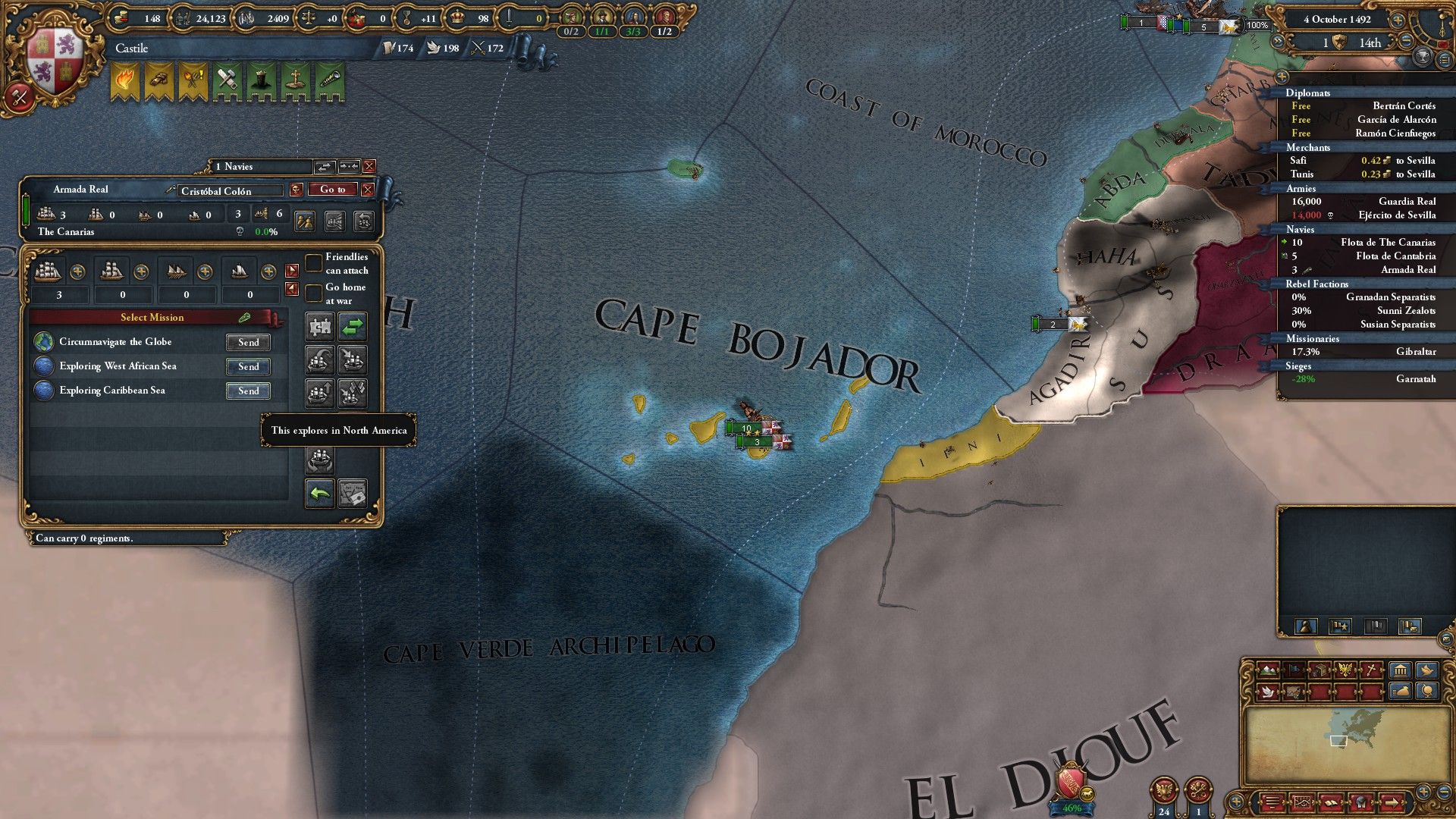
With a focus on the New World, exploration mechanics were re-worked for the expansion. Without El Dorado, it still works the same; get Quest for the New World, hire explorers and conquistadors (instead of admirals and generals), and have them command forces that can slowly uncover new areas.

With the expansion, you never ‘explore’ just by walking into terra incognita (outside of ways that everyone can always do it; notably marching around the interior of a country you’re at war with). Instead, you assign explorers and conquistadors to exploration missions.

An explorer will get options to explore the ‘waters of x’, which will send out his fleet to uncover all the sea zones of a region. Once at least some of these are known, he can ‘chart the coast’ of that region, which will uncover all the coastal provinces there.

These require a fleet of at least three light or heavy warships to do, and once one of these missions is started, it cannot be recalled (you do get a notice when it comes back home). So a lot of control is taken away, and as these only work within your colonial range, it might be difficult to target the area you want. But it takes a lot of micromanagement out, and the ships do not suffer attrition while on these missions (unless the explorer dies, at which point there might be very high attrition on a fleet a long way from home).

Conquistadors can go exploring on their own, which works pretty much like the usual auto-explore command in any game, though the army will halt to rest and replenish troops if too many are lost to combat against native populations.

And finally, explorers can attempt to circumnavigate the world. This takes a slightly higher tech level, and the fleet will take normal attrition. However, the first nation to complete the mission gets 100 prestige, with other nations getting 10 if they do it later.

All of these missions have extra events attached to them, especially the conquistadors. Their auto-explore is actually hunting for the seven cities of gold, and in addition to to the normal dealing with the natives, getting lost, and other exploration events, they may find clues and actually try to find one of the legends of the New World, with a (small) chance of succeeding.

A final note is that a country that builds up a colonial nation first gets a ‘claim’ on all the provinces of that region. Well, assuming you’re Catholic, and only other Catholic nations will care. It’s meant to represent the effects of the Treaty of Tordesillas. Generally, the AI will abide by these claims, and violating them causes relations penalties; though conquering territory from native nations is still fair game.

Religion

With more attention on the New World, three new religions were added: Nahuatl, Mayan, and Inti, displacing some of the generic Animist religion that had been used. They have bonuses roughly similar to Animism, and that’s it.

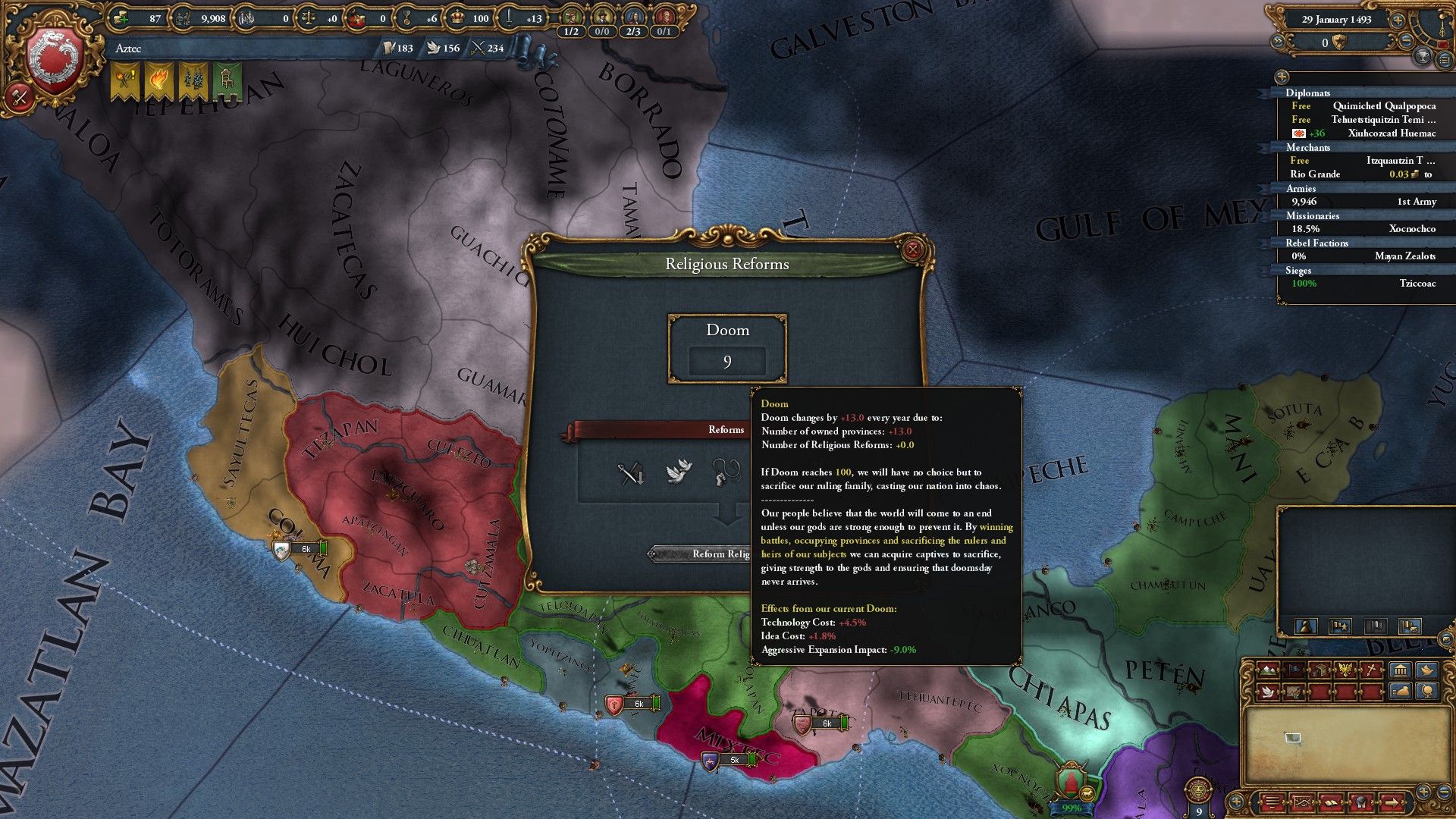
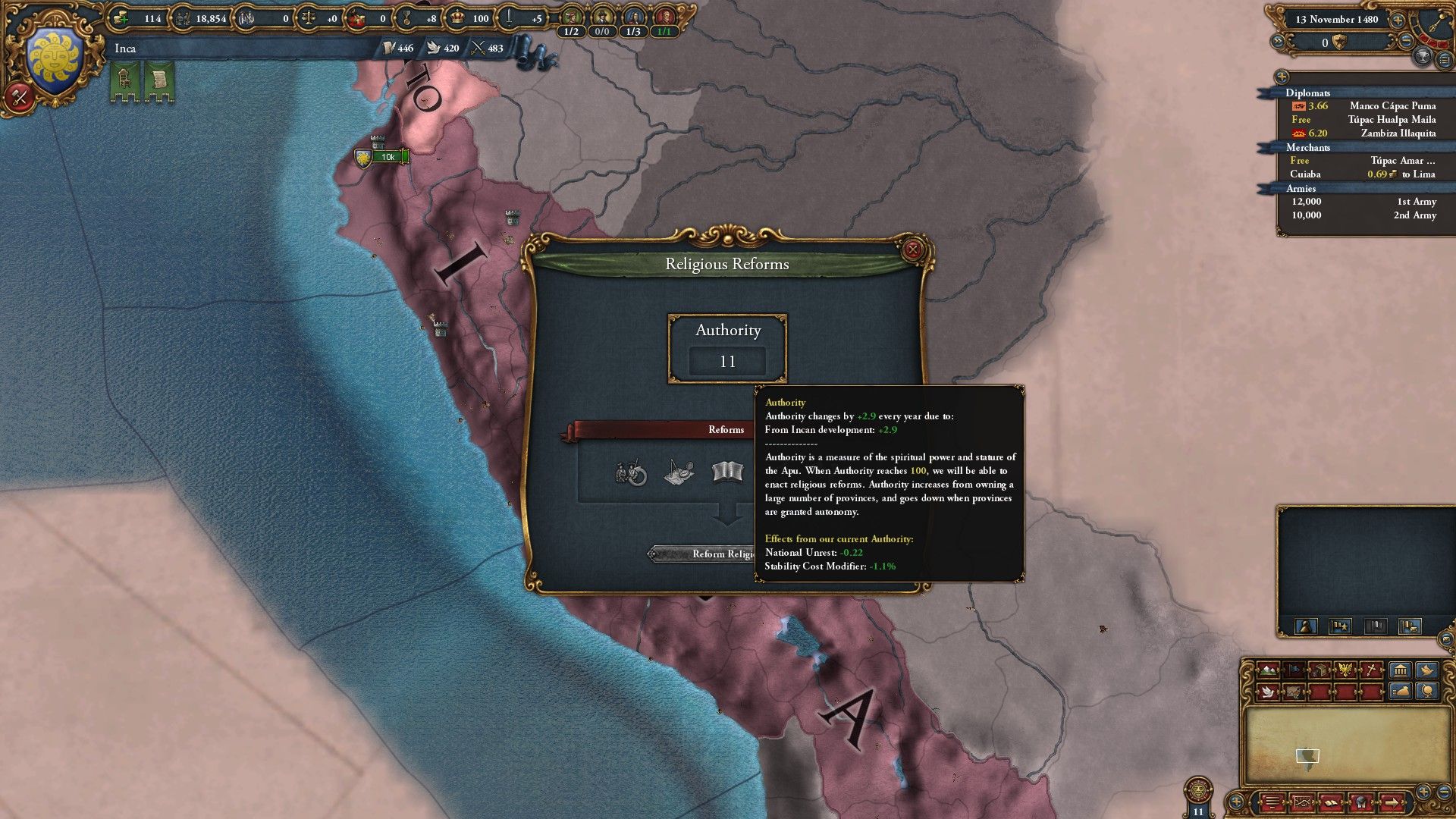
Unless you have El Dorado, in which case they all have similar enhanced mechanics. Notably, they all have five reforms they can pass for fairly good bonuses. Passing one is difficult, and resets everything that was needed to pass it. For instance, a Nahuatl country needs five vassals, and positive stability to pass a reform, but doing so lowers stability and releases all the vassals. Once all five are passed, the religion as a whole can be reformed (if there’s a Western nation on its border), which will basically ‘Westernize’ the country, bringing its tech level up as is done for other methods. Each one also has a unique extra mechanic:

Nahuatl has Doom, representing the Aztec belief in a series of sacrifices to empower the gods to keep the world from ending. Doom is a counter that slowly goes up, technologies and ideas become more expensive, and at 100, the royal family is sacrificed, eliminating the current ruler and heir in favor of a new 0/0/0 monarch. Large battles and sacrificing monarchs can reduce Doom.

Mayans don’t have an overt mechanic, but have to (directly) control 20 provinces to pass a reform. Doing so splits up the country, releasing nations, or transferring provinces to other bordering nations.

Inti has Authority, representing the current power of the Sapa Inca worshiped as a god. Authority is gained from having a large, prosperous nation, and decreases stability cost and unrest. Once it hits 100, a reform can be passed… which lowers Authority to 0, and starts a civil war with pretender rebels.

All three are neat ideas, and are guaranteed to cause instability in the region, especially in Mesoamerica, where the competing states won’t just conquer each other as they specifically need vassals. And naturally, someone has to lose, and since each Nahuatl nation has its own Doom counter (a universal one might be a little more reasonable), sacrifices of reigning monarchs are common.

Liberty Desire

The colonial nations introduced with Conquest of Paradise had a new stat, liberty desire. As of patch 1.10, all vassal nations now use this. Originally, it was just to allow for colonial revolutions, but now any sufficiently unhappy vassal state can rebel. Since one of of the modifiers for this score is just how powerful all the subjects of a nation are (taken together), it’s also a serious brake on just establishing a handful of powerful vassals, who will then act as a buffer against all the other powers, while you concentrate on one or two things.

Below 50% liberty desire, a vassal is loyal, and will act as vassal states always have in the series; always joining wars with the leading nation, and being a good little servant. Over 50%, and they are disloyal, which causes them to stop paying taxes, and only defend themselves in wars. Also, other countries can promise to support their independence. At 100%, the nation is rebellious, and will actively seek opportunities to successfully rebel.

Trade & Treasure Fleets

Trade came in for another round of tweaks, with some general rework of inland trade power. Also, colonial nations now generate an extra merchant for their parent country if they’re large enough (10 provinces). These can be used anywhere, but the obvious intent is to put them into New World trade centers to steer the trade to your own European trade centers for collection.

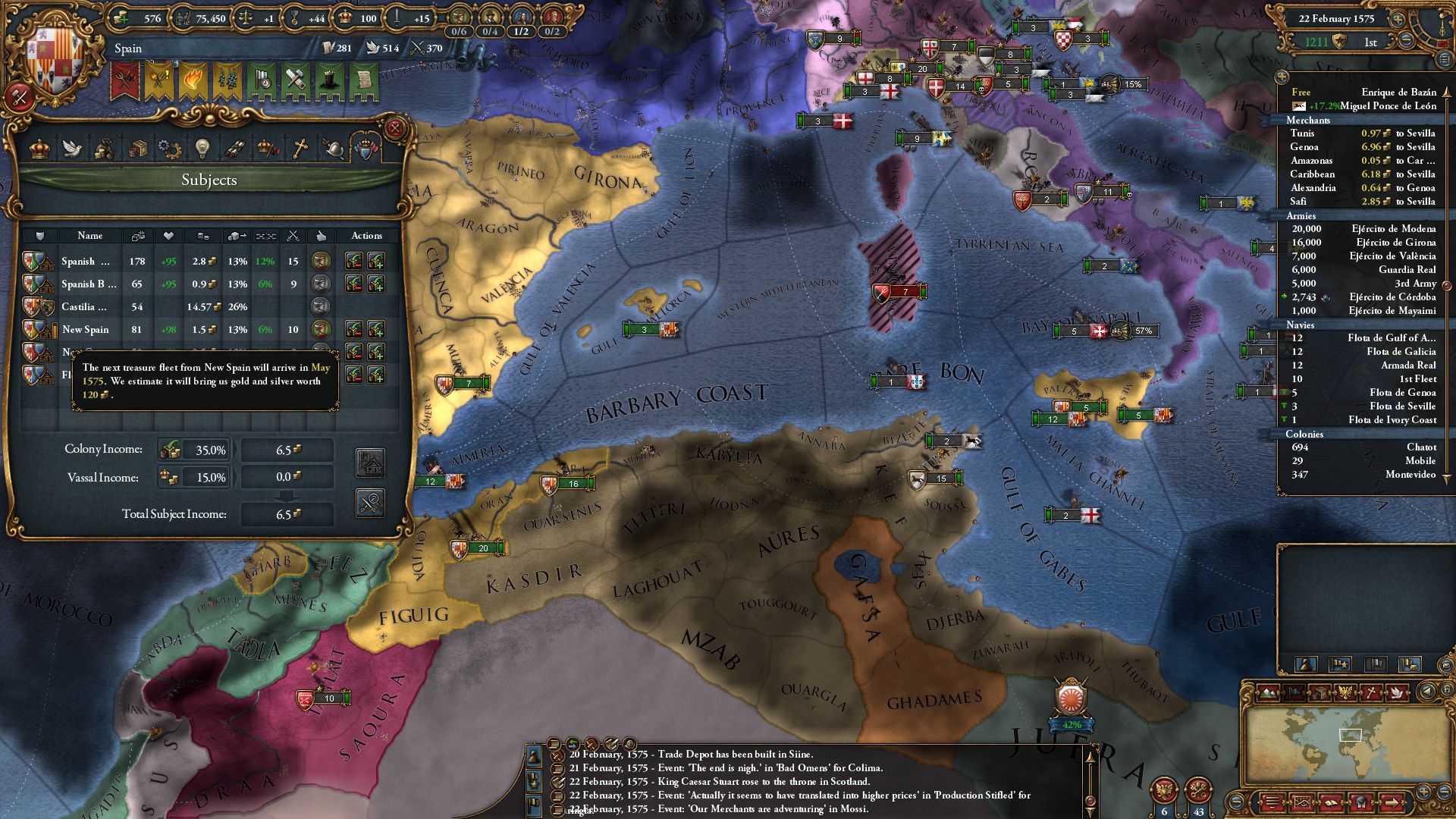
With the expansion, treasure fleets were added to the game. Sort of. Colonial nations with gold-producing provinces now store up gold and send it home as one big lump sum. It technically travels down the trade routes to the overlord’s trade capital, and it can be intercepted by privateers, who will whittle away at the amount of gold depending on their trade power in the nodes it goes through.

Once it arrives, the receiving nation gets the money, and inflation, as if they’d gotten it in a peace deal. With them coming in regularly, it can really start causing real inflation problems, instead of the more usual modest problems from gold provinces. Overall, it’s a neat idea, and the use of privateers is good, but it’s not obvious to anyone but the receiving nation that anything’s happening. And of course, since it’s not really on the map, they can’t be directly captured or disrupted by an enemy nation in a war.

Nation Designer

Another addition of the expansion is a custom nation designer. You choose a capital province, and then build out a nation from there, including the territory, culture, religion, traditions, etc. This all uses up a budget of points, which can be set to nearly any level. There’s achievements connected with it that all have a set budget to use, but more usefully, everyone in a multiplayer game can be set to get the same number of points, and then create ‘equivalent’ nations to play with.

I haven’t really used it, but the interface for it is pretty good.

Women in History

This was a free DLC that automatically gets downloaded as part of the Steam copy of EU IV, though it could be disabled in the launcher. Mostly, it adds events for countries to get historically prominent women as possible advisors. This also means that female portraits for all advisor types were also added, and they can, very occasionally, show up without the specific events.

It’s a nice bit of adding a bit of awareness of how much women have added to history, and not even so much in the background. I’m not quite sure why Paradox did it as a DLC instead of adding it straight to the game files; presumably so it would be easier to talk about the fact that they did do it. At any rate, I will say it feels a little odd, because its mostly fixed people at a fixed time, which gets back to the acting out history style of the first two games of the series.

Conclusion

For some, the Nation Designer is the headline feature, and reason enough to get the expansion. I don’t care for things like that (if I had a particular alternate-history to explore, maybe, but then I’d need to adjust more than one nation), so I pretty much ignore it.

As far as filling out the New World, I like it a lot better than CoP. The new religion mechanics are interesting (well, Maya not so much), and make the dynamics of the Aztecs in particular much more in line with history. Exploration is a mixed bag, seemingly taking some of the wonder out as explorers do things on their own, but taking micromanagement out with it, with all the attrition-watching that was needed, is overall worth it. If you get lots of colonial nations the number of extra merchants gets out of hand, but a few extras are a great boon for steering trade from your colonies to your home port.

The main patch is mostly notable for the rework of vassal relations, which gives that system a lot more character, and I think it was really needed. On the other hand, it saw the second rework of inland trade nodes, and this one was way too heavy handed with a flat extra 50 trade power or not.

Overall, the game improved again, and the free Women in History DLC is a nice addition. Assuming you’re not interested in the Nation Designer, I give El Dorado a limited recommendation: it won’t do much if you’re not exploring, and it’s a good, but not essential, addition if you are.

└ Tags: EU IV, Europa Universalis, gaming, Paradox, review
1 Comment

The Short Way

by Rindis on July 13, 2020 at 12:00 pm
Posted In: Computer games

This is the sixth in a series of reviews looking at the evolution of Crusader Kings II. See the previous reviews here:
Crusader Kings II:
The Second Crusade
The Old Gods: That Old-Time Religion
Sons of Abraham: A Little of Everything
Rajas of India: My Elephant for a Kingdom
Charlemagne: Back in Time

The next expansion for CKII (the eighth, not counting Sunset Invasion) after Charlemagne was a small, focused, ‘character experience’ one. After a bit of open beta testing, CK II: Way of Life was released on December 16, 2014.

It really was focused, with just one actual feature, though of course it did cause some changes elsewhere. Patch 2.3 featured a change to the UI (right-clicking on a portrait to interact with the character—from anywhere—instead of hitting a button that character’s main screen), and added some more modding hooks, as well as properly multithreading the game startup.

Each count-level and above character can now choose a focus, one of ten different subjects to focus his attentions on. There’s two per primary attribute, and they generally provide similar bonuses to that attribute, but different secondary bonuses. Despite what the main advertising art might suggest, these pairs are just separate interests for each attribute, and not any sort of good/evil pairing.

With WoL enabled, the normal ‘improve this low attribute’ ambitions are disabled (see the Intrigue section of my original review), largely reducing them back to the original set of ‘become wealthy’, ‘become steward’, ‘have a son’, etc., ambitions. However, if you take a focus in an attribute that is low (below 8), the same ambition-driven events to raise them become available, so they’ve just been moved from one system to another. (However… the focus gives a +3 to an attribute, so if you were 5 originally, you go to 8, don’t get any special events to raise it, and go back to 5 if you switch to a different focus….)

Additionally, of these foci can generate character modifiers to ‘level up’ the appropriate abilities. These generally come in three levels, and will stay even if you change your focus. While the AI will generally stick to one focus for a character, you can change it every five years, either as needs change, or once you get the bonuses you want out of them.

Conclusion

As a small, focused (cough), expansion, this is a great idea. It doesn’t really interfere with anything, and doesn’t enhance some major aspect of the game, so it comes down entirely to how you feel about it. The theory is to add a bit of role-playing to the game, but for some it still feels gamey, as you can just cycle through foci, picking up bonuses (starting with some that are known to be very reliable in providing them).

I generally like it, and like pulling the self-improvement goals back out of the ambitions (I felt that was too gamey), but think a couple of opportunities were missed. The AI sticks with one focus his entire life, which is generally fine, but I think it would have been better to have some events have a chance of an AI character switching to another one (say he gets a trait that’s opposed to one of the ones the focus can grant—have a chance to switch out; or a hunting accident causes a change away from the hunting focus, or going on pilgrimage can cause a shift to theology).

I’d say this is among the least necessary expansions, but if you like CK II for the opportunity for a bit of mental role-play, it’s well worth looking at; and if you don’t, you may still find it a fun idea.

└ Tags: Crusader Kings, Paradox, review
1 Comment

Reform-Minded Patch

by Rindis on June 11, 2020 at 12:00 pm
Posted In: Computer games

This is the fourth in a series of reviews looking at the evolution of Europa Universalis IV. See the previous reviews here:
Europa Universalis IV: A Fantastic Point of View
Wealth of Nations: National Trade
Res Publica: A Tradition of the People

After Res Publica, a fairly small update and expansion, Paradox scheduled a larger expansion, and the biggest overhaul to EU IV yet. Art of War concentrated on warfare, with new events and mechanics for the Thirty Years War and the Napoleonic period. It was released with patch 1.8 on October 30, 2014, which included some massive overhauls of major mechanics in the game.

Patch 1.9 was a major patch with no accompanying expansion (this every-other major patch pattern became the general procedure for EU IV) that was released on December 19th, and did more re-works of the game. This review looks at both patches and the expansion.

Country Update

While different, the EU IV world map was naturally based on EU III’s, and was more detailed in Europe than anywhere else. Patch 1.8 increased the number of provinces by about half, and added a large number of new nations in all corners of the world. Some of these are only ‘potential’ countries; ones that can exist only by revolt or being released by a larger country, but many represent smaller nations that couldn’t be represented on the old map, or just better research on an area.

In addition, a number of new tradition sets were created, mostly for sets of these new countries, but overall the variety and individuality increased substantially. Finally, more dynamic historical events were added for all sorts of countries, enhancing that system overall.

Patch 1.9 then added the idea of disasters. There were a number of large-scale bad events that could affect a country, seemingly randomly. Now, they were surfaced to the user, making the game a bit more controllable, and feeding into the feel of this iteration being a game. Generally, all countries are eligible for the ‘peasant revolt’ (low manpower and stability) and ‘civil war’ (low legitimacy), while some countries have special ones (England can have the War of the Roses and the English Civil War disasters).

When the preconditions for a disaster are met, the clock starts ticking down to it. If the conditions go away, then the disaster stops, otherwise it fires once the clock ends. Peasant Wars have always been a more common one (especially for the AI), and as an example, force stability to -3, cause additional unrest, make stability more expensive, and creates a couple peasant armies for an immediate problem while the unrest and negative stability cause more.

This is one place where I feel too much is being surfaced to the user, as these are the types of events that, at best, are only obvious in retrospect. That said, getting stuck in a poor position, and watching the clock tick to an even bigger problem certainly does add its own brand of tension to the game.

Revolt & Unrest

Speaking of revolts, those changed too. The province-by-province check for revolts every month, that had existed since the original game was replaced by unrest. This is pretty much figured the exact same way, but it does not cause revolts in itself.

Instead, the province’s prominent revolt type is figured (independence, religious, pretender king, etc.), and all the provinces with a positive unrest towards that particular type add together for a chance of progressing a revolt. Then that is checked each month, and when it does come up, that revolt gets 10% progress, which is displayed in a few places. Once progress hits 100%, then an actual revolt happens with a decent army or two.

This makes revolts something of a ‘mini-disaster’, where you can see the problem coming from some time off. The listing of factions will even tell you, on average, how long it will take a revolt to occur based on current unrest and progress. If an in-progress revolt loses all support (i.e., the respective provinces go to negative unrest), it will lose 10% progress each month until it goes away, so solving a problem for a month or two will set it back, but not instantly get rid of it.

A final adjustment is that revolts that start on an island have been a very small problem as they can’t spread, and take control of more territory. Now a revolt that has control of everything it can reach will automatically try to move to a non-connected nearby province, without needing sea movement or anything, just a decent amount of time.

Autonomy and Clients

One of the things revolt risk did was cause lower taxes and recruiting, as the population was resisting the government’s efforts. This did not get taken over by unrest, and instead these factors are now reduced by autonomy.

Autonomy is a new measure of how much attention a province is paying to the central government expressed as a percentage; manpower and income from the province are both reduced by the amount of autonomy, which generally goes down a little each month while the country is at peace, and the later government forms tend to have bonuses to autonomy reduction.

Naturally, newly conquered territory will have fairly high autonomy to start with, though reconquering core areas and inheriting in a union will result in minimal, if any, autonomy. The big thing is that you can also raise or lower autonomy in an area, which will lower or raise unrest in the province. So, take a new province, raise autonomy, which reduces unrest, and then peace will eventually bring autonomy back down again. Or, lower autonomy to exploit a rich province, and garrison the area to put down any revolts that crop up.

Also, releasing independent nations has always been a way of splitting off troublesome areas, or creating a buffer. But, it requires an appropriate possible nation in the area, and that may include areas you don’t wish to let go of. With AoW active, custom client states become possible in the late game (emulating Napoleon’s many reorganizations of the map of Europe). They’re set to be fairly loyal, and get their own traditions, in addition to their territory and name being entirely at the whim of the creating nation (well, the territory has to be contiguous).

Wars of Reformation

The Reformation came in for its own major overhaul. Generally, events would fire to randomly convert provinces to Protestant or Reformed, causing chaos and potentially making conversion a smart idea for smaller central European states.

With the new patch, instead there would be centers of reformation that would actively try to convert other provinces nearby, going for more of a proselytizing model. This makes the entire process much less random, and ensures that anyone near one of these centers will have to deal with the problem for some time to come.

Generally, three centers show up for the Protestants, and then another three for Reformed (with the first of each as an event, and the other two being ‘rewards’ for the first countries to convert to the new religion). The process can be stopped, by conquering the province and converting it (which will destroy the center), but that’s not easy either.

AoW also introduced religious leagues. These are coalitions that form to enforce, or change, the religion of the Holy Roman Empire. To start with, the Emperor must be Catholic; but there’s no restrictions on the electors, and if one of them goes Protestant, then he automatically forms the Protestant League, which can declare war on the emperor to force the official religion of the HRE to change. Once started, anyone (regardless of religion) can join the leagues, but religious tension is what starts them.

Liberty, Equality, Fraternity

Along with the Thirty Years War, the French Revolution came in for some serious attention. The Revolution was of course one of the major points of events in the original two games, In III, there had been the separate Revolutionary Republic and Empire government types, which had event chains as pre-requisites for them, and some very powerful bonuses, along with plenty of events to make sure that such a government would end up at war with most of the rest of Europe.

Now, a Revolution disaster was added which could happen to any European country that was in dire straights in the late 18th Century, making them the revolutionary target (France gets a customized French Revolution disaster). The lead ‘unhappy’ country gets to be the target of the events that bring about the revolution, changing the government to Revolutionary Republic, and changing the national symbol to a tricolor (many countries have the colors defined, and the rest get random colors picked for them).

Of course, all the relations problems of the old system are kept here, with the Revolutionary government getting a casus belli to ‘spread the revolution’, while everyone else gets reactionary modifiers to put the anti-monarchist upstarts down.

Naval Affairs

Art of War had a few tweaks for the military, the biggest one being the ability to just upgrade ships to modern types with a single click. You still pay the standard construction cost, and the ships are reset to minimum morale and durability, but it’s instant, and saves all the trouble of retiring old ships to stay under your naval limit while building the new ones.

Even better (and really needed), the expansion allows the ability to mothball fleets. Generally, it was common to set naval maintenance to minimum during peacetime in previous EU games. This can save a fair amount of money, and you don’t generally need the morale while at peace. Except now, trade protection with light ships suffers with lower maintenance, so mercantile nations can’t afford to do that (and possibly still can’t afford a regular fleet). Mothballing basically sets maintenance to minimum for selected fleets, so your light ships can still do their thing (along with any anti-pirate patrols you end up needing), allowing big ship and galley navies to not strangle the economy any more.

A final option is the ability to sell surplus ships to other powers, though I’ll admit I haven’t played around with it, and don’t know how eager the AI is to take your old castoffs. Also, as part of the big map expansion, trade was reworked with a more stable pricing scheme, and three new trade items were added.

A final naval convenience is that transporting armies was made simpler in the expansion. If you give an army an order to march across a body of water, the game will now ask if you want to use your transports automatically. And then it will send them out, pick up your troops (automatically dividing the army if it’s bigger than the transport fleet), and ferry them over. It’s not perfect, as it’ll try to do this when the waters are contested, and you need to ‘sneak’ across away from patrolling enemy fleets, but it’s a big convenience when it can be used.

Conclusion

Just in terms of the patch, 1.8 was a great improvement for EU IV. The new Reformation mechanics feel a lot more natural, and let you see whether or not you’re likely to be in the path of religious controversy. The new revolt mechanics aren’t as dramatic, but affect you no matter when/where you play the game as, and was just the beginning of PDS re-thinking core mechanics that had been there from the beginning. EU IV changed a lot of things in the interests of a better game, and this showed that the process hadn’t stopped.

The new map of course added a lot of content. If you’re stuck in Western Europe, you won’t see the changes, but everywhere else saw some major changes, and loads of new nations (and potential nations), adding even more life away from the ‘bright center’ of the game’s roots. The amount of work to update the timeline files for all the extra provinces and counties must have been massive. As much as I say I’m not a fan of patch 1.9’s disasters, they are in line with the rest of the features of EU IV, and I can’t really complain.

The expansion is also big, with a lot of nice things in it, though the out-of-expansion changes are still big enough to get all the top billing. Much of it is paying for convenience, and despite the features, nothing is really essential. It certainly makes you happy to be able to just automatically ferry troops, or any of a half-dozen other things. Content-wise there’s also a lot in the events, but they’re hard to pick up on. So there’s no one ‘get this now’ feature, and I only recommend this to dedicated players.

└ Tags: EU IV, Europa Universalis, gaming, Paradox, review
 Comment 
  • Page 7 of 12
  • « First
  • «
  • 5
  • 6
  • 7
  • 8
  • 9
  • »
  • Last »

©2005-2026 Rindis.com | Powered by WordPress with ComicPress | Hosted on Rindis Hobby Den | Subscribe: RSS | Back to Top ↑