Rindis.com

All my hobbies, all the time
  • Home
  • My Blog
  • Games
  • History

Categories

  • Books (503)
  • Comics (10)
  • Gaming (917)
    • Boardgaming (673)
      • ASL (154)
      • CC:Ancients (83)
      • F&E (78)
        • BvR – The Wind (26)
        • Four Vassal War (9)
        • Konya wa Hurricane (17)
        • Second Wind (5)
      • SFB (78)
    • Computer games (162)
      • MMO (77)
    • Design and Effect (6)
    • RPGs (66)
      • D&D (25)
        • O2 Blade of Vengeance (3)
      • GURPS (32)
  • History (10)
  • Life (82)
    • Conventions (9)
  • News (29)
  • Technology (6)
  • Video (49)
    • Anime (47)
  • Writing (1)

Patreon

Support Rindis.com on Patreon!
Become a patron at Patreon!

Other blogs:

RSS Inside GMT

  • Coast Watchers – Session Report – “The Airfield” June 5, 2026

RSS Playing at the World

  • Playing at the World 2E V2 Arrives May 5, 2025

RSS Dyson’s Dodecahedron

  • Cyberstyle 8.4 June 6, 2026

RSS Quest for Fun!

  • The Expense Post May 24, 2026

RSS Bruce Heard and New Stories

  • Pain, Exhaustion, and Morale in D&D BECMI June 7, 2026

RSS Chicago Wargamer

  • The 2 Half-Squads - Episode 310: Cruising Through Crucible of Steel January 27, 2023

RSS CRRPG Addict

  • BRIEFs: Black Crystal (1982), Creepers (1982), Chitei Tanken (1982) June 8, 2026
SF&F blogs:

RSS Fantasy Cafe

  • The Leaning Pile of Books May 24, 2026

RSS Lynn’s Book Blog

  • Booking Ahead/Weekly Wrap Up June 7, 2026
ASL blogs:

RSS Sitrep

  • Cardinal ASL Sins March 18, 2026

RSS Hong Kong Wargamer

  • FT114 Yellow Extract After Action Report (AAR) Advanced Squad Leader scenario April 16, 2025

RSS Hex and Violence

  • This still exists? March 25, 2025

RSS Grumble Jones

  • AAR Slides for Schwerpunkt SP96 Husum Hotfoot June 5, 2026

RSS Desperation Morale

  • How to Learn ASL March 16, 2025

RSS Banzai!!

  • October North Texas Gameday October 21, 2019

RSS A Room Without a LOS

  • [Crossing the Moro CG] T=0902 -- Rough start July 18, 2015
GURPS blogs:

RSS Dungeon Fantastic

  • Felltower House Rules Examined June 7, 2026

RSS Gaming Ballistic

  • B-Scale: Damage That Scales from Tardigrades to Kaiju June 5, 2026

RSS Ravens N’ Pennies

RSS Let’s GURPS

  • Review: GURPS Realm Management March 29, 2021

RSS No School Grognard

  • It came from the GURPS forums: Low-Tech armor and fire damage January 29, 2018

RSS The Collaborative Gamer

  • Thoughts on a Town Adventures System January 18, 2022

RSS Don’t Forget Your Boots

  • GURPS Supers Newport Academy #6: “Old Friends, New Again” June 7, 2026

RSS Orbs and Balrogs

  • Bretwalda - Daggers of Oxenaforda pt.4 - Fallen King May 27, 2017

Roman Centurions 753-31 BC

by Rindis on September 15, 2020 at 12:00 pm
Posted In: Books

I was a little skeptical of a Men-at-Arms sub-series dedicated only to the Roman Centurion, but it does make some real sense. Mostly, they’re the lowest rank that is going to regularly come to the attention of prominent people, so we have a few more individuals whose careers are discussed. The introduction points out that as the main bulk of officers, their discipline and example was instrumental in leading Roman armies to victory; I kind of thought that would make a good plug for an Elite series instead of Man-At-Arms, but I assume there’s just not enough content to fill out a longer title.

This first volume covers from founding of Rome through end of the Republic. As usual, there is a good combing of the sources, and lots of pictures of various artifacts and art (in black and white) depicting centurions. The color plates are quite good, and interestingly, while three of plates are traditional no-background military figure art, but the other five are full pieces, and among the best I’ve seen out of the MAA line lately (not that I’ve seen a lot of the more recent books). I think that makes for a good mix, and presumably keeps the art budget under control.

Overall, it’s about as limited a book as I supposed. Within its limits, it is very good however. If you want to get into some of the details of the Roman army, this is a worthwhile addendum, but if you want how it fought… there’s a few interesting tales in here (especially for the earlier period), but this isn’t where to go.

└ Tags: books, history, MAA, Men-at-Arms, Osprey, reading, review, Rome
 Comment 

Patricians and Emperors

by Rindis on June 10, 2019 at 12:00 pm
Posted In: Books

Hughes provides a good overview of the end of the western Empire in this volume. He does analyze things, and come to conclusions, but the primary focus is providing a chronological outline of events.

That latter is the primary value as it can be hard to find any coherent look at the four decades from the death of Aetius to the death of Odovacer. There’s no central figure, which is part of the point, political power and fortunes were so fractured by this period that no one entirely rises above the other players.

However, Ricimer (who should be more prominent in synopses of this era) does provide the central focus for part of this book (enough so that I wonder if Hughes really should have focused in a little bit more and done a book purely on him). He is generally considered to have been the ‘power behind the throne’ for, oh, maybe fifteen years, and often takes the fall for the instability of the West. Hughes gives good reasons to believe that this is not the case, and that his actions were often in response to other political pressures.

This largely comes down to the Roman Senate, which, like in his book on Stilicho, takes the blame for a fair number of ills without introducing any real evidence. He may reference some pertinent sources in the end notes (which I have not gone through), but there is nothing in the main body. Nobody from the senate is mentioned by name. No description of what the senate was like in the Fifth Century is provided. Now he ascribes the senators as a whole with motives that are likely (protecting their own position, and the safety of their own lands), but there’s nothing here to actually support these assertions, so it’s nothing more than an axiom of the book.

Other than that hole, there’s a lot of interest here. Beyond any problems with the Senate, problems of the division of the Empire between East and West are made manfest. Thanks to a lack of a stable dynasty, and a horde of ongoing problems, in the West, the Eastern Empire has become the senior political partner, which ends up crucially weakening the West. Any time an Emperor dies (too common), there is a wait while the choice of a new Western Emperor is coordinated with the East. If the Eastern court doesn’t care for what’s going on, political and military support can get withdrawn, which leaves the West’s leadership high and dry. Additionally, Marcellinus maintains an almost independent existence as comes rei militaris Dalmatiae for almost this entire period as he’s supported by the East, but refuses to work with Ricimer’s administration of the West.

And of course, at the same time there is growing ‘barbarian’ influence in the territories outside Italy and Dalmatia. The book has about one map per chapter showing the slowly shifting patterns of who had control of what. Now, these groups are settled in the Empire by agreement, and acknowledge it’s authority. Mostly. Even the better actors, like the Visigoths under Theoderic acted largely independently of the administration in Italy, even when pursing the same goals. Meanwhile, Vandal kingdom in Africa raided Italy regularly, and the book shows two attempts to counterinvade that came apart utterly, and likely recriminations did much to make the situation in Italy worse. Hughes figures Gaiseric to be the most able leader and diplomat of the period to explain his long stable reign, and the Empire’s inability to reclaim Africa.

Hughes sticks to a largely chronological format, which means he doesn’t give any one subject his full attention as nothing got wrapped up neatly within one year. Mostly, this is well handled, but with some real long-term trends going on here, I think seeing something concentrating on just one of them would be a real plus. I don’t recommend this one for a more casual read because of this, but it is definitely a great framework for anyone in an interest in the last years of the Western Empire.

└ Tags: books, history, reading, review, Rome
 Comment 

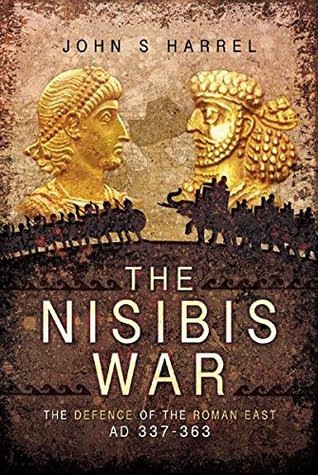
The Nisibis War

by Rindis on May 1, 2019 at 12:00 pm
Posted In: Books

You’ve probably never heard of this war. There’s a good reason: John Harrel is the only one calling it that. This book covers what is usually considered two wars, neither of which seems to have any sort ‘official’ name. “Nisibis” was the name of a city that Rome had gotten in the previous peace deal with Persia (known as the Peace of Nisibis), and was the focus of much of the campaigning in this period, though not where the most decisive actions happened.

Considering that there is basically nine quiet years on the frontier between the two wars, I’m not sure considering them one war is justified. However, they are of a piece, with Shapur II campaigning to drive the Roman Empire out of Mesopotamia, so no matter how you look at it, studying them together is well justified.

This is a fairly in-depth study of the campaigning and the armies of the period, and definitely recommended for anyone interested in 4th Century military history. Given the state of knowledge of the period, I think he’s a bit too certain on some of his statements, but he does a good job of laying out his thinking for the state of the Roman army, it’s composition, and sources of replenishment. There’s a good number of maps, I found the symbology a little crude, but effective.

My main problem is the use of terminology, which kind of goes all over the place. For most Roman offices, he sticks with the Roman names, in italics as foreign words, which is fine. However, he then insists on translating comes and dux as ‘count’ and ‘duke’. That is where the English words come from, but those forms come with a lot feudal baggage that has nothing to do with the Roman offices, and they shouldn’t be translated like that. Also, oddly, he insists on giving place and unit names italics as foreign words, even though as proper nouns, that not the general practice. It makes for some highly distracted reading in places.

There is also some good discussion of Shapur II’s activities (including during the ‘lull’), and discussion of his strategic skill. Sadly, while he gives a good look at Emperor Julian (and a very good account of the entire retreat from Ctesiphon), he touches on Julian’s experience (and gives an account of his campaigns in Gaul), but doesn’t consider anything analogous to  Goldworthy’s assertion from In the Name of Rome that Julian’s being unused to the scale of operations (in men and distance) was the major Roman failing in 363, though he does touch on a similar idea.

└ Tags: books, history, reading, review, Rome
 Comment 

The Roman Empire and the Silk Routes

by Rindis on April 17, 2019 at 12:00 pm
Posted In: Books

This basically a follow-on to McLaughlin’s study of trade across the Indian Ocean. Despite being almost the same size, it feels like an appendix to it.

Whereas his former book spent a lot of time giving specifics of particular trade goods and where Romans were going to get them and trying to get an idea of the overall Roman budget, this is more of a jumbled history of some of the land area between Rome and China. He starts off with a discussion of what Rome had to get from China, which is interesting.

The obvious part is silk, and he goes into the difference between ‘domesticated’ silk, and ‘wild’ silk, where the latter uses threads from cocoons where the larvae ate it’s way out, cutting the strands. Chinese ‘domesticated’ silk is so good because it has extremely long single strands to work with. At any rate, the lesser version was produced in many places, including the Greek island of Cos. More surprising is the assertion that Chinese steel was superior to what Rome could produce, so high-quality steel was an import. I’d like to see some sort of study of the history of metallurgy to check that. The most surprising part is indications that Rome was exporting silk to China. It wouldn’t have been much, but the Roman world had access to some brilliant dyes that China did not, so dyed silks left the Empire again.

Most of the rest of the book takes a look at various areas and regimes along the northern trade routes that made up the Silk Road(s). He starts with China’s troubles with the Xiongnu (Huns!), which started China exploring to the south of their territory looking for potential allies against them. This eventually gets them to Bactria… but just as the post-Alexandrian nation there is dissolving into fragmented city-states.

There is some look at the Chinese economy, but it’s not nearly as well developed, and most of the book he seems to try to avoid discussing their currency. (“Han revenues: 12,300 million cash”, without saying cash what.) At one point near the end he does define the wushu, which seems to be the currency base for his calculations. He spends some time discussing the differences between revenue collection between the two, which could probably stand to be more in depth, though I’d have to spend a fair amount of time thinking about it to make sense of everything he does have there.

All that is basically the ends of the book. In between, there’s a discussion of various regions in between, their contacts with other areas, trade routes through, but mostly little on the actual trade itself. It makes for a good history of central Asia from ~200 BC to ~100 AD, also with some helpful notes on the geography involved, but it doesn’t integrate them with each other very much except for a time line given in the front. So, it’s nowhere near as useful as The Roman Empire in the Indian Ocean, though it is interesting, and good books on this region are rare.

└ Tags: books, history, reading, review, Rome
 Comment 

Sertorius and the Struggle for Spain

by Rindis on March 26, 2019 at 12:00 pm
Posted In: Books

This is mostly a reconstruction of the Sertorian War. There’s also some notes of the larger history of the Iberian peninsula, and people with an interest in the history of Iberia in general may want to pick this up too.

Back to the main subject, Sertorius is considered one of Rome’s best and least known generals. While I generally agree, I can’t help wondering if Sertorius was only successful because he was well-suited to the mixed force he had and the guerilla holding action he fought. That is, put him in charge of regular Roman legions in a more normal Roman war, would he have done so well, or would all of his superb qualities have been wasted in the standardized system, away from terrain he knew well? In any case, he was the perfect person for the role he did play, but that was unfortunately on the losing side of the civil wars of the early 1st Century BC. And the upshot of that is despite some glowing praise for his generalship, we don’t know a lot about what exactly happened over the course of eight years of fighting.

However, scholars have combed through all the various references that do exist to what happened, many of which are just particular incidents without a lot of context, and assembled them into a framework that seems to work. This book is Matyszak’s presentation of this framework for a popular audience. As there is so little go off of, a high percentage of the book is direct quotes from the ancient sources, woven together with explanations and probable interpretations.

As such, this is a very important book for those wanting to know more about Sertorius’ campaigns, as this is about as fleshed out as it gets at the moment (and quite possibly, ever). I have some quibbles with yet another unneeded in medias res opening to a history book, and Matyszak is still too unforgiving on the character of Gaius Marius (but that’s much more peripheral than it was in Cataclysm 90 BC). There’s three maps of Iberia at the beginning of the book, and the fun one is ‘from a campaigning point of view’, and is keyed with ‘merely unpleasant’, ‘rugged and mountainous’, and ‘practically impassible’. Overlaying the apparent routes of march of various campaigning seasons on that one would have been interesting.

└ Tags: books, history, reading, review, Rome
 Comment 
  • Page 3 of 5
  • «
  • 1
  • 2
  • 3
  • 4
  • 5
  • »

©2005-2026 Rindis.com | Powered by WordPress with ComicPress | Hosted on Rindis Hobby Den | Subscribe: RSS | Back to Top ↑