
Rindis.com

All my hobbies, all the time
  • Home
  • My Blog
  • Games
  • History

Categories

  • Books (503)
  • Comics (10)
  • Gaming (917)
    • Boardgaming (673)
      • ASL (154)
      • CC:Ancients (83)
      • F&E (78)
        • BvR – The Wind (26)
        • Four Vassal War (9)
        • Konya wa Hurricane (17)
        • Second Wind (5)
      • SFB (78)
    • Computer games (162)
      • MMO (77)
    • Design and Effect (6)
    • RPGs (66)
      • D&D (25)
        • O2 Blade of Vengeance (3)
      • GURPS (32)
  • History (10)
  • Life (82)
    • Conventions (9)
  • News (29)
  • Technology (6)
  • Video (49)
    • Anime (47)
  • Writing (1)

Patreon

Support Rindis.com on Patreon!
Become a patron at Patreon!

Other blogs:

RSS Inside GMT

  • Coast Watchers – Session Report – “The Airfield” June 5, 2026

RSS Playing at the World

  • Playing at the World 2E V2 Arrives May 5, 2025

RSS Dyson’s Dodecahedron

  • Cyberstyle 8.4 June 6, 2026

RSS Quest for Fun!

  • The Expense Post May 24, 2026

RSS Bruce Heard and New Stories

  • Pain, Exhaustion, and Morale in D&D BECMI June 7, 2026

RSS Chicago Wargamer

  • The 2 Half-Squads - Episode 310: Cruising Through Crucible of Steel January 27, 2023

RSS CRRPG Addict

  • BRIEFs: Black Crystal (1982), Creepers (1982), Chitei Tanken (1982) June 8, 2026
SF&F blogs:

RSS Fantasy Cafe

  • The Leaning Pile of Books May 24, 2026

RSS Lynn’s Book Blog

  • Booking Ahead/Weekly Wrap Up June 7, 2026
ASL blogs:

RSS Sitrep

  • Cardinal ASL Sins March 18, 2026

RSS Hong Kong Wargamer

  • FT114 Yellow Extract After Action Report (AAR) Advanced Squad Leader scenario April 16, 2025

RSS Hex and Violence

  • This still exists? March 25, 2025

RSS Grumble Jones

  • AAR Slides for Schwerpunkt SP96 Husum Hotfoot June 5, 2026

RSS Desperation Morale

  • How to Learn ASL March 16, 2025

RSS Banzai!!

  • October North Texas Gameday October 21, 2019

RSS A Room Without a LOS

  • [Crossing the Moro CG] T=0902 -- Rough start July 18, 2015
GURPS blogs:

RSS Dungeon Fantastic

  • Felltower House Rules Examined June 7, 2026

RSS Gaming Ballistic

  • B-Scale: Damage That Scales from Tardigrades to Kaiju June 5, 2026

RSS Ravens N’ Pennies

RSS Let’s GURPS

  • Review: GURPS Realm Management March 29, 2021

RSS No School Grognard

  • It came from the GURPS forums: Low-Tech armor and fire damage January 29, 2018

RSS The Collaborative Gamer

  • Thoughts on a Town Adventures System January 18, 2022

RSS Don’t Forget Your Boots

  • GURPS Supers Newport Academy #6: “Old Friends, New Again” June 7, 2026

RSS Orbs and Balrogs

  • Bretwalda - Daggers of Oxenaforda pt.4 - Fallen King May 27, 2017

The Storm Before the Storm

by Rindis on February 10, 2024 at 12:00 pm
Posted In: Books

I started listening to podcasts at just the right time: There was a minor explosion of good historical subjects going on. This was largely due to Mike Duncan, and his History of Rome podcast. Not that you can tell by listening to the very early episodes; it took a while for his delivery to loosen up and become a very good podcast.

But it did become a very good podcast, and so is his later Revolutions podcast. So, I’m a little embarrassed that it’s taken me seven years to read his first book, especially since its a look at a period of Roman history that needs more attention.

And hey, Mike Duncan agrees with me, it’s why he wrote this particular book. This is a popular history book, and even less dense than most of those. It’s not particularly long, coming in at 265 pages in hardcover.

But, then there’s extensive endnotes, and a lengthy index. While this is geared to someone just taking an interest in history, all the tools to dig deeper are provided. In fact, the endnotes are particularly geared at getting you to the relevant primary sources. This is great place to begin if you want to develop an interest in the period. (One entry in the index, “murders”, then references eleven people killed in his narrative, and then cross-references to “killings, political”, with another seven sub-entries.)

And I should mention that period covers from the first real crisis of the Republic, the rise of the Gracchi brothers, and gives some nice background to the social forces at play at the time. From there, Duncan goes on to events in Africa and Spain, with Jugurtha rising to power, and the troubles in Spain leading to the siege of Numantia, and then to Marius and Sulla, whose attempt to rework the Republic into something more stable concludes the book (along with Duncan’s thoughts on why it didn’t work). So, for those of you used to McCullough’s Master of Rome series, the first half of this is before the series, and covers everything she talks about from before the first book, through the first three books of the series.

Duncan’s prose is very readable, the contents very informative, and overall he takes as neutral a stance as possible on what unfolds in his pages. Even if you’ve read up on Roman history, 146–78 BC is a period you may know much about, and this is a very good starter book on the period.
└ Tags: books, history, reading, review, Rome
 Comment 

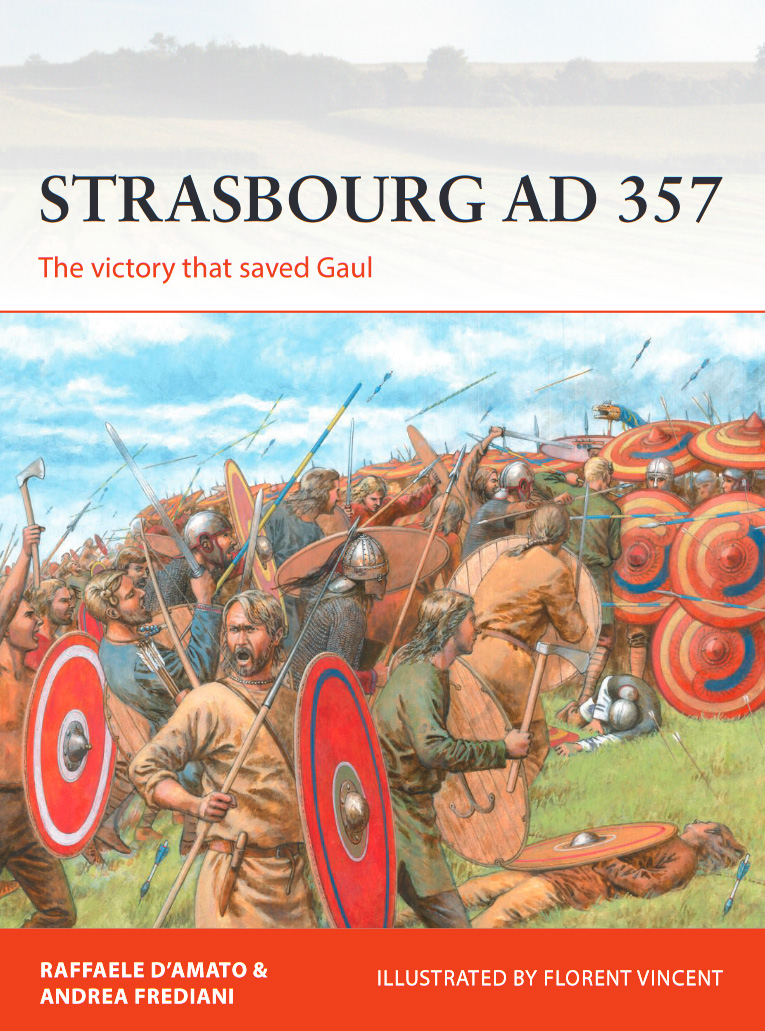
Strasbourg AD 357

by Rindis on May 1, 2023 at 12:00 pm
Posted In: Books

Julian the Apostate is known for his disastrous defeat by the Sassanids in 363. d’Amato and Frediani go back six years to show Julian’s very successful campaign in Gaul.

This is a typical Osprey Campaign book with its conventional format, length, and topics. With two exceptions, all the photographs are in color, and Florent Vincent’s illustrations are good (there are three two-page spreads), better than many from Osprey, but not the best. There also a few older small illustrations showing sample figures with equipment by Igor Dzis. The bibliography goes two pages, the section on the battlefield today is merely one paragraph, but there are several good photos of it in the book.

The authors go into the political background that kept Julian out of the spotlight before he finally ends up in command in Gaul. This also has implications for his relationship with the court of Constantius, and Barbatio, who was effectively a co-commander. This is followed up with events after the main campaign being discussed, and fills out the situation well.

d’Amato and Frediani point to Julian’s background in the classics as explaining his successes here. Roman practice of the time had become very conservative, endeavoring to take as few chances as possible, and manage the various crises that had come up. Julian, his head full of Julius Caesar’s Commentaries, went for a much more bold approach, looking for decisive battles after which he could dictate terms.

They don’t go into the reasons why Roman practice had evolved this way. But Julian’s approach certainly worked here. The battle at Argentoratum (Strasbourg) led to the surrender of the main Germanic commander, and Julian got time to arrange a series of buffer states on the other side of the Rhine, instead of settling people inside of Gaul. Northeastern Gaul especially had taken enough damage that this may never have been a stable arrangement, but we (and Julian) never got a chance to find out, as he and most of his Roman army got transferred to the east because of the latest disaster from the Sassanids, and the frontier collapsed again without them.

Short of some of the imponderables, Julian certainly made it work for a few years, and Osprey has another very good book in their Campaign line discussing the central action.

└ Tags: books, history, reading, review, Rome
 Comment 

The Beacon at Alexandria

by Rindis on August 25, 2021 at 12:00 pm
Posted In: Books

Gillian Bradshaw is one of my favorite historical authors, and this one does not disappoint. She admits up front to distorting the timeline slightly in the interests of the plot, which spans about seven critical years in the Fourth Century.

At this point the Roman Empire is Christian, but not necessarily deeply so, with plenty of pagan traditions surviving, and of course deep factionalism over the proper form of belief. All of this is far from the life of a sixteen-year-old upper-class girl in Ephesus, but the plot takes us into that world. Athanasius is one of the most prominent figures of this time, and from what very little I know of him, I think Bradshaw did a great job depicting him.

But back to the center of the story. Charis is in love with medicine in a society that doesn’t allow women to practice it. So she largely hides her interest, and then for much of the book hides who she is instead, and much of the novel is an outpouring of love for medical learning, and the practicalities of its practice in this age as well as a glimpse into the scholastic side of Alexandria.

This is an intensely character-driven novel, with Charis’ first-person descriptions and relationships driving everything. With a couple exceptions for when larger events intrude on her life, and suddenly plot drives everything to lever it into the next major section. Some of that feels abrupt, because of the change in pacing, but overall, it’s a wonderfully-written, very personal feeling novel, and another winner from Bradshaw.

└ Tags: books, historical, reading, review, Rome
 Comment 

Roman Centurions 31 BC-AD 500

by Rindis on May 21, 2021 at 12:00 pm
Posted In: Books

The second volume of Osprey’s survey of Roman Centurions is a bit better than the first. Most likely, there’s just more source material to draw from. There is less of the individual career profiles, so if you thought that was a nice touch, you’ll miss it here. However, I’m sure those were just there to provide examples when the evidence was otherwise sparse, so the lack here only points up the overall better knowledge of the period.

The art and photographs continue to live up Osprey standards, though with only three full pieces this time. The photography concentrates more on depictions of particular gear, instead of needing to find anyone who was a centurion at all, again pointing up the better sources for the period.

There is a very good outline of centurion positions inside a legion, and the gradings between them. Things get less certain for detached appointments (assigned to non-legionary units, on a governors staff, etc), but there’s good discussion there too. The selection of centurions is also gone into, along with other general details. The last section is the typical (for Osprey) dive into equipment. Naturally, there’s a lot go over, which is done at Osprey’s usual level of detail, so it’s quite long.

Overall, this is a notably better book than the first one, mostly because everything said is much less nebulous and uncertain. I have a feeling that it gives a greater impression of stability than is deserved, but that comes down to the nature of the sources again.

└ Tags: books, history, reading, review, Rome
 Comment 

Aetius: Attila’s Nemesis

by Rindis on May 13, 2021 at 12:00 pm
Posted In: Books

Ian Hughes’ books on the period where the Western Empire dissolved into nothingness have been very good at providing a clearer picture of the process. I think this volume might be the best one of the lot.

Like his earlier book on Stilicho, this traces the career of one man, who many with the barest of knowledge of the period will know of because of his commanding the Roman side at the Battle of the Catalaunian Plains against Attila the Hun.

The early section looks at Aetius’ early life, and positions him as part of the Roman upper class. He was traded to the Huns as a ‘hostage’ during his teenage years; Hughes is at pains to talk about the actual nature of hostages as political insurance in the pre-modern world, something that needs looking at more often. At any rate, this part informs a large part of his thesis. The Roman military had become very conservative with manpower and emphasized sieges and the like to set-piece battles. The Huns and other tribal confederations still emphasized combat and set-piece battles of various sizes, and Aetius’ career shows the same pattern, so Hughes assumes that much of his military training and style comes from his period with the Huns.

Aetius also relies on support from Hunnic factions, particularly early in his career. Hughes also figures this comes from friendships formed in his time with them. This is important during some early maneuverings, which could easily have ended up with Aetius dead as a rebel, but after stong-arming the other faction, ended with him working quite effectively inside and with the system for the next two decades.

It can reasonably be said that his use of Hunnic troops during his internal fight against Boniface was part of the downfall of the Western Empire. Hughes doesn’t go too much into that, but does spend a good amount of time and thought on various settlements of barbarians inside the empire. This too he sees as not necessarily destructive of the Empire as it had successfully been done before. In his concluding part though, he talks about the various methods by which this was done, and points out that the Goths in southern Gaul had been allowed to settle with their leadership intact, instead of it being sent elsewhere, generally as leadership in a different section of the army. This put people used to politics and power with a built-in power base inside the Empire, and that is what Hughes points to as the dramatic step towards the dissolution of the western Empire.

Often what is known of Aetius comes straight out of Gregory of Tours, and Hughes does a good job here pulling together the sources, and giving the outline of his character. I think Hughes may have trended towards being too sympathetic to him, but his conclusions are reasonable.

└ Tags: books, history, reading, review, Rome
 Comment 
  • Page 2 of 5
  • «
  • 1
  • 2
  • 3
  • 4
  • 5
  • »

©2005-2026 Rindis.com | Powered by WordPress with ComicPress | Hosted on Rindis Hobby Den | Subscribe: RSS | Back to Top ↑