Rindis.com

All my hobbies, all the time
  • Home
  • My Blog
  • Games
  • History

Categories

  • Books (503)
  • Comics (10)
  • Gaming (917)
    • Boardgaming (673)
      • ASL (154)
      • CC:Ancients (83)
      • F&E (78)
        • BvR – The Wind (26)
        • Four Vassal War (9)
        • Konya wa Hurricane (17)
        • Second Wind (5)
      • SFB (78)
    • Computer games (162)
      • MMO (77)
    • Design and Effect (6)
    • RPGs (66)
      • D&D (25)
        • O2 Blade of Vengeance (3)
      • GURPS (32)
  • History (10)
  • Life (82)
    • Conventions (9)
  • News (29)
  • Technology (6)
  • Video (49)
    • Anime (47)
  • Writing (1)

Patreon

Support Rindis.com on Patreon!
Become a patron at Patreon!

Other blogs:

RSS Inside GMT

  • Coast Watchers – Session Report – “The Airfield” June 5, 2026

RSS Playing at the World

  • Playing at the World 2E V2 Arrives May 5, 2025

RSS Dyson’s Dodecahedron

  • Cyberstyle 8.4 June 6, 2026

RSS Quest for Fun!

  • The Expense Post May 24, 2026

RSS Bruce Heard and New Stories

  • Pain, Exhaustion, and Morale in D&D BECMI June 7, 2026

RSS Chicago Wargamer

  • The 2 Half-Squads - Episode 310: Cruising Through Crucible of Steel January 27, 2023

RSS CRRPG Addict

  • BRIEFs: Black Crystal (1982), Creepers (1982), Chitei Tanken (1982) June 8, 2026
SF&F blogs:

RSS Fantasy Cafe

  • The Leaning Pile of Books May 24, 2026

RSS Lynn’s Book Blog

  • Booking Ahead/Weekly Wrap Up June 7, 2026
ASL blogs:

RSS Sitrep

  • Cardinal ASL Sins March 18, 2026

RSS Hong Kong Wargamer

  • FT114 Yellow Extract After Action Report (AAR) Advanced Squad Leader scenario April 16, 2025

RSS Hex and Violence

  • This still exists? March 25, 2025

RSS Grumble Jones

  • AAR Slides for Schwerpunkt SP96 Husum Hotfoot June 5, 2026

RSS Desperation Morale

  • How to Learn ASL March 16, 2025

RSS Banzai!!

  • October North Texas Gameday October 21, 2019

RSS A Room Without a LOS

  • [Crossing the Moro CG] T=0902 -- Rough start July 18, 2015
GURPS blogs:

RSS Dungeon Fantastic

  • Felltower House Rules Examined June 7, 2026

RSS Gaming Ballistic

  • B-Scale: Damage That Scales from Tardigrades to Kaiju June 5, 2026

RSS Ravens N’ Pennies

RSS Let’s GURPS

  • Review: GURPS Realm Management March 29, 2021

RSS No School Grognard

  • It came from the GURPS forums: Low-Tech armor and fire damage January 29, 2018

RSS The Collaborative Gamer

  • Thoughts on a Town Adventures System January 18, 2022

RSS Don’t Forget Your Boots

  • GURPS Supers Newport Academy #6: “Old Friends, New Again” June 7, 2026

RSS Orbs and Balrogs

  • Bretwalda - Daggers of Oxenaforda pt.4 - Fallen King May 27, 2017

Rome and Attila

by Rindis on January 17, 2025 at 12:00 pm
Posted In: Books

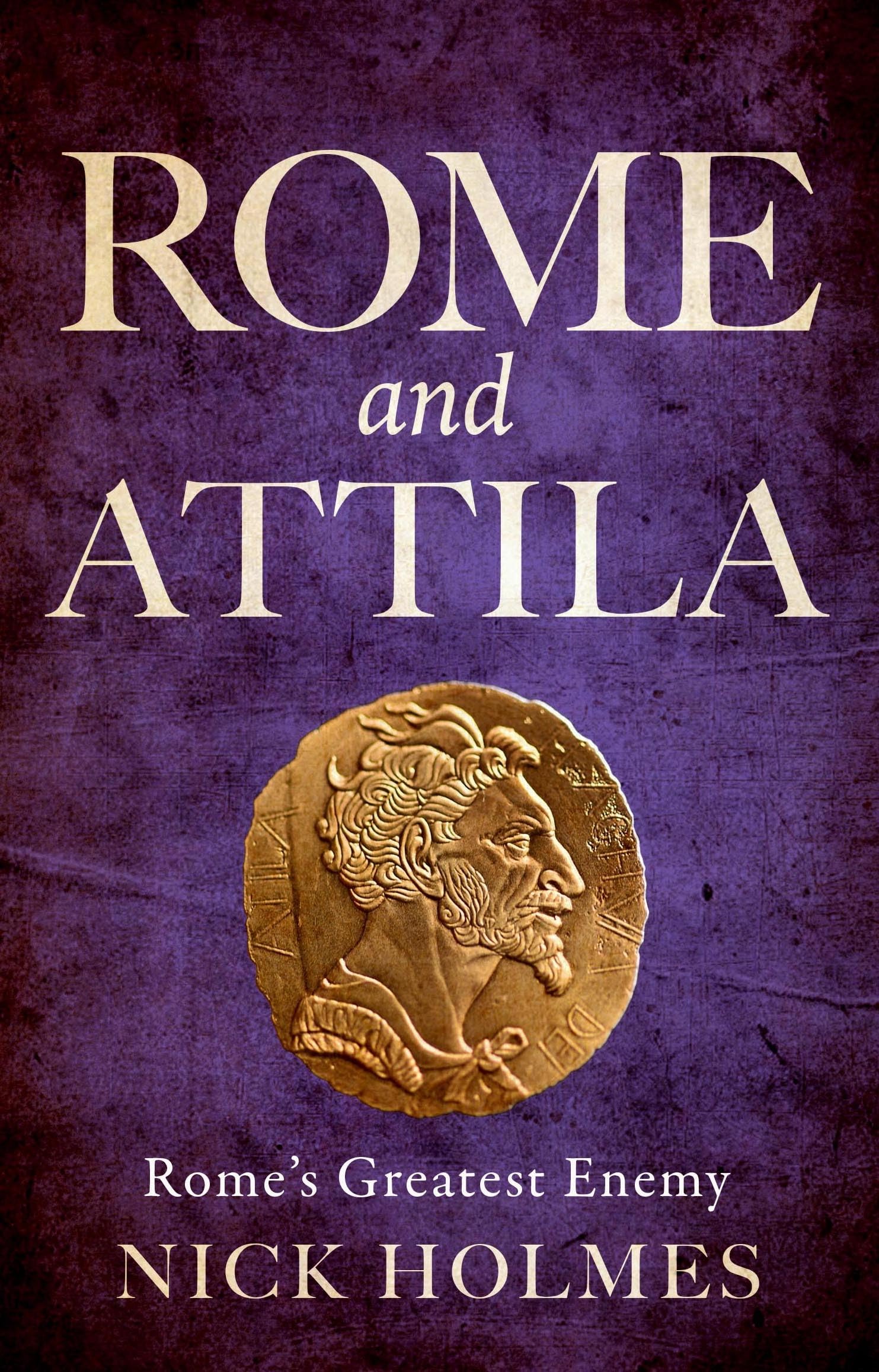
The third of Nick Holmes’ books on the end of the Roman Empire covers from the sacking of Rome in 410 through the death of Attila in 453, and then the end of Western Roman administration in 476.

The good news is that the transition between The Fall of Rome and this book isn’t as repetitious as between the first two, and I don’t know of any books essential to the period that he’s missed out on this time.

The bad news is the transition does still have a lot of copy-and-pasted material that someone reading straight through will want to skip, and there’s no roadsigns to it. But it’s not as extensive, and seems broken up a little by new or rewritten material.

I am gratified to see Ian Hughes’ books (most notably Patricians and Emperors) show up in the notes. I have some problems with his books, but they are invaluable reconstructions of what was going on politically in the western Empire in this period. For anyone wanting more on the climatic battle between (effectively) Western Europe and Atilla, I recommend Osprey Publishing’s Catalaunian Fields AD 451 (Campaign #286). This is a detailed look at the campaign, and might have informed this book some, but is at a lower level than the bulk of the narrative.

On the other hand, Holmes has definitely fallen in love with one of his sources, Priscus’ History of Byzantium; or at least those pieces that survive. The actual work is lost to us, but it extensively quoted in other places, and he presents a translation of parts of those quotes put together at the end of his book. I admit I haven’t really read that part, but I certainly commend him for its inclusion.

Holmes does have his own thoughts on the importance of Atilla, and the tribute the eastern Empire was paying during this period. Even better, he has some thoughts on a military recovery in this period. I’d have to see something a little more finely argued, and some counter arguments to come to a real opinion, but he does make an interesting case. Overall, its a good addition to the series, and while I still say don’t read it immediately after the previous book, it’s still a great starting place on this bit of history.

└ Tags: books, history, reading, review, Rome
 Comment 

The Fall of Rome

by Rindis on December 24, 2024 at 12:00 pm
Posted In: Books

Holmes’ second book covers from the recovery of the Roman Empire from the Crisis of the Third Century to the sacking of Rome in 410.

Well, mostly. While the second book in a series, it is meant to be a stand-alone read as well. This means there’s some lead-in summary introduction. This is generally fine, but a lot of it is copy-and-pasted from book one, which makes it rough going if you read one directly after another. I can’t blame him, but some sort of guidepost to where that stops would have been good in my case.

But the main action is tracing the events that brought Alaric to Rome, three times, and led him to sack it.

Along the way, we see various people come and go, decisions made, and the slow crumbling away of authority in the western Empire, until the government is in northern Italy (Ravenna), and unable/unwilling to do anything for Rome when Alaric threatens it.

Holmes also sees this as the ‘true’ end of the Western Empire, rather than the later ending of central authority there. He’s not alone in that assessment, and you could make a very good argument (he doesn’t, really) that it is the end of the west’s reputation, and that the next fifty years were government without respect. Personally, I go with the “official” end of government, but that is entirely a personal preference.

So, this is the tale of the years leading up to the fall of the Western Roman Empire, well-told at a high level, with attention paid to more modern works, especially dealing with climate change. I think he missed another opportunity here. He does reference Peter Heather’s The Fall of the Roman Empire, but I think Holmes would have been better served to pay attention to his Empires and Barbarians, which looks at the Germanic migrations through the lens of modern migration studies.

So, another readable, informative book. If you have an interest in the later Roman Empire, but are not already well-read on it, this is a great place to start. But… maybe don’t read this right after the first book.

└ Tags: books, history, reading, review, Rome
 Comment 

The Roman Revolution

by Rindis on December 4, 2024 at 12:00 pm
Posted In: Books

Nick Holmes is doing a very good job writing a clear beginning-level series on Roman history. This also has the advantage of being recent (2022), and so has access recent findings.

There is one short chapter two-thirds of the way through titled “Climate Change” which talks about what fairly recent research has to say about the Roman Climate Optimum from 200 BC to AD 150, and how it seems to have helped Rome’s rise, and how shifting climate trends after that added instability (he starts with a series of years where the Nile did not flood, or had a very weak flood in the 240s).

This was the highlight of the book for me, and if there’d been more chapters like it, I’d have been very happy with the book. However, it seems there are missed opportunities here. He talks about the Roman economy at times, and reference to The Roman Empire and the Indian Ocean could have helped develop some arguments. That book has problems, but talking about the evident closing of the Iberian silver mines after the Antonine Plague would be valuable for Holmes’ discussion of the Roman economy.

At the same time, Holmes is wanting to make a specific argument, and I just didn’t feel like he ever got to really arguing it. A better feel for what he considers ‘revolutionary’, as opposed to ‘evolutionary’ would have helped (he doesn’t use the latter term; part of his trouble is a lack of contrast against his thesis). The idea seems to be that the Crisis of the Third Century left Rome in a vulnerable place, and the way out (at least the one taken) was the ‘revolutionary’ measure of converting the Empire from Ancient paganism to Christianity. But there’s not enough there on what that meant either.

Which is part of the other weakness: A real look at where Roman thought and culture had gone during the life of the Empire. He does address part of it, trying to unravel the rise of Christianity. But, he doesn’t look at the other side. From other books (I don’t remember which ones), it’s been argued that paganism had hit a dead-end, with it becoming slowly clearer to the educated that the myths and mysteries associated with the old cults had no reality behind them. And there was nothing really to put in it’s philosophical place. Other than those odd monotheists that is.

So, it’s not really the reassessment of the Third Century Holmes says it is, but it is very readable, and does a good job presenting… too long of a period in a very readable format. To give background, Holmes goes back to the mythical founding of Rome and gives a quick view of how it got to a Mediterranean empire. But that is a lot of ground to cover, and so takes up a fair chunk of the book, no matter how abbreviated it is.

└ Tags: history, reading, review, Rome
 Comment 

Dynasty

by Rindis on November 18, 2024 at 12:00 pm
Posted In: Books

I haven’t read Tom Holland’s Rubicon, but I also know the civil wars period better than the Julio-Claudians (I have to admit that the BBC production of I, Claudius is still the bedrock of my knowledge of the period).

This is still very much popular history, but it’s a very good one. Holland spends one hefty chapter detailing the rise of Rome, up through the assassination of Julius Caesar, with the next going into the Second Triumverate though Octavian being awarded the title “Augustus”, and the third the rest of Augustus’ career. The second half of the book is a second part, with four chapters roughly for the rest of the dynasty (that’s Tiberius, Caligula, Claudius, and Nero if you’re not quite up on your emperors).

Of course, there is much more here. The entire period is of power politics of the most personal kind. So, Holland does his best to introduce us to all the significant pieces, and trace them through to their various ends, often bloody.

There are also excursions to events away from Rome; we get a very good treatment of the Teutoburg Pass (and he thankfully give a footnote on the fact that Tacitus uses the word ‘saltus’, which can be ‘forest’ or ‘pass’, and the latter has been shown a correct by archaeology). And there’s a lot about how the Romans saw the world, virtue, and mores. All of which is needed to understand these figures.

There’s not a lot of hard detail, and away from the central player’s concerns, a lot is left out. But, this is history just about as thrilling as Robert Graves’ novels.

└ Tags: history, reading, review, Rome
 Comment 

Two Rounds of Picenum

by Rindis on October 29, 2024 at 12:00 pm
Posted In: CC:Ancients

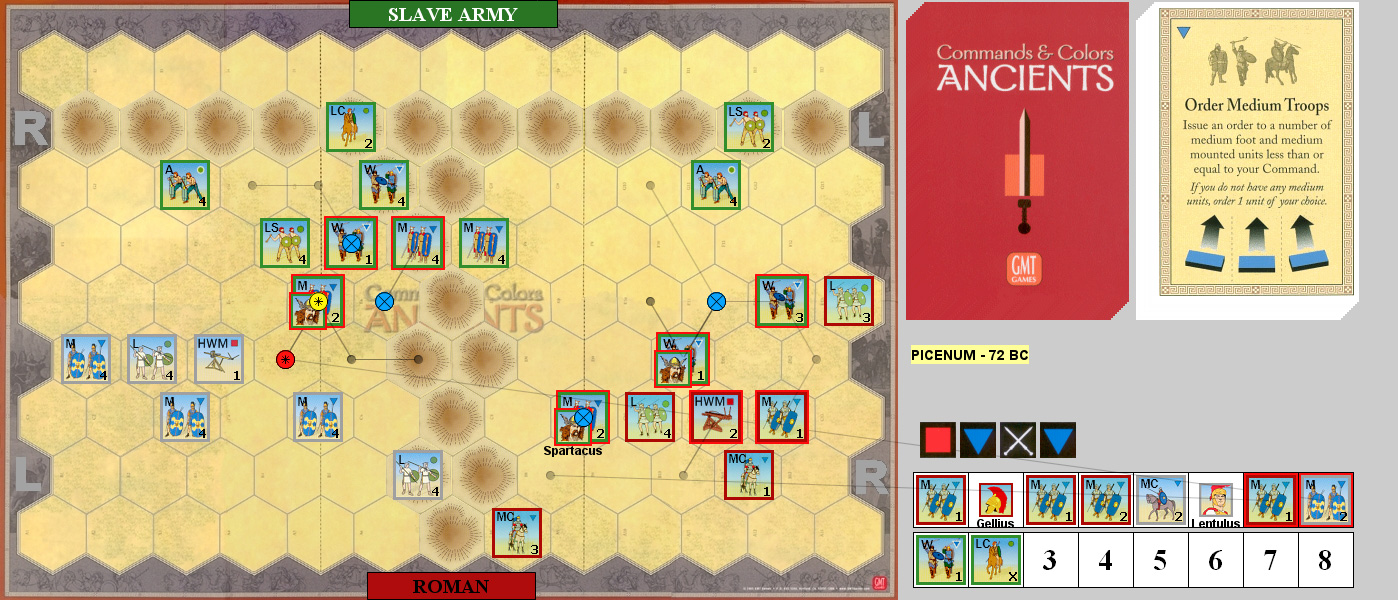
After my too-close win in Hatten, Patch and I went to our between-games round of Commands & Colors: Ancients. Up this time was the Battle of Picenum from Expansion #2. There’s a line of hills down the center, and the Romans have two separate armies; one on each side of the hills. Any command card can only order units from one army or the other, so things like Out Flanked aren’t nearly as useful. The slave rebellion has no such problem, and can roll burning logs down onto the Romans (‘rolling fire’). It costs them a block to use, so we hardly did it, but it can generate a series of two-die attacks. Almost as unusual as that, each Roman force has a heavy war machine. Also the slaves can get banners by exiting units off the Roman side of the board.

I had the rebellion first, and we spent a few turns trying to maneuver before I charged down out of the hills with a Coordinated Attack and drove off a unit of Lights. Patch hit back with a Line Command, but merely took three hits for his trouble. I then Out Flanked to knock out the weakened Medium and drive off the Light again, but lost three blocks to nothing on momentum. Inspired Center Leadership finished off my weak Warrior, drove another off, where it took a hit from the HWM, and did two hits to another Warrior.

Order Mediums put me in contact on both sides, and we both had a unit nearly knocked with, with Gellius getting killed. Out Flanked (more Order Two here) let Patch reshuffle while Move-Fire-Move let me move up and knock out a couple blocks. I advanced along the hills with Order Three Center, and finished off two Mediums. Order Three Left drove off my LC with a hit, and Patch did a hit to a Medium, but lost his MC and Lentulus in return. Order Four Left got me into his fraying line, but I only took a hit to my LC. Patch Counter Attacked to finish them off with a blocked retreat, and two of my units barely hung on, but did equal hits in return. Order Mediums finished off a Medium and drove off another with three losses (taking a banner to retreat, and then retreat again on momentum). A final Medium took two hits, and drove off the attacker, survived a second attack, retreated from a third attack, but was finally knocked out on momentum. 8-2

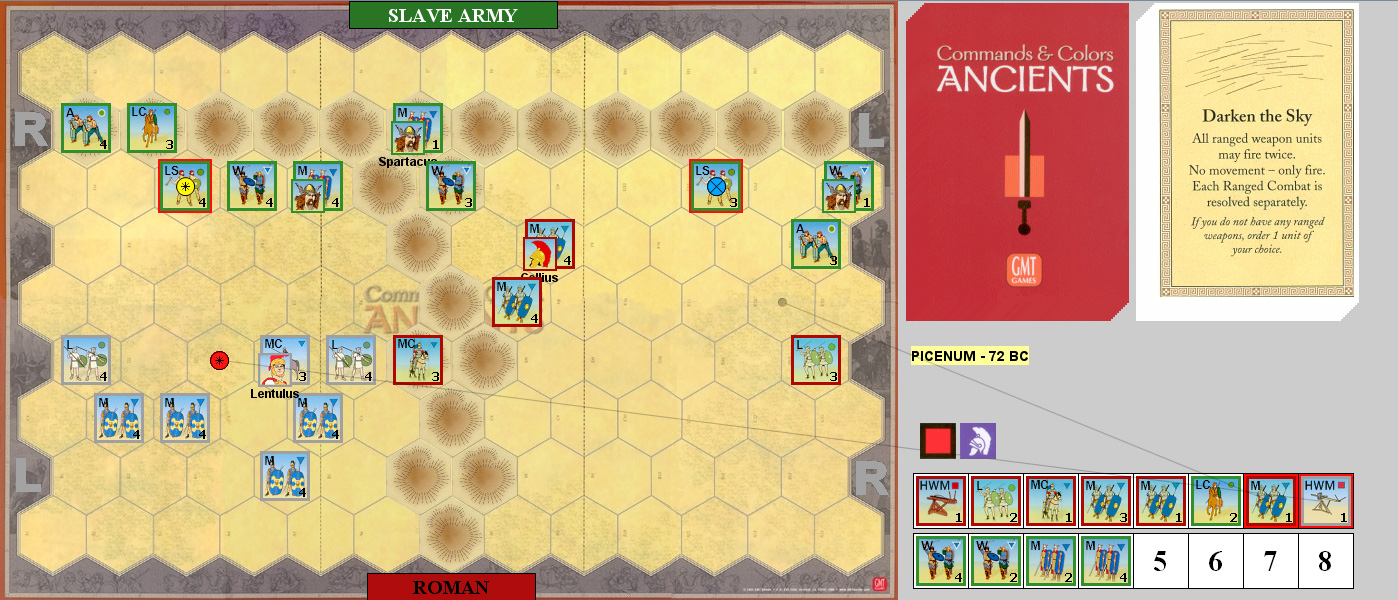
Again, it took a couple turns to get to grips with each other in the second round, and the action started on the Roman right (Gellius) when Patch Double-Timed up to my line and knocked out the HWM, a light trapped against my line, and did three blocks to a Medium, but lost five blocks and a full Warrior in return (18 blocks gone in the first turn with combat!). Line Command let me finish off a Warrior and Medium, and Patch pulled back with Four Units Left. He sent a LC into the middle hills, who evaded a Mounted Charge, which did nothing.

Patch Ordered One (Heavy) for a rolling fire attack that did nothing, and I tried telling the slaves that I Am Spartacus to order three units to do one hit, and take one in return. Patch Ordered Mediums to finish off a MC, and I Ordered Four Right to do two damage while taking one. Patch Ordered Two Center to pull back a weak Medium and knock out one of mine, followed by Order Three Center to get a LC through the lines and finish off a weak Medium. I Out Flanked on the right to wipe out a full Medium. Patch Ordered Three Center for the exit and I Ordered Three Right (with only two left…) to lose two blocks for no gain. Patch Darkened the Sky to finish off a Medium, and knock out the other HWM. 4-8

Afterword

Okay, this is a highly unusual scenario. I think the rolling fire is too costly for what you get, and is really complicated (hard to get around that though). But the terrain is interesting, and the ‘two armies’ bit really takes a lot of wind out of the Roman’s sails.

Thanks to the cards, the fighting stayed on the Roman right in both games. Also, the initial Roman set up is strung out, which led to the game being slow to get going. The slave revolt could rush down to try to pick off units… but they’re out of rang for that too. At any rate, it’s a really wild situation.

└ Tags: C&C Ancients, gaming, Rome
 Comment 
  • Page 1 of 5
  • 1
  • 2
  • 3
  • 4
  • 5
  • »

©2005-2026 Rindis.com | Powered by WordPress with ComicPress | Hosted on Rindis Hobby Den | Subscribe: RSS | Back to Top ↑