
Rindis.com

All my hobbies, all the time
  • Home
  • My Blog
  • Games
  • History

Categories

  • Books (503)
  • Comics (10)
  • Gaming (917)
    • Boardgaming (673)
      • ASL (154)
      • CC:Ancients (83)
      • F&E (78)
        • BvR – The Wind (26)
        • Four Vassal War (9)
        • Konya wa Hurricane (17)
        • Second Wind (5)
      • SFB (78)
    • Computer games (162)
      • MMO (77)
    • Design and Effect (6)
    • RPGs (66)
      • D&D (25)
        • O2 Blade of Vengeance (3)
      • GURPS (32)
  • History (10)
  • Life (82)
    • Conventions (9)
  • News (29)
  • Technology (6)
  • Video (49)
    • Anime (47)
  • Writing (1)

Patreon

Support Rindis.com on Patreon!
Become a patron at Patreon!

Other blogs:

RSS Inside GMT

  • Coast Watchers – Session Report – “The Airfield” June 5, 2026

RSS Playing at the World

  • Playing at the World 2E V2 Arrives May 5, 2025

RSS Dyson’s Dodecahedron

  • Cyberstyle 8.4 June 6, 2026

RSS Quest for Fun!

  • The Expense Post May 24, 2026

RSS Bruce Heard and New Stories

  • Pain, Exhaustion, and Morale in D&D BECMI June 7, 2026

RSS Chicago Wargamer

  • The 2 Half-Squads - Episode 310: Cruising Through Crucible of Steel January 27, 2023

RSS CRRPG Addict

  • BRIEFs: Black Crystal (1982), Creepers (1982), Chitei Tanken (1982) June 8, 2026
SF&F blogs:

RSS Fantasy Cafe

  • The Leaning Pile of Books May 24, 2026

RSS Lynn’s Book Blog

  • Booking Ahead/Weekly Wrap Up June 7, 2026
ASL blogs:

RSS Sitrep

  • Cardinal ASL Sins March 18, 2026

RSS Hong Kong Wargamer

  • FT114 Yellow Extract After Action Report (AAR) Advanced Squad Leader scenario April 16, 2025

RSS Hex and Violence

  • This still exists? March 25, 2025

RSS Grumble Jones

  • AAR Slides for Schwerpunkt SP96 Husum Hotfoot June 5, 2026

RSS Desperation Morale

  • How to Learn ASL March 16, 2025

RSS Banzai!!

  • October North Texas Gameday October 21, 2019

RSS A Room Without a LOS

  • [Crossing the Moro CG] T=0902 -- Rough start July 18, 2015
GURPS blogs:

RSS Dungeon Fantastic

  • Felltower House Rules Examined June 7, 2026

RSS Gaming Ballistic

  • B-Scale: Damage That Scales from Tardigrades to Kaiju June 5, 2026

RSS Ravens N’ Pennies

RSS Let’s GURPS

  • Review: GURPS Realm Management March 29, 2021

RSS No School Grognard

  • It came from the GURPS forums: Low-Tech armor and fire damage January 29, 2018

RSS The Collaborative Gamer

  • Thoughts on a Town Adventures System January 18, 2022

RSS Don’t Forget Your Boots

  • GURPS Supers Newport Academy #6: “Old Friends, New Again” June 7, 2026

RSS Orbs and Balrogs

  • Bretwalda - Daggers of Oxenaforda pt.4 - Fallen King May 27, 2017

Crusader Castles of the Teutonic Knights (1)

by Rindis on June 6, 2026 at 1:37 pm
Posted In: Books

As a crusading force moving into hostile lands, castles were essential for the Teutonic Order’s survival in Prussia. Undeveloped and swampy, there was only a limited amount of stone available, which all went to building foundations. Naturally, early castles were constructed of wood, and this gets a little description, and one art plate reconstruction. More sturdy structures were all made of of red brick, which lends them a very different look, and make it an interesting field of study.

The overall history is presented well in a short format, as is usual for Osprey books. We get a quick look a life in the order, and some of the more prominent campaigns, starting with the initial invasion of Prussia to the fall of the Order to Poland.

One lack is any sort of description of a “typical” castle of this type. The Teutonic Order had learned all about siege warfare in the Holy Land, so these are fairly advanced, but we only get oblique discussion of what this means. Indirect approachways and machicolations are mentioned, but not discussed. The typical arrangement of gatehouses is not discussed, nor normal thicknesses of walls and the like. It is implicitly assumed that you already know something of Medieval siege engineering. Which, for a short book on a rare subject in English, is not a bad assumption, but I’d still like some more technical details.

On the other hand, we have a map showing where all the castles were, and plenty of photographs. This is from a transitional period for Osprey; they no longer need to confine the color to one signature partway through the book, but much of it is still in black-and-white, so there is mix of color and B/W photographs. All of them are clear and reproduced well, though size can be an issue for details.

The Order’s main headquarters, Marienburg (currently Malbork), gets a two page spread art plate detailing its layout (shown on the cover), and two color photographs showing views across the river. There are are also five B/W photographs and two color showing further details, such a a covered well, and another long shot.

Lochstadt (which is completely ruined today) gets a color plate, which doesn’t quite match to the two floor plans reproduced for it. Those show one corner as having a projection at one corner for a watchtower that also squeezes the path inside the outer wall into a natural choke point, while the art doesn’t have that, and instead has a wall and gate set back from that corner.

Thorn (Torun) has a color plate showing the several layers of defenses, plus a small color shot of a model of the town around it, and color long shot of the site, a detail B/W photo of the dansk, or sewage tower, which is still preserved, and a (dark) color shot of the ‘leaning tower’, which was part of the defenses and is now a pub.

One color plate depicts a large riverside granary at Graudenz (Grudziadz). This particular place still has twenty-six granaries, and a color photograph shows the main line of them going down to the river.

There’s a couple of plates depicting sieges, which are good looks at what that was like, and well executed. Marienwerder (Kwidzyn) has a color photograph of a model of the old castle, plus three B/W and one color photo. Some fourteen other locations have one or more photos showing them (mostly one, Neidenburg—Nidzica—has three photos). There’s also a couple of details of old illustrations showing castles that no longer exist.

Overall, it’s about as useful a book as you’re going to get in this format. I’d like some more detail to chew over, that would need concentrating on one or two locations and diving deep into that. For an introduction which is needed for almost any native English-speaker, it covers things very well if you already know something about siege warfare.
└ Tags: books, fortress, history, Osprey, reading, review
 Comment 

FtF Husky

by Rindis on June 2, 2026 at 12:07 pm
Posted In: Boardgaming

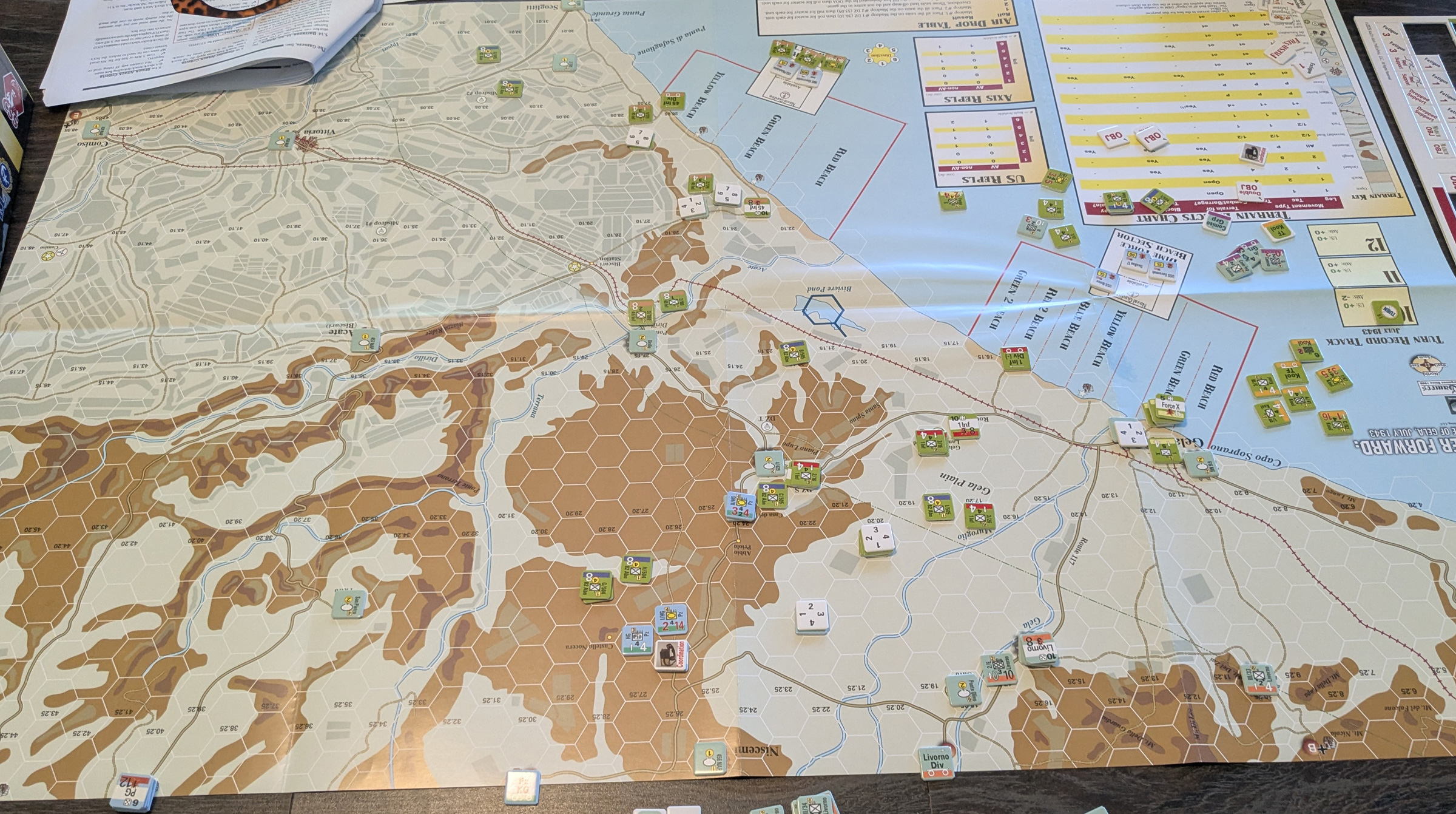
Had Jason over on Sunday for some overdue FtF gaming. After some back-and-forth, we ended up with the new(is) BCS magazine game Danger Forward. Arrangements happened a bit last minute, so I was hurriedly clipping counters the day before (didn’t get through them all).

Part of the reason for this is that I’m currently in the middle of a game of Danger Forward with Mark on Vassal, so I’ve currently got the system ironed out. And the organization is bad enough that you can’t really pick it up without lots of lost time figuring out where a particular rule is stuck.

At any rate, despite having the Axis in my other game, I gave Jason the Allies here because I think they’re a bit more active and exciting to play, though Axis needs to be proactive too. He read some of the rules ahead of time, but I started with the basic rundown of formations, types of combat, and the like. We also went with the “American Husky” scenario, since it’s mostly static setup, but the paratrooper drops still scatter for some variation. These went well, with most of the distances staying short, and nothing going off-board.

The first day’s fighting was of course mixed, with the 1st Infantry getting off the beach and taking the nearby airfield. Force X was still hung up on the line of garrisons at Gela. Pz KG got into motion first, and cleaned elements of the 82nd from Niscemi, while the 82nd failed its attempt at a second activation to get out of move mode. The 45th Infantry cleared some of the garrison, and sent a couple battalions NE inland so they could get at Biscari station from the north later. This required being unready in move-mode, which was fine because the biggest non-news of the day was PG KG rolled a 2 for SNAFU. With the -2 penalty for the first day, this was a failed activation, and they couldn’t get a second activation either, leaving them at the entry hex the entire day.


End of July 10, the first day.
↓ Read the rest of this entry…

└ Tags: BCS, Danger Forward, gaming
 Comment 

Emperor: A New Life of Charles V

by Rindis on May 29, 2026 at 12:17 pm
Posted In: Books

Okay, lets just start with the fact that this far from the most engaging book I’ve read. It is by no means poorly-written, and it is well organized and presented. But, I’m no hurry to go through it all again.

This is a large, detailed look at Holy Roman Emperor Charles V from birth to death. It is broken up into four parts, with a kind of epilogue at the end of each part. The main chapters are focused on events, while the first three epilogues try to focus on what Charles was like as a person. This is actually a good way to handle it, and helps out the book as a whole.

Mostly, the main part of the book is chronological, tackling events as they come. But there are some exceptions fairly late in.

First, chapter 13 is about the New World, and steps back quite a ways to present everything that had been going on there as a coherent whole. This is sensible, and justified, since it is pretty much all happening off stage as far as Charles’ life is concerned. He is the ruler of Spain, and Spain ends up in charge of two large empires in the New World at this time, but none of this happens on his express orders, he does not ever see these new lands himself, everything he knows is purely intellectual exercise. Given that, his preferred treatment of his lands there is fairly good. He was against enslaving the locals, or even effectively enfeuding them with the encomienda system. (If the mines needed slaves as workers, let them be shipped over from Africa. — Sadly, Parker doesn’t even start to try to unpack that idea.) But, people ambitious enough to actually go adventuring in the New World are more interested in money and power. There are objections, they are listened to, and when the crown tries to halt the abuses by the newly empowered, there are revolts. These are put down, but the abuses persist.

Second, chapter 14 deals with his familial relations, starting with his three illegitimate daughters. This is another ‘roll-up’ chapter, dealing with events decades apart (in this case, from conception, to birth, to life, to acknowledgement, or not). The other main topic of the chapter is his illegitimate son, Gerónimo, better known as Don Juan of Austria. Charles’ relations with all of these children are very inconsistent, ranging from use in dynastic politics to near-abandonment. Don Juan himself is only posthumously acknowledged as his; Parker leaves it to the reader to try to imagine the impact of this revelation on his legitimate children, but it is also rightly out of the scope of this book.

There’s only another three chapters after this which deal with the end of his reign, and his all too short retirement to a monastery, where he dies of malaria. The final chapter deals with how he has been seen ever sense, and the final epilogue deals with thoughts on his reign. There’s no solid answers there (and I don’t think any are possible), but he does come to some interesting conclusions that the entirety of his lands were indeed too much for one man or government to handle, and Charles only managed it because he built the system that—mostly—kept things balanced. To continue would need another Charles V, and no one is going to be so… “him” as to manage the job.

It should be noted that not only is this a large and complicated book, on a complicated man, but there’s a lot of showing what went into the book. The appendices start just over the halfway mark. They have their own interest, as he draws heavily from Charles V’s Memoirs, which are often considered to be fake. Here he talks about his reasons for accepting it as real. He also talks about Charles’ corpse, and whether one study actually was of one of his fingers, another document (the Last Instructions), which he considers fake while others have accepted it, and whether Charles had another illegitimate daughter.

Because Charles V was so central to his time, if you want to understand the early Sixteenth Century, you need to know about him. I can’t say how other biographies hold up to this one, but it is good, but is more on the scholarly side than the general reader side.

└ Tags: biography, books, history, reading, review
 Comment 

The Conquest of Saxony AD 782–785

by Rindis on May 25, 2026 at 12:00 pm
Posted In: Books

This volume is a little different than most Osprey Campaign books, because it’s really about more than one campaign. In some senses it’s even about more than one war.

But only in fairly limited senses. Mostly, this is about one phase in a larger conflict (“war”), and because of this there’s two distinct battles that get major coverage. The introductory section moves from vague origins of the Franks and Saxons (and notes their main groupings into East- and Westphalians, Angrians, and Nodalbians) to the fact that Charles Martel fought the Saxons something like ten times, and then goes on to his son Charlemagne’s early campaigns against them.

We start with a good map of various campaigns against the Saxons from 772 to 781. While up to the usual Osprey standards, it is relatively confusing because they’re packing a lot of motion into one display. There’s good captioning to help sort it out, but it also serves to show just how much effort was being expended for a fairly constrained area. The effective overall war starts in 772 with Charlemagne invading and destroying the Irminsal, some form of sacred tree that was important to Saxon paganism. It was probably meant to show Christian superiority and symbolically take the Saxons into the Frankish orbit, but of course it also caused resentment. There are two Saxon attacks after that, and Charlemagne imposes peace again. At this point, Widukind emerges as the main leader of Saxon resistance. The main qualification for this is being able to slip out the back door, and just not get forced into much by the Franks. Certainly, he is first noted as not being present at an assembly in 777 called by Charlemagne, and is instead visiting the ruler of the Danes.

The main section of the book opens with Charlemagne holding another assembly in southern Saxony in 782, largely to organize administration in the region, but also to recruit men for a campaign against the Avars. Part of this gets redirected against the Sorbs, but the three senior Frankish leaders find a Saxon rebellion has started behind them, and joined by a fourth commander, they get drawn into fighting in the Süntel hills. This is a disaster, with two of the top commanders, and a number of other important men being killed. There’s another good map showing the area and movements towards battle, and then three isometric maps showing the course of the main battle.

That’s the end of the initial campaign.

There’s another regular map showing movements over the next year, as Charlemagne puts together a new army and looks to put down the rebellion. He defeats them at Detwold, retreats from a confrontation at Osning (Teutoberger Wald; yes that one), and fortified Paderborn. There’s a another battle, which is said to last three days, but Nicolle opines was probably two days of getting Charlemagne’s force over a river (I think that’s sensible interpretation). The Saxons are crushed, and the rebellion is over.

But, Widukind slips out again, and gets more allies. This time the Frisians and Eastphalians rebel, and Charlemagne gets to do it all over again. Progress is blocked by flooded rivers, but little else, and during 785 hostages are exchanged, and Widukind goes to see Charlemagne in Attigny, and converts to Christianity. All of this gets another good overview map.

The ending section goes into the aftermath of Widukind’s incorporation into the Frankish Kingdom, giving a very brief summary of further small rebellions that last until AD 804. At this distance it is hard to point to a lot of concrete results, but the sources make it plain that the fighting had been particularly savage and damaging to the entire region. After this, Saxon resistance was nearly crushed, and most Saxon social and governmental institutions were done away with.

This isn’t the best of the Campaign series by any means, but it is still well put together and informative. The maps, as always are a big help, and both the Irminsal and Widukind feature in modern (French) memory of Charlemagne, so a book focusing on this part of his reign makes a lot of sense. There’s the usual useful color and B/W photography of various artifacts, and some of the landscape (not enough to really help me), and a good set of colored archaeological diagrams of a few Saxon forts of the period.

└ Tags: books, history, reading, review
1 Comment

Journey Home

by Rindis on May 21, 2026 at 12:00 pm
Posted In: Books

At about 1,300 words, this is a short-short. So there’s not a lot of room for anything here.

Writing wise, it’s pretty good, but I wonder if there’s a bunch of unclosed italic tag errors in the manuscript. There’s some decent chunks that are italic for unclear reasons. It seems like it may be meant to show character thoughts from in-viewpoint, but that’s not always true. My instinct from other books is that it’s meant to designate telepathy, but that’s not right either.

We have two characters, plus just a little more, in a partially-defined science-fantasy future (literally, we’ve gotten to the stars, but it largely seems to be through magic). Much of the story references the Solar System, but we have a Dragon Queen who as a plot point started on Earth and went elsewhere.

Okay, magic and dragons, so other fantasy elements are possible, but not mentioned. Though I suppose some people seem to regard a close platonic relationship as fantasy.

So this is a character piece of two aroace women in a close relationship and then a spot of adventure happens. There’s also some wish-fulfillment of getting away from rent.

Even as such, it’s not entirely successful, as the two main characters don’t show any really distinctive traits. On the other hand, they do get to show they care for each other. The ending is a bit sudden, and this could easily expand into something more on the “found family” genre if it kept going.

└ Tags: books, fantasy, reading, review
 Comment 
  • Page 1 of 314
  • 1
  • 2
  • 3
  • 4
  • 5
  • »
  • Last »

©2005-2026 Rindis.com | Powered by WordPress with ComicPress | Hosted on Rindis Hobby Den | Subscribe: RSS | Back to Top ↑